US ‘hopeful’ as Islamabad tries to prevail on Tehran

• Rubio sees progress towards ending war after Pakistani officials’ visit; upset by Nato allies’ snub
• Reports suggest CDF Munir may travel to Iran if Naqvi-led talks lead to breakthrough
• Tehran says it is reviewing latest US proposal; Hormuz control remains key sticking point
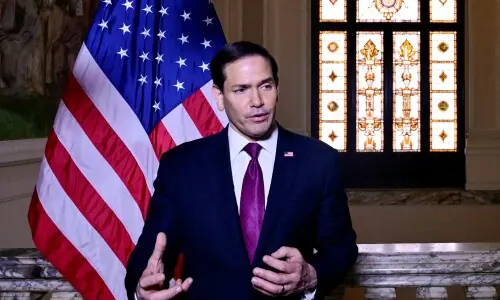
ISLAMABAD: As Pakistani officials continued to lay the groundwork for a possible US-Iran rapprochement, US Secretary of State Marco Rubio appeared hopeful for progress towards ending the war with Iran, despite the rigid stances adopted by both countries.
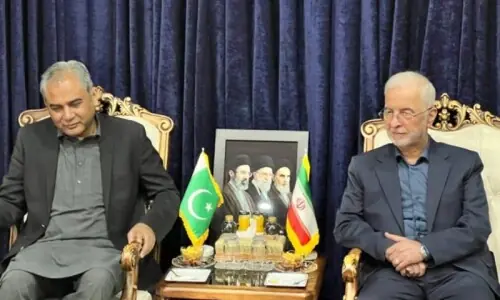
Pakistan’s Interior Minister Mohsin Naqvi, who is visiting Iran for the second time in a week, engaged the senior Iranian leadership, including Foreign Minister Abbas Araghchi and Interior Minister Eskandar Momeni, on Thursday to prevent a communications breakdown.
The efforts made by Pakistan were seemingly acknowledged by Rubio, who hoped for a breakthrough on the back of these talks, saying: “There’s some good signs… I don’t want to be overly optimistic … So, let’s see what happens over the next few days.”
Rubio also renewed criticism of Nato allies for not supporting the US in its war on Iran, as he headed to alliance talks in Sweden, AFP reported. US President Donald Trump is “not asking them to send their fighter jets in. But they refuse to do anything,” he told reporters. “We were very upset about that.”
“I believe the Pakistanis will be travelling to Tehran today. So hopefully that’ll advance this further,” Rubio told reporters on Thursday.
His statement came amid reports that a high-level functionary from Pakistan could be travelling to the Iranian capital to capitalise on progress made by the interior minister.
The Reuters wire service, quoting Iran’s ISNA news agency, reported that Chief of Defence Forces Field Marshal Asim Munir was expected to arrive in Tehran, but there was no official word from Inter-Services Public Relations (ISPR) about the army chief’s schedule.
Reports further suggested that the high-level visit may take place if current efforts — led by Naqvi — succeed in reducing gaps sufficiently to warrant higher-level intervention. According to ISNA, the reported visit would be aimed at continuing “talks and consultations” with Iranian authorities. It did not provide details.
As of Thursday evening, talks appeared to have narrowed into difficult text-based bargaining over an interim formula, focused on uranium custody, sanctions relief, maritime security and guarantees against renewed strikes.
According to diplomats, the process has entered a critical phase, even though there are concerns if talks collapsed at this stage, it would push the region back toward military confrontation.
Focus on Hormuz
Meanwhile, Iran said it was reviewing Washington’s latest position on ending the war. “We have received US views and are reviewing them,” Iranian state-run agency Nour News quoted Foreign Ministry spokesperson Esmaeil Baghaei as saying. He said messages had been exchanged “on several occasions” between Tehran and Washington through Pakistan based on a 14-point Iranian proposal.
Diplomatic officials said the negotiations were focused on constructing a narrowly managed stabilisation framework capable of extending the ceasefire and creating space for structured follow-up on talks during the next 30 days.
The most sensitive of those disputes increasingly appears to be the future status of the Strait of Hormuz, which has now evolved from a wartime pressure point into a central issue within the negotiations themselves.
But Iran’s announcement defining a formal “management and supervisory zone” in Hormuz significantly raised the stakes of the diplomacy by signalling Tehran’s intention to institutionalise elements of the leverage it acquired during the conflict. Washington has continued to insist on unrestricted maritime passage and is opposing any Iranian-controlled tolling or supervisory arrangement in Hormuz, viewing such mechanisms as incompatible with a durable diplomatic settlement.
Rubio told reporters a diplomatic solution would be unfeasible if Tehran implemented a tolling system in the Strait of Hormuz.
The future of Hormuz remains a key sticking point in the negotiations, with fears growing that the global economy will feel more pain as pre-war oil stockpiles run down.
UAE irked
Iran’s new body overseeing the Strait of Hormuz said its claimed area of control extends to Emirati waters, drawing a sharp rebuke from the Gulf neighbour. In a post on X on Wednesday accompanied by a map, the newly-established Persian Gulf Strait Authority said it had outlined “the regulatory jurisdiction for the management” of the strait.
It said this covered the area between the line extending from “Kuh-e Mubarak in Iran to the south of Fujairah in the UAE… to the line connecting the tip of Qeshm island in Iran to Umm Al-Quwain in the UAE”.
It added that “transit through this area for the purpose of passing through the Hormuz Strait requires coordination with, and authorisation from, the Persian Gulf Strait Authority”.
Emirati presidential adviser Anwar Gargash on Thursday slammed the Iranian announcement. “The regime is trying to establish a new reality born from a clear military defeat, but attempts to control the Strait of Hormuz or infringe on the UAE’s maritime sovereignty are nothing but pipe dreams,” he posted on X.
With input from Agencies
Published in Dawn, May 22nd, 2026