Peshawar High Court rules it can’t interfere in govt’s policy matters
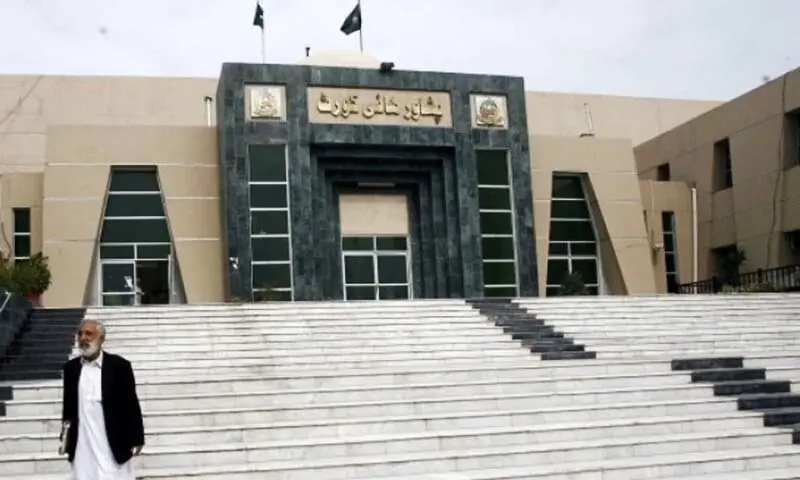

PESHAWAR: Peshawar High Court has declared that it couldn’t interfere in policy matters of government if it remains within the constitutional limits.
A bench consisting of Justice Ijaz Anwar and Justice Farah Jamshed rejected multiple petitions against the government’s move to outsource 24 of its hospitals in the province to private companies.
“The superior courts of this country are consistent on the point that the superior courts shall not interfere in policy matters of the government,” the bench ruled. It observed that superior courts had recognised that policymaking involved complex factors, technical expertise and resource management.
Referring to multiple judgements of Supreme Court, the bench ruled: “The core principle derived from the aforementioned judgements is that policy matter of the government cannot be interfered with by constitutional courts in writ jurisdiction as long as the policy remains within legal and constitutional bounds.”
Rejects pleas against outsourcing of hospitals
“The judiciary cannot ‘assume the functions of policy making or determining the priorities of various development projects’ as this is the ‘exclusive domain’ of the government. The judiciary serves as a guardian of legality, not as a superior policymaker,” the bench ruled in its 24-page detailed judgement.
“The Honourable Supreme Court of Pakistan has explicitly stated that ‘it cannot act as an appellate authority to scrutinise the rightness or aptness of a policy,” the bench observed. It added that it (apex court) had repeatedly emphasised that legislature, executive and judiciary must work within their respective mandates.
“Encroaching upon the executive’s policymaking role is viewed as a violation of this constitutional structure,” the court observed.
The bench maintained: “Whatever would be the outcome of outsourcing these health facilities and whether it will lead to betterment of the masses or would further deteriorate the performance of health facilities, is mainly the domain of the provincial government and relates to governance in the province.”
“In this respect, superior courts lack technical expertise, because these are complex health policy matters and when health professionals have recommended, interference by courts would not be advisable,” the bench observed.
“It is not the role of courts to determine policies and especially those, in which the court lacks technical expertise. It is the mandate of the Constitution and is also trite that courts must confine themselves to legal interpretation,” the bench quoted from an earlier judgement of the apex court.
It further quoted: “The learned high court must satisfy itself that there is a breach of fundamental rights, vested constitutional/legal rights before any direction is issued. Such directions must not be based on an understanding of the law which is contrary to the Constitution. Doing so goes against the principle of trichotomy of powers and is against the mandate of the Constitution.”
The bench pronounced: “In view of the above, we have not found any violation of fundamental rights or patent arbitrariness or discrimination, besides the issue relates to the policy decision of the provincial government, as such, this court cannot interfere in such like matters.”
Six petitions were filed last year by several citizens and lawyers including Jamal Nasir, Nauman Yousaf and others, challenging an advertisement of Khyber Pakhtunkhwa Health Foundation (KPHF) for outsourcing of 24 hospitals to private sector.
Last October, the court had granted status quo in the matter and directed KPHF that it could continue the process on the relevant advertisement, but no final order regarding outsourcing of the hospitals should be issued.
The petitioners had sought directives of the court for respondents including provincial government and KPHF to withdraw the said advertisement/expression of interest and also cancel the outsourcing process undertaken by the foundation under the garb of public-private partnership and to continue to manage those hospitals under the public healthcare system as mandated by law.
They had also sought directives of the court for respondents to ensure uninterrupted and free provision of medical facilities and health services at all the said hospitals to people in accordance with their constitutional obligations under different provisions of the Constitution.
The petitioners’ lawyers stated that on Sep 18, 2025, the KPHF managing director published the advertisement for provision of services at 24 health facilities across the province through public-private partnership.
They contended that the impugned expression of interest, if acted upon, would result in privatisation of all the 24 hospitals that were government-managed health facilities providing services to poor and marginalised population, thereby depriving the petitioners and general public of their constitutional right of access to affordable healthcare.
Advocates Habib Anwar and Subaktageen Khan Chamkani appeared for the respondents including KPHD and stated that the government had decided to outsource the management of underperforming hospitals to private companies to improve service delivery, while patients would still receive free treatment at government rates.
They dispelled the impression that it was any sort of privatisation, stating that it was outsourcing of management and the government would retain ownership and oversight through its health department.
Published in Dawn, June 8th, 2026