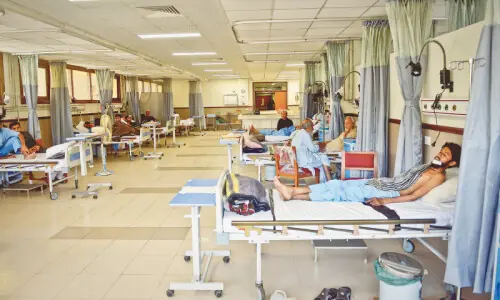
ISLAMABAD: While Pakistan continues to spend less than 1pc of GDP [Gross Domestic Product] on health, its economic indicators are one of the worst in South Asia (SA).
According to Pakistan Economic Survey 2025-26, released by the government on Thursday, the Public Sector Development Programme (PSDP) allocation for health was just Rs19.37 billion. It claimed that the life expectancy at birth increased from 66.5 years in 2018 to 67.8 years in 2024, but the same for South Asia was 72.6 years.
While maternal mortality ratio (per 100,000 births) is 155 in Pakistan, the same ratio in SA is 120. Birth rate (crude) per 1,000 people, which means the number of live births occurring in a population of 1,000 people over one year, is 27.4 compared to 16.4 in SA. The infant mortality rate (per 1,000 live births) is 47 against 23.2 in South Asia.
The document further shows that even prevalence of HIV (total percentage of population 15-49 years of age) is slightly higher in Pakistan (0.20pc) compared to SA (0.19pc).
Pakistan has better numbers in prevalence of overweight (percentage of children under 5) -- 2.1 -- compared to 3.4 in SA. However, in terms of people using at least basic sanitation facilities, 82pc of the population get the facility in SA compared to 71.9pc in Pakistan. In SA, 95.9pc people using at least basic drinking facilities, while in Pakistan the ratio is 90.7pc.
As many as 11.7pc of the population in South Asia are undernourished compared to 16.5pc in Pakistan. Similarly, 31.5pc children (under age of 5) in South Asia are facing stunting while the percentage in Pakistan is 33.6.
Year on year indicators
According to the Economic Survey, year-on-year indicators have improved, as there were 319,572 doctors in 2024 and the number increased to 336,582 in 2025. Similarly, the number of dentists has also increased from 39,088 in 2024 to 42,118 in 2025. The number of nurses did not increase and their number remained at 138,391. Similar is the case with midwives and lady health workers with their numbers remaining at 46,801 and 29,163, respectively.
As per Pakistan Social Living Standard Measurement Surveys (PSLM), progress was also observed in child health as the immunisation coverage rose from 68 per cent in 2018–19 to 73 per cent in 2024–25 alongside reductions in neonatal mortality from 41 to 35 per 1,000 live births and infant mortality from 60 to 47 per 1,000 live births.
Pakistan has also made progress toward achieving SDG 3 — good health and well being — despite facing challenges. As per the Sustainable Development Report 2025, Pakistan ranked 140th among 167 countries.
Published in Dawn, June 12th, 2026