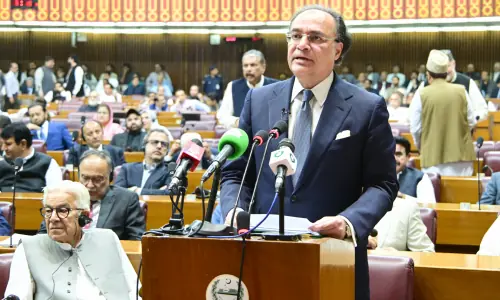

As part of its budget proposals for the next fiscal year (FY26-27), the government has announced a range of measures to provide some measure of relief to the public, ranging from an expanded income support programme for the most vulnerable segment of the population, to lower taxes for individuals earning more than Rs183,000 a month.
As part of its relief, subsidy and social safety plans, the government has announced a seven per cent increase in salaries for serving federal employees, a 7pc increase in pensions for retired employees, and a 10pc increase in the federal minimum wage. However, with inflation expected to average 8.2pc over the next fiscal year, the gains in real terms are expected to be minimal.
The budget for the Benazir Income Support Programme has also been increased by 17pc to Rs838 billion, with programme to cover 12 million families. Another 9.2m children are to be provided educational scholarships under the government’s proposals.
The PM Apna Ghar scheme, which has gained quite a lot interest in recent months, is getting another Rs71bn for the next year for subsidised, low-interest mortgage loans at a fixed mark-up of 5pc.
Separately, the budget also holds some good news for the salaried class. The government has proposed that those earning an annual income of between Rs2.2-3.2m be taxed at a maximum rate of 20pc instead of 23pc; those earning between Rs3.2-4.1m be taxed at 25pc instead of 30pc; those making between Rs4.1-5.6m be taxed at 29pc instead of 35pc; while those making between Rs5.6-7m be charged at a maximum rate of 32pc instead of 35pc. Only those making above Rs7m a year will now be charged the maximum rate of 35pc. Because of these proposals, the number of tax slabs will increase from six to eight, allowing better rationalisation of the tax burden on various income groups.
The government has also proposed removing the 9pc income tax surcharge on high-earners (those making above Rs10m a year), while it also seeks to abolish the super tax for businesses earning up to Rs500m. The super tax on business with income exceeding Rs500m is proposed to be slashed down to 8pc instead of the prevailing 10pc. However, this exemption will not apply to banks, oil and gas companies, and fertiliser manufacturers.
Expected relief for the real estate and construction sector has also materialised, with the government proposing to halve the withholding tax for filers. The government has also proposed the complete abolishment of the Capital Value Tax on declared foreign assets to encourage declaration.
The concessionary 0.25pc ‘final tax regime’ for IT and IT-enabled services exports — which has long been a lifeline for the freelance and startup ecosystem — has been extended for another three years. Meanwhile, the minimum tax on exports in general has been proposed to be cut to 1.25pc instead of the prevailing 2pc.
There’s good news for everyone who uses their credit and debit cards to make foreign transactions as well. The withholding tax on such transactions is proposed to be cut from 5pc to 0.5pc in a bid to “discourage informal channels”.
A copy of the Finance Bill seen by Dawn also makes comfortable travel more accessible for those who can afford it. It states that new federal excise duty rates are being proposed for club, business and first class tickets issued after July 1, 2026, which will be: Rs50,000 (Americas), Rs25,000 (Middle East/Africa) and Rs40,000 (Europe/Far East). However, the finance minister’s speech proposed that the FED on business class tickets be abolished completely. Perhaps this confusion will be resolved through a clarification note.
Finally, the government has proposed to completely remove sales tax and duties on sanitary pads, contraceptives and over 100 raw materials used in cancer medicine manufacturing, which is expected to make these items more accessible to the general public.