Political, rights activists criticise budget, demolition of slums

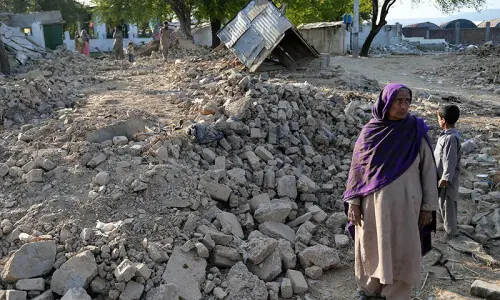
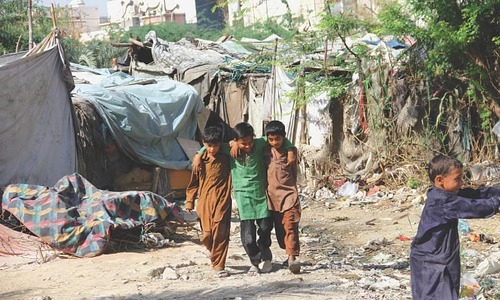
ISLAMABAD: Political leaders, rights activists, academics, trade union representatives and katchi abadi residents on Friday criticised the federal budget, demolition of slums and warned that growing economic inequality was alienating ordinary citizens from the state.
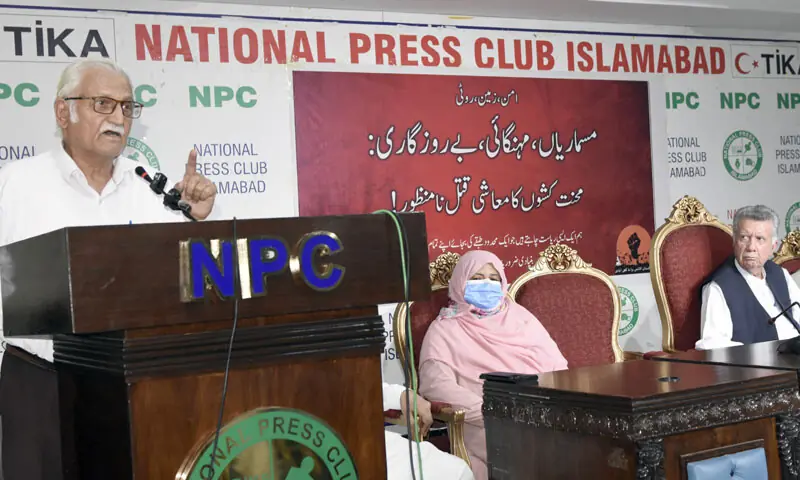
The concerns were voiced at a roundtable conference organised by the Awami Workers Party-Marxist (AWP-M) at the National Press Club, where participants discussed forced evictions in Islamabad, shrinking civic freedoms, the federal budget and what speakers described as the concentration of wealth and power in the hands of a small elite.
The speakers said Pakistan’s political and economic structures had become increasingly exclusionary, while parliament and other institutions were failing to protect the rights of ordinary citizens. They also criticised the displacement of working people from their homes and livelihoods, saying such actions threatened to further weaken the social contract between citizens and the state.
Political economist Dr Aasim Sajjad Akhtar said Islamabad depended on the labour of residents who were now facing eviction. He said thousands of low-income families who had contributed to building and servicing the capital were being displaced while authorities continued to facilitate large-scale real estate projects to build “Manhattan-like structures”.
Say parliament and other institutions have failed to protect rights of ordinary citizens
The people whose homes are being demolished are the same people who build this city, clean its streets and provide essential services, he said.
Speaking on the federal budget, National Party Punjab president Ayoub Malik said the burden of economic adjustment continued to fall on salaried workers while influential sectors received concessions.
“Pakistan will spend more than Rs8200 billion on debt servicing alone, but the burden of repayment will ultimately be borne by ordinary citizens,” he said.
Mr Malik criticised the government’s fixed tax regime for traders and retailers, arguing that it favoured powerful business interests while salaried employees continued to bear a disproportionate tax burden.
He also questioned how workers would meet basic household expenses after the minimum wage was raised to Rs40,700.
Former senator Farhatullah Babar said: “Attempts to address political and social conflicts through force had repeatedly failed”.
He also expressed concern over growing economic disparities, saying wealth was increasingly being transferred from poorer segments of society to powerful economic interests.
AWP leader Alia Amirali said the issue was not simply about changing governments but transforming a system that consistently favoured powerful interests over ordinary citizens.
“If laws can be changed for the rich, why can’t they be changed for the poor?” she asked while criticising the treatment of katchi abadi residents.
CDA Workers Union Chairman Izzat Kamal Pasha questioned the rationale behind declaring long-established settlements illegal while a dedicated slum cell continued to exist within the civic authority.
Several speakers criticised Islamabad’s development model, saying authorities treated katchi abadis as illegal encroachments while facilitating large housing and commercial projects. They also criticised repeated eviction drives, including in Muslim Colony, I-10, Rimsha Colony and other neighbourhoods facing demolition notices.
The participants expressed concern over what they described as shrinking democratic space, restrictions on dissent and the targeting of activists and lawyers advocating for marginalised communities.
The gathering concluded with a pledge to resist forced evictions and unite pro-people political and social forces across the country.
Published in Dawn, June 20th, 2026