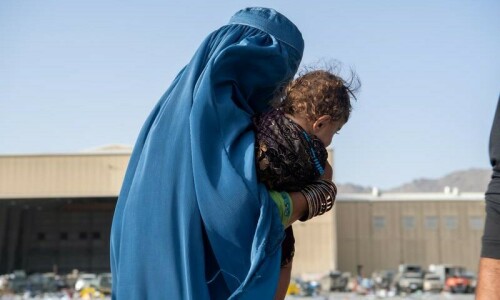

EVER since Kabul fell to the Taliban in August 2021, the world has turned very bleak for Afghan women. As they did when they first took power in the 1990s, the Taliban immediately set about erasing women from public spaces in Afghanistan. Deploying a self-serving interpretation of religion, they issued edicts requiring women to cover themselves completely in public and be constantly accompanied by a male guardian. In later months, they imposed even more draconian restrictions, make it nearly impossible for women to work outside the home even in desperately needed professions like medicine and teaching. Currently, women can only get primary education. If there is any other freedom left to prohibit, it is a safe bet that they have eliminated it.
Banning women from public spaces is strategic for the Taliban. It is easy to crack down on the vulnerable, and women are undoubtedly the least powerful in Afghanistan’s war-torn reality. Imposing veils and other restrictions immediately transforms public spaces, where half the population is now suddenly absent or swathed in layers of fabric. Policing this vulnerable population becomes an easy way to wield power, rounding up offenders, harassing others and imposing fines as a money-making scheme.
This sort of demand for complete submission can be effective only for so long. In recent weeks, Afghans have begun to speak out against the Taliban rulers’ oppression. About two weeks ago, some women in Herat were protesting against the tactics of the morality police, which roams the streets in search of people to persecute. While verified information from the initial protest has been difficult to confirm, the UN and various news agencies reported that a number of women were arrested over dress-code violations.
It is possible for men to stand with women.
On June 9, BBC reported that Taliban authorities fired at a crowd protesting the detention of women allegedly for violating the dress code. According to Human Rights Watch, at least 30 women had been detained on June 7. This came after a June 5 announcement at Friday prayers urging greater compliance with hijab rules. The Taliban’s morality police took to the streets to round up women. The protest broke out in a predominantly Hazara neighbourhood where about 70 men and women had gathered to express solidarity with those arrested.
In a video by Radio Free Europe, police can be seen firing live rounds into the crowd which is chanting for education, work and freedom. Two people, including a small boy, were killed. Fereshta Abbasi, the Afghanistan researcher from HRW, was quoted as saying the “people are angry” and that family members and others had been protesting because women were arrested in recent days. “They see the Taliban as interfering in people’s privacy, which is unacceptable.” As one woman put it: “They were arrested wearing full hijab and were manhandled despite being fully covered… .”
What is remarkable about the protest is that it was organised and supported by men. One protester described to The Guardian how WhatsApp groups had been used to organise people so both men and women could protest. Their actions are worth noting because the mainstay of Taliban policy has been to reduce women to the status of second-class citizens. It seeks to divide men and women by giving men all the rights and women none of them. The fact that men in the community were willing to risk arrest and being fired upon suggests this tactic may no longer be so successful.
Pakistan, too, has seen numerous acts of public violence against women in recent months. The most horrific was the acid attack on Dr Mahnoor Shah, allegedly by lift operator Humayun Shah. The suspect had reportedly been harassing Dr Shah for months before the attack. As women in Pakistan can attest, this sort of thing is nothing new. Pakistan’s public space is controlled by men who see the very existence of women as an insult. As men, they believe they have a greater right to occupy public space and can discipline any woman they want. Indeed, that is precisely what the acid attack was all about.
However, unlike the Afghan men who have been standing up against the Taliban alongside women, few men in Pakistan see they have duty to stand with Pakistani women when they are fighting to occupy public spaces without the threat of acid attacks and other forms of violence. The absence of male voices when public violence against women occurs suggests that ordinary men are allied with those who perpetuate the violence rather than those standing up against it. As the Afghan example shows, it is possible for men to stand with women when they protest for their rights. Unlike Afghan men, however, Pakistani men have chosen to stay silent and stay at home.
The writer is an attorney teaching constitutional law and political philosophy.
Published in Dawn, June 20th, 2026