Rubio commits to UAE security, discusses Iran-US deal with Emirati leader
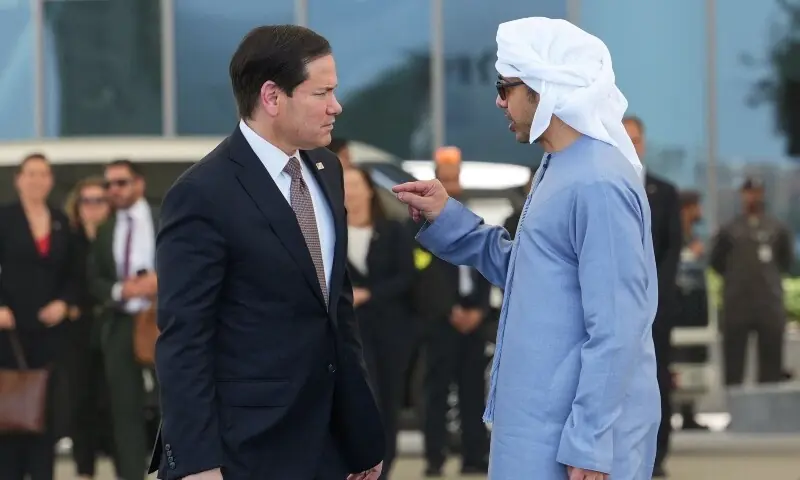

US Secretary of State Marco Rubio discussed the US-Iran deal with UAE President Mohamed bin Zayed on Wednesday, renewing Washington’s commitment to the country’s security as he embarks on a tour of the Gulf.
Rubio is seeking to reassure close US allies — who were hit by Iranian missiles during the Middle East war — about the memorandum of understanding with Tehran, which fails to address some of the Gulf’s long-standing concerns about its missile programme. Iran contends that it targeted US bases and assets in Gulf countries and has not accepted responsibility for all attacks.
“They discussed President Trump’s memorandum of understanding with Iran, efforts to secure full and safe transit through the Strait of Hormuz, and the importance of peace and stability in the region,” his spokesperson Tommy Pigott said.
Rubio also “thanked the UAE for their leadership and unparalleled support, praised their courage and resilience in the face of Iran’s attacks, and reaffirmed the US commitment to the security of the Emirates”, Pigott added.
The secretary of state arrived in Abu Dhabi on Tuesday evening and held closed-door talks with Sheikh Mohamed the following day, then set off for Kuwait.
After that, he will travel on to Bahrain, where he will attend a Gulf Cooperation Council meeting on Thursday.
He insisted that no country is allowed to impose tolls on the Strait of Hormuz after Oman and Iran, which border the waterway, said they were considering charging “costs” for ships navigating the key conduit for Gulf oil and gas.
“It’s an international waterway. No country is allowed to charge tolls or fees on an international waterway. That’s existing international law,” he said as he arrived in the United Arab Emirates capital.
Rubio held a working lunch with the UAE president and other senior figures, including National Security Adviser Sheikh Tahnoun bin Zayed Al Nahyan and Foreign Minister Sheikh Abdullah bin Zayed Al Nahyan.
Asked on arrival if he planned to address allies’ disquiet with the accord, Rubio told reporters: “That most certainly will come up in these discussions.”
He said they would also discuss issues not covered by the memorandum of understanding (MoU).
America’s top diplomat has been largely absent from Iran-related discussions in recent weeks, with Vice President JD Vance instead leading a round of talks with Iranian counterparts over the weekend in Switzerland.
The UAE faces particularly severe economic strains, as the war caused some expatriates at the core of its non-oil economy to flee the global financial centre, which prides itself on stability in a volatile Middle East.
Rubio’s remarks during his swing through the region will be closely scrutinised to see how the man once known as a hawkish critic of Iran frames a deal that many congressional Republicans argue amounts to capitulation.
Rubio and Vance, both former US senators, are widely viewed within Republican Party circles as potential candidates to succeed Trump, with party insiders and early polling often casting the race as a two-way contest between them.
Rubio’s mission is delicate: While he needs to defend a preliminary accord that Trump firmly supports, he also has to credibly address the concerns of his Gulf counterparts, who are more circumspect about the deal.
The US and Iran signed a 14-point MoU last week, setting out broad agreements in principle to end the war.
The interim accord paved the way for 60 days of talks aimed at hammering out thornier details, including issues related to Iran’s nuclear programme.
A central issue in talks is what will happen to Iran’s highly enriched uranium, including material enriched to up to 60 per cent purity, a short step from the roughly 90pc of weapons grade.
Tehran says its nuclear programme is for peaceful purposes.
While Gulf leaders pushed for peace during the four-month-long conflict, many were surprised and disappointed by the terms of the accord.
US regional allies are especially concerned that Iran could use the proposed $300 billion reconstruction fund to rebuild its military.
The accord also does not address Tehran’s ballistic missile capacity, a concern for Gulf states, all of which were struck by Iranian missiles and drones in the war.
Tehran has noted that the Gulf states made various logistical accommodations for Washington’s war effort, while hosting US military bases that were central to the conflict.