17 killed as deadly storms buffet China; over 130,000 evacuated

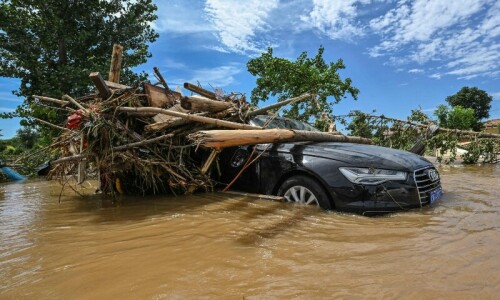
BEIJING: The death toll from devastating storms in parts of China rose to 17 on Tuesday, with hundreds more injured and tens of thousands evacuated, as President Xi Jinping urged “all out” rescue efforts.
Over 130,000 people were evacuated, but 11 are still missing, regional officials told a news conference, adding that the rain has damaged nearly 13,000 acres of agricultural land.
Dramatic video shared by state broadcaster CCTV showed a torrent of muddy water rushing past the crumbled concrete walls of a reservoir dam that had burst in the southern region of Guangxi, the worst-hit area.
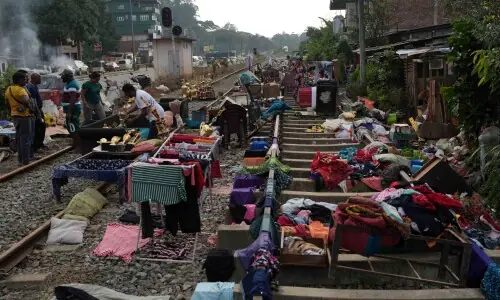
Rescue workers wearing life vests searched for missing people in inflatable boats, while authorities erected emergency shelters to house those displaced.
40 rivers and waterways overflowing in southern Guangxi region
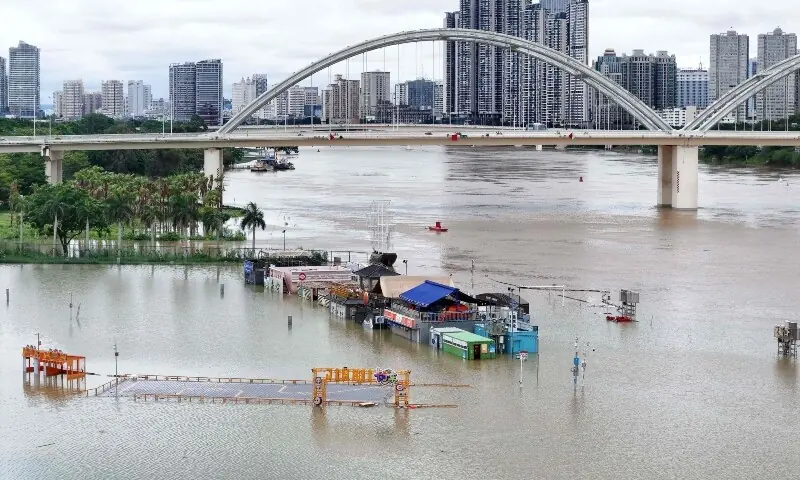
Intense rain and severe flooding from typhoon Maysak killed six people in Guangxi, where authorities raised the flood control emergency response to its highest level in the regional capital, Nanning.
The state broadcaster said 40 rivers and waterways in Guangxi were overflowing.
Videos of villagers knee-deep in floodwater frantically trying to catch snakes swimming in a flooded Guangxi town went viral on social media, with a related hashtag racking up more than 180 million views.
Around 800 to 900 snakes escaped on Monday morning after a breeding farm was washed away, the head of a village committee told a state-owned newspaper.
Intense winds
Thunderstorms and gale-force winds killed another 11 people and injured 331 in the central province of Hubei, and tornadoes were reported elsewhere late on Monday, state news agency Xinhua said.
One person is missing in Hubei, Xinhua said, adding that 4,800 houses were damaged and 22 more had collapsed.
A man, surnamed Wang, told local media that his brother-in-law, surnamed Zhang, had been “sucked out” of his home in Hubei’s Huanggang city by strong winds, and was found unconscious outside his apartment complex, breathing only faintly.
“Wall cabinets, sofas, coffee tables, dining tables and chairs vanished in an instant. It was as if the entire building had been hollowed out,” Wang told the Xiaoxiang Morning Herald.
President Xi said on Tuesday that rescuers should “go all out” in organising emergency operations.
Natural disasters are common across China, particularly in the summer when some regions experience intense rainfall while others bake in scorching heat.
Parts of Guangxi’s coastal and eastern regions, as well as southwestern Guangdong, will continue to be hit by heavy rain on Wednesday, Minister of Water Resources Li Guoying said on Tuesday.
Flood peaks “exceeding the warning water level” by more than six metres are expected at a hydrological station in Guangxi, Li said.
“Due to the impact of persistent heavy rainfall and the prolonged passage of floodwaters at high levels, the safety of reservoirs and embankments in the affected areas faces a severe test,” he said.
Landslide buries dozens
A landslide in China’s northwestern Gansu province killed five people on Tuesday, with rescuers working to locate 12 others still missing.
At least 33 people were initially reported missing after the landslide in a village near Gansu’s Longnan city.
Rescue teams had located 21 trapped individuals, but five of them died “despite emergency medical efforts”, the agency said.
Authorities have set aside 30 million yuan ($4.4 million) in reconstruction funds following the landslide.
Scientists warn the intensity and frequency of global extreme weather events will increase as the planet continues to heat up because of fossil fuel emissions.
China is the world’s biggest emitter of greenhouse gases, but it is also a global renewable energy powerhouse that aims to make its massive economy carbon-neutral by 2060.
Twenty-two people were killed in the country in May after heavy rains lashed its central and southern regions, with some places “hit by record-breaking rainfall”.
Published in Dawn, July 8th, 2026