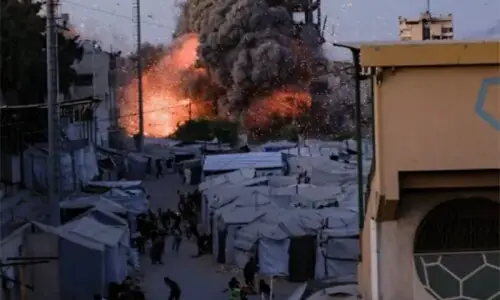
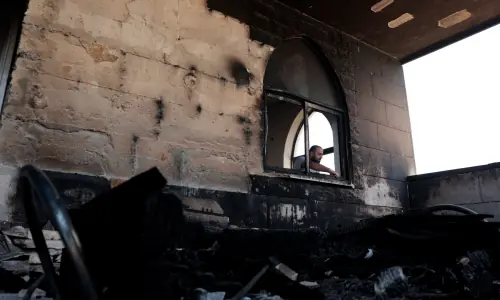
Illegal Israeli blockades encroach deeper into Gaza

• Earth barriers now seal off 85pc of boundary
• Satellite images show land cleared, olive groves razed, buildings demolished beyond Yellow Line
• Troops forcing families from tent camps into ever-shrinking safe zone
ISRAEL’s military is systematically expanding an extensive network of earth barriers and shifting demarcation markers deeper into the Gaza Strip, displacing Palestinian families and raising concerns of a prolonged occupation, according to a BBC News report.
Under a US-brokered ceasefire agreement between Israel and Hamas last October, Israeli forces agreed to withdraw to a designated demarcation known as the Yellow Line, leaving Israel in temporary control of 53pc of Gaza’s territory.
However, Israeli PM Benjamin Netanyahu recently stated the military controlled over 60pc of the teritory, and in May said his directive was to increase that area to 70pc, the report said.
Hamas maintains that Israel is violating the agreement by pushing the Yellow Line westward.
The IDF, meanwhile, described its posture as a defensive measure involving physical barriers and intelligence capabilities to prevent infiltrations, declining to provide further details on the barrier’s route for operational security reasons.
Yet, physical evidence demonstrates encroachment beyond agreed boundaries. Despite initially marking the boundary with concrete blocks, Israel has since constructed a network of barriers stretching more than 42 kilometres and covering 85pc of the Yellow Line, according to the report.
The longest section spans 13.8km. The embankments extend significantly beyond the originally mapped line, including a section near the al-Mawasi camp positioned more than 1.5km past the boundary and another in Khan Younis extending more than 500 metres over it.
For displaced Palestinians, the shifting markers have prompted renewed evacuations.
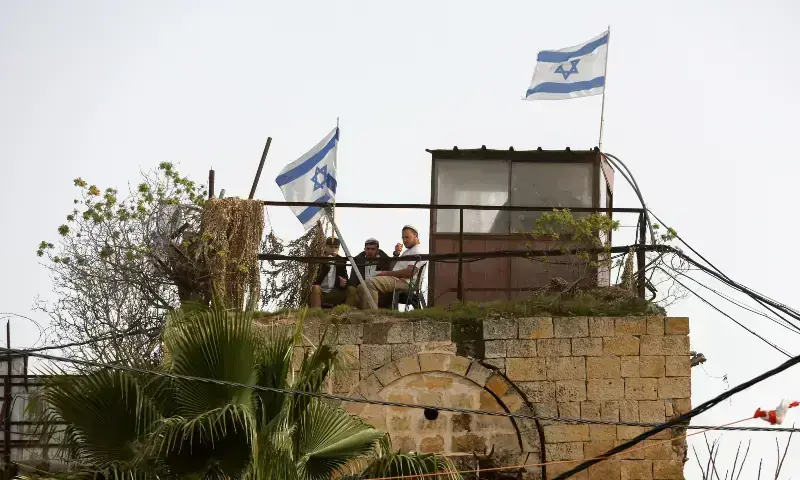
In the al-Tuffah neighbourhood of northern Gaza, residents found yellow concrete blocks moved westward into the center of Salah al-Din road, a key north-south thoroughfare, with an Israeli flag hoisted atop a three-metre (10-foot) earth barrier nearby.
Similar displacement occurred east of Gaza City in the Zeitoun area on July 18, when dozens of families fled following an IDF evacuation order.
According to UN-OCHA, roughly 30 families lost their shelters during the evacuation. Residents reported shooting from military vehicles, drone activity and shelling as heavy machinery built a new base and earth banks east of the neighbourhood.
Satellite imagery and verified video analysed by BBC News show land cleared, olive groves torn down and scores of buildings demolished beyond the Yellow Line in Khan Yunis, Deir al-Balah, Rafah, Jabalia and Beit Lahia.
The military has also established 14 new positions along the boundary since the October ceasefire, and expanded seven existing sites.
Palestinians say the changes have further restricted an already displaced population of more than two million people.
“The Yellow Line keeps moving day by day,” Abu Kamel Hamami, a displaced resident of Gaza City, told BBC News.
Published in Dawn, July 31st, 2026