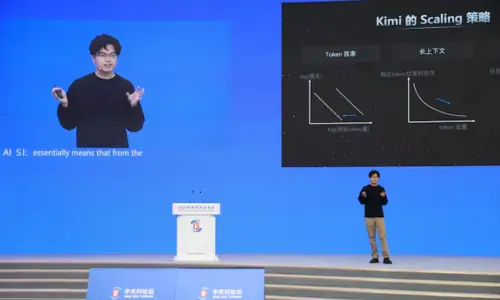
Alibaba unveils its most capable AI model to date, not far behind Moonshot's in size


China’s Alibaba on Monday unveiled what it said is its largest and most capable artificial-intelligence model, the Qwen3.8-Max, which is not far behind in size when compared with an offering from domestic rival Moonshot AI launched last month.
Chinese tech companies — a huge force in open-weight AI models globally — are locked in a fierce and fast-moving battle to build more powerful systems without making them prohibitively expensive to run.
Qwen3.8-Max has 2.4 trillion parameters, the numerical settings a model learns from data and uses to recognise patterns, generate answers, and carry out tasks. Moonshot’s Kimi K3 has 2.8 trillion parameters.
A higher figure does not automatically make a model better, but it has become a closely watched measure of the scale of the computing and data behind advanced AI systems.
Chinese tech companies are keen to publish parameter count to help their models gain traction among the developer community. Their models tend to be open-weight, meaning the underlying learned settings that allow developers to run or adapt the system are available for download.
By contrast, OpenAI, Anthropic and Google do not publish parameter count for their closed-source models.
Qwen3.8-Max was unveiled on crowdsourced model-comparison platform Arena.AI, where it immediately became the highest-ranking Chinese model in terms of text models, though it still lags Claude Fable 5 and three Opus variants, which are all from Anthropic.
But on Arena.AI’s leaderboard for AI models that analyse images and other visual material, Qwen3.8-Max ranked second globally, only behind a Claude Fable 5 variant.
Both Qwen3.8-Max and Kimi K3 can handle text, images and video, and process up to 1 million tokens at a time.
Tokens are chunks of data, often parts of words or short words, and a big figure means the model can take in large amounts of material in one go, such as long legal files, a large software codebase or hundreds of pages of documents.
Alibaba said its model uses a “mixture-of-experts” design, which divides work among specialised parts of the system instead of switching on the entire model for every request. Only 95 billion parameters are used at a time, reducing costs and response delays.
The tech giant said the model completed a software-engineering project in 16 days.
The Qwen3.8-Max is due to be released next week through Alibaba Cloud’s Model Studio platform.