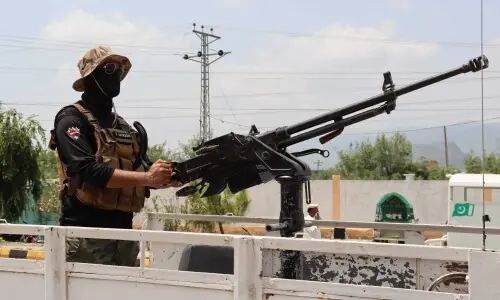
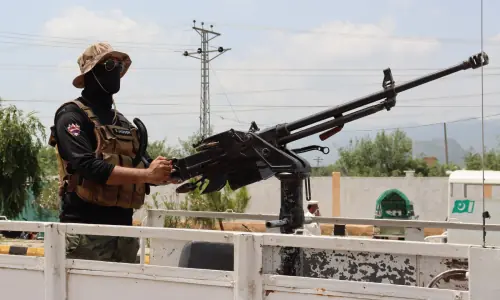
Pakistan, US hold counter-terrorism dialogue, reaffirm commitment to combating terrorist groups
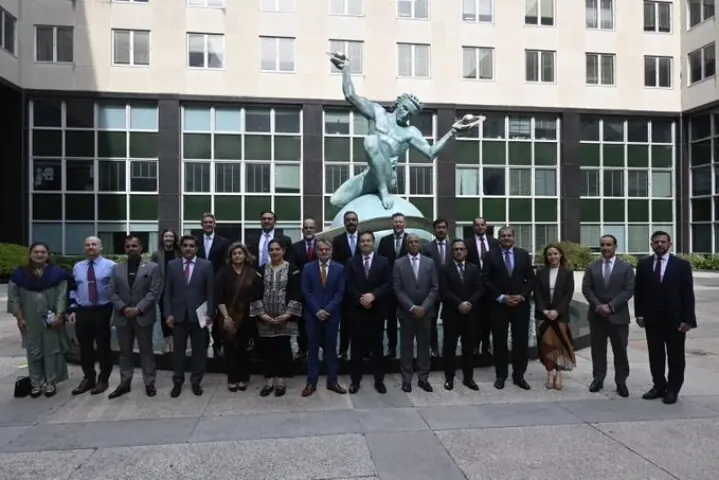

WASHINGTON: The United States and Pakistan on Tuesday held the fourth counter-terrorism dialogue in Washington, reaffirming their commitment to combating terrorist groups and strengthening security cooperation at a time when regional tensions remain high.
The talks were led by US Coordinator for Counterterrorism Ambassador Gregory LoGerfo and Foreign Ministry Special Secretary Ambassador Nabeel Munir, a joint statement released by the US State Department said.
“The dialogue underscored shared interests in the US-Pakistan counter-terrorism partnership and the two countries’ determination to confront terrorism,” the joint statement said.
“Delegations exchanged views on the current threat environment, explored avenues to enhance collaboration, and discussed steps to strengthen border security and disrupt terrorist facilitation networks,” it added.
The statement specifically named ISIS-Khorasan (ISIS-K), Al Qaeda, the Tehreek-i-Taliban Pakistan (TTP), and the Balochistan Liberation Army (BLA) and its affiliates among organisations that both governments said posed threats to regional security.
“The US and Pakistan affirmed their joint resolve to confront terrorist organisations that endanger the safety of their citizens and the stability of the region,” the statement said.
“The two governments committed to ensuring their counter-terrorism collaboration to keep both of their nations safe and secure, and as part of an enduring vision of regional peace, prosperity, and stability,” it said.
Meanwhile, the Foreign Office said that the two sides held “extensive deliberations on the regional and global terrorist threat and pledged to deepen counter-terrorism collaboration both bilaterally and at multilateral fora”.
The renewed engagement marks a shift from the difficult period in US-Pakistan relations following the withdrawal of American forces from Afghanistan in 2021. Washington had expressed concerns over terrorists sanctuaries in the region, while Islamabad repeatedly highlighted the security challenges it faced from cross-border militancy and instability in Afghanistan.
In recent years, both countries have sought to focus on areas of mutual interest, including counter-terrorism, trade, investment, climate cooperation, and regional stability.
Pakistan’s strategic location and longstanding diplomatic links with neighbouring countries have also increased its importance in regional diplomacy. The country’s diplomatic role also gained renewed attention during the US-Iran conflict, as Islamabad has mediated between the two sides.
The improved engagement with the US also comes as Pakistan continues to face serious internal security challenges. According to the Pakistan Institute for Conflict and Security Studies, an Islamabad-based think tank, violence linked to terrorist attacks and counter-terrorism operations intensified sharply in July, making it the deadliest month of 2026, with 112 security personnel among 205 people killed.
Pakistan, US look to finalise reciprocal trade framework
While representatives from the US and Pakistan held counter-terrorism discussions in Washington, Finance Minister Muhammad Aurangzeb held a virtual meeting with United States Trade Representative Ambassador Jamieson Greer from Islamabad.
The meeting was held to review the progress of ongoing negotiations, which are focused on strengthening bilateral trade and economic cooperation between Pakistan and the US, a statement released by the finance ministry said.
The engagement took place roughly three weeks after the finance minister visited Washington, where he held talks with senior American officials on trade, tariffs, investment and economic cooperation.
During his visit, Aurangzeb held meetings with officials from the Office of the Trade Representative, the US Export-Import Bank (Exim), the US International Development Finance Corporation (DFC) and the International Monetary Fund.
The discussions focused on a possible bilateral trade agreement covering tariffs, market access, investment opportunities and wider economic cooperation. Separate talks with the Exim Bank and the DFC explored financing for infrastructure, energy and private-sector investment projects in Pakistan.
During the meeting on Wednesday, he recalled his recent discussions in Washington and “welcomed the steady progress made by the respective negotiating teams and appreciated the constructive engagement that has characterised the dialogue over time”, the finance ministry said.
It added that both sides noted that negotiations on the proposed reciprocal trade framework had advanced significantly and reaffirmed their shared commitment to conclude the agreement at the earliest.
“The finance minister highlighted the importance of maintaining the momentum of negotiations in view of Pakistan’s economic priorities.
“He emphasised that a strengthened trade and investment partnership with the United States would contribute to Pakistan’s export-led growth strategy, support economic resilience, and create greater commercial opportunities for businesses in both countries,” the statement read.
It further said that Aurangzeb also underlined the importance of continued collaboration with the Exim Bank to facilitate bilateral trade and investment.
According to the finance ministry, Ambassador Greer acknowledged Pakistan’s continued engagement throughout the negotiations.
He reaffirmed the United States’ commitment to “sustaining the positive trajectory of bilateral trade discussions and expressed confidence that the remaining issues could be resolved through continued technical engagement”, the finance ministry said.
It added that Aurangzeb also emphasised the importance of maintaining close coordination and accelerating technical-level discussions to build on the progress already achieved.
“Both sides expressed satisfaction with the progress achieved and agreed to continue working closely to finalise the remaining elements of the framework and agreed to continue regular engagement with a view to concluding the reciprocal trade framework soon, further strengthening the longstanding economic partnership between Pakistan and the United States,” the ministry’s statement read.
It added that Greer also “appreciated the progress made on labour and regulatory reforms, including measures relating to forced labour compliance”.
Pakistan is among the 60 countries on which the US imposed new import tariffs last month over what Washington said was their failure to effectively prohibit imports of goods produced with forced labour.
Pakistan was placed in the lower 10 per cent tariff category, alongside countries that had either adopted forced labour import prohibitions, committed to doing so under reciprocal trade arrangements, or had partial enforcement regimes.
The finance ministry said that Pakistan’s Federal Secretary for Commerce Jawad Paul and senior team members of the USTR also joined Wednesday’s meeting.