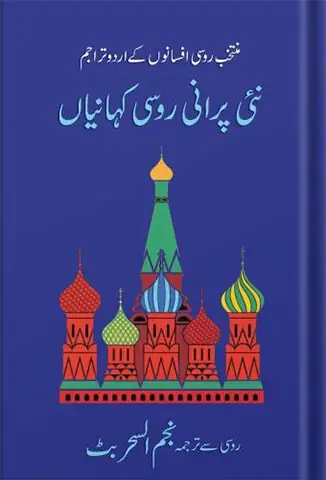
Nai Purani Roosi Kahaniyaan
Translated by Najam-ul-Sahar Butt
Maktaba-e-Danyal
ISBN: 978-969-419-127-0
178pp.
Some of our earliest reading experiences stay with us forever.
My own journey with Russian literature began in my childhood, thanks to my father. Whenever he returned from Saddar in Karachi, he would bring home bundles of translated Russian classics from old bookshops. Those books became my greatest treasures. One, in particular, a grey-covered Russian children’s book, remains as vivid in my memory today as it was when I first opened its pages.
As I grew older, I found myself lost in the works of Maxim Gorky, Anton Chekhov, Fyodor Dostoevsky and Leo Tolstoy. Their writing introduced me to a world of profound ideas and emotions, shaping my love of literature.
Realism is one of the most important movements in literature. It presents life as it truly is, without exaggeration or fantasy. Realist writers focus on ordinary people, everyday experiences, and the social realities of their time, allowing readers to better understand human nature and society. Russian literature has been the most outstanding example of realism in world literature, distinguished by its deep exploration of human psychology and its honest portrayal of society. It is this commitment to truth that has made it one of the world’s greatest literary traditions.
A collection of four contemporary Russian stories, beautifully translated into Urdu, captures the enduring power of realism and human emotions
Perhaps that is why receiving Maktaba-e-Danyal’s newly published book Nai Purani Roosi Kahaniyaan [New and Old Russian Stories], an Urdu translation of four classic Russian stories, felt like reconnecting with an old friend. Beautifully translated directly from Russian by Najam-ul-Sahar Butt, this collection captures both the spirit of the original works and the beauty of the Urdu language.
Butt’s translation deserves special praise. It is fluent, graceful and remarkably natural. At times, one forgets that these stories were originally written in another language. His thoughtful use of Urdu idioms gives the text warmth and authenticity, making the stories feel as though they were originally written in Urdu itself.
As the translator observes in his introduction, one thing has remained constant through the Russia of the Tsars, the Soviet era and modern-day Russia — the rich literary tradition. While the themes have changed with the times, Russian writers have remained committed to realism and to portraying human life with honesty.
The collection brings together four carefully selected stories from different periods of Russian literature. The stories — ‘Kahani Insaan Ki’ [The Story of a Man] by Mikhail Sholokhov, ‘Roomal Aur Murgh’ [The Handkerchief and the Rooster] by Mikhail Bulgakov, ‘Happy End’ by Viktoriya Tokareva and ‘Qissa Aik Letter Box Ka’ [The Story of a Letterbox] by Yelena Leonova — represent contemporary Russian writing. Despite their different settings and eras, all these four stories explore universal human experiences with remarkable sensitivity.
If you want to understand how cruel and devastating war can be, you should read Mikhail Sholokhov’s ‘Kahani Insaan Ki’. It is a simple story, yet it leaves a deep and lasting impact on the heart.
Sholokhov’s short story is undoubtedly the emotional centre of the collection. Set during the Second World War, it follows an ordinary man forced to leave his wife and children to defend his country. Through suffering, loss and repeated encounters with death, the story reveals the devastating cost of war. One of its most moving moments comes when the protagonist meets an orphan who has lost both parents. Their relationship reminds us that even in the darkest of times, kindness and hope can survive.
This story carries the emotions so naturally that, before you realise it, your eyes well up with tears. It is one of those rare stories that quietly breaks your heart and stays with you long after the final page.
In contrast, Bulgakov’s ‘Roomal Aur Murgh’ offers a lighter yet equally compelling reading experience. Set in rural Russia in the early 20th century, it tells the story of a young doctor beginning his medical career in an isolated village. Unsure of his own abilities, he suddenly finds himself facing a life-threatening medical emergency. Bulgakov masterfully combines humour, realism, suspense and gentle irony to create a story about fear, courage and growing self-confidence.
The third story, ‘Happy End’ by Viktoriya Tokareva, is a thought-provoking novella that explores the dilemmas of modern life, the psychological impact of technology and the pursuit of a better future. It follows Eliya, a young woman who leaves her village for Moscow in search of a better future. Along the way, she experiences loneliness, disappointment and countless hardships, only to realise that the happiness she had been searching for was perhaps closer than she had imagined.
The final story, ‘Qissa Aik Letter Box Ka’ by Yelena Leonova, is short, charming and surprisingly profound. It carries a deep message. Through an imagined conversation between an old letter box and a crow, the author gently takes readers back to a time when letters connected hearts and carried emotions across distances. Together, they remember the past and quietly mourn the disappearance of letter-writing in the age of modern technology.
It is a delightful story, yet one that leaves you thinking long after you have finished it. Beneath its simplicity lies a thoughtful reminder that, in our race towards new technology, we may also be leaving behind some of the most beautiful and meaningful parts of life.
Beautifully written and translated, this collection of stories demonstrates why Russian literature continues to speak to readers across generations and cultures. Whether writing about war, ambition, loneliness, compassion or the passage of time, the authors remind us that the deepest human emotions remain unchanged.
Najam-ul-Sahar Butt’s sensitive translation makes these timeless stories accessible to Urdu readers without losing their emotional depth or literary beauty. This collection is more than a translation — it is an invitation to rediscover the enduring power of Russian literature. For anyone who appreciates thoughtful storytelling and realistic fiction, it is a book well worth reading.
The reviewer is a writer, social activist and performing artist
Published in Dawn, Books & Authors, August 9th, 2026