Pleasing no one: Netanyahu tries to placate his right-wing base instead of Trump
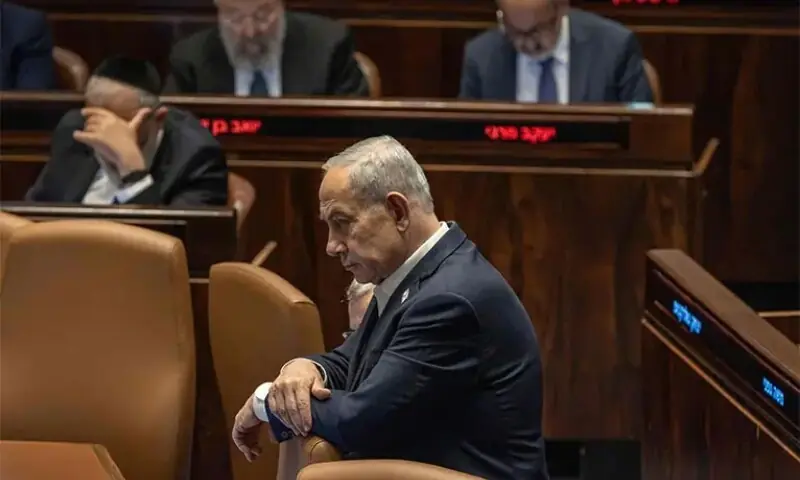

JERUSALEM: Faced with a divisive US-led Gaza plan just before elections that could end his career, Israeli Prime Minister Benjamin Netanyahu had to choose between pleasing his ally Donald Trump or his right-wing base.
In rejecting the plan, he may not please anyone.
The decision is a tactical and PR victory for Hamas, analysts say, with the movement publicly backing the deal under which it would disarm, without taking any steps yet to do so.
Netanyahu, who has built his decades-long career on hawkish security positions, had voiced concern but softly, after the US president hailed the “historic milestone” on ending the Gaza conflict.
He finally rejected the plan on Sunday during a cabinet meeting after pushback from the far-right, which opposes the 15-point deal that would see Israel eventually withdraw troops from much of Gaza.
Netanyahu, Israel’s longest-serving prime minister, is by nature “a procrastinator” and is struggling to secure the trust of the hard-right ahead of the Oct 27 vote, said Yossi Mekelberg, an expert on Israeli politics at London-based think tank Chatham House.
Netanyahu’s calculation is to dissuade votes for the opposition by creating the impression that he is “still the only bastion of power that will stop Hamas”, Mekelberg said.
“Netanyahu knows that falling out with Trump doesn’t serve him or Israel.”
On the other hand, he knows the minute that he agrees to the 15 points, he would be attacked not only by the right wing but that some opposition parties will attack him, too,” he said.
“He’s trying to appease everyone. At the end of the day, he will be appeasing no one.”
Cooperating despite rejection
Israel will be voting for the first time since the Oct 7, 2023, raid.
Despite Netanyahu’s public rejection of Trump’s plan, Israel in practice appears to be complying with a key part of it. It has stopped air strikes since Aug 3, although Gaza authorities report periodic Israeli gunfire.
“These strikes could be resumed and even intensified at any time. It is one of the cards Israel can manoeuvre with,” said Ehud Eilam, a former analyst at Israel’s defence ministry.
He noted that Israel had not succeeded in its goal of completely destroying Hamas. “Therefore, Israel at least seeks to disarm Hamas, which is also a very difficult task,” Eilam said.
“Hamas will anyway refuse to completely disarm, and for now can continue to use Netanyahu as an excuse to avoid or at least slow down this process,” he said.
Netanyahu had long campaigned on his close rapport with Trump, who has taken unprecedented steps such as moving the US embassy to Jerusalem and joining Israel in attacking Iran.
But Trump’s popularity in Israel took a nosedive in April when he called a ceasefire with Iran and sought a settlement, seeing the war as politically and economically damaging.
Netanyahu could be willing to take some steps forward on Gaza to please Trump in return for new US action against Iran, Eilam said.
“For Netanyahu, the Gaza Strip, and Lebanon too for that matter, are not the most urgent concerns; Iran is,” he said.
Tactical win for Hamas
Hamas publicly backed the disarmament agreement shortly after it chose a new leader, Khalil al Hayya.
“I think Hamas, from the get-go, did this for tactical reasons,” said Ghaith al Omari, a former Palestinian Authority official who is now a senior fellow at the Washington Institute for Near East Policy.
He said that Hamas wanted to be seen as a “reasonable actor” – and that Netanyahu’s rejection worked in its favour.
“What this does is actually give Hamas and mediators reason to say, look, Hamas has committed, Israel has not committed – the ball is in Israel’s court,” he said.
“It lets the pressure off Hamas.”
Published in Dawn, August 11th, 2026