Saudi oil exports ‘go dark’ amid Houthi threat

• Tankers in Red Sea switch off tracking to evade attacks; conflicting data clouds scale of export disruption
• Tehran says no major progress in talks with Washington
• Trump claims US has total control over Hormuz
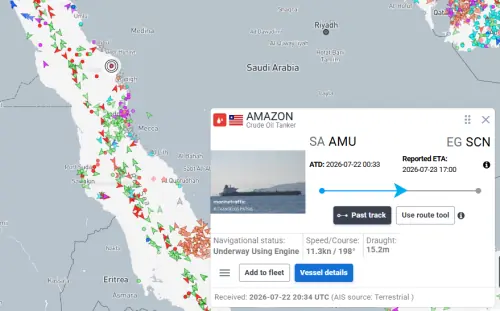
DUBAI: Saudi crude exports from the Red Sea are increasingly vanishing from view as tankers switch off tracking signals to avoid attacks by Yemen’s Houthis, with analysts saying all recent Yanbu loadings have been conducted “dark”.
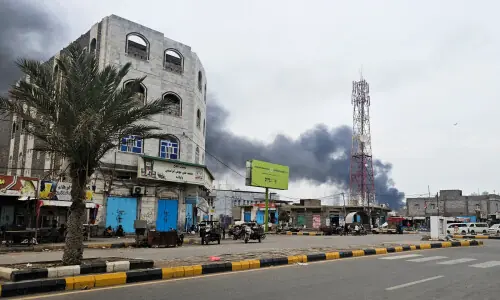
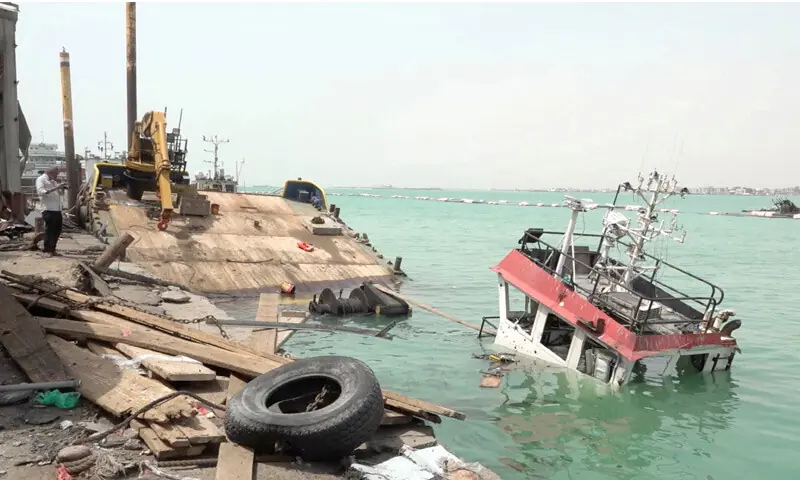
The Houthis declared a maritime embargo on Saudi Arabia on July 20, targeting the US and allies in the Iran conflict. They’ve since claimed attacks on Saudi-linked tankers, Yanbu oil facilities, and Jazan refinery, leading vessels to turn off tracking signals.
The increase in “dark voyages” is complicating the assessment of Houthi threat impacts on Saudi crude flows. Ship-tracking firms have produced widely differing export estimates — data used by the International Energy Agency, OPEC and traders to forecast market trends.
In the week beginning Aug 3, data analytics firm Vortexa estimated Yanbu loadings fell to 2.38 million barrels per day from 2.71m the previous week. Kpler estimated a sharper drop to 1.78m bpd from 4.04m, while AXSMarine calculated a rise to 850,000 bpd from about 420,000 bpd.
Those trying to monitor shipments rely on a vessel reappearing on tracking systems once it has left the high-risk area, using satellite data to cross-check movements and fill in the gaps.
According to Vortexa’s George Morris and Kpler’s Nhway Khin Soe, recent Yanbu cargoes were loaded ‘dark’, meaning no AIS tracking was active, with about 70pc of Saudi west coast shipments lacking continuous AIS coverage since July 23.
Houthi attacks have reduced traffic through the Bab al-Mandeb Strait, with vessel numbers down to 32 from 50. Saudi Arabia is rerouting more oil via the Suez Canal or Egypt’s SUMED pipeline, with Sidi Kerir loadings reaching a record 2.17m bpd, 90pc of which is Saudi crude.
Meanwhile, Iran and the United States remain at loggerheads over efforts to agree to a permanent end to the war in the Gulf.
There were no discussions to extend their ceasefire because, from Tehran’s perspective, the deal had no start date, a senior Iranian source said.
“One of the issues that is being discussed via mediators is the US returning to the interim agreement and defining a timeframe,” the source said. “There has been absolutely no progress on this issue.”
Both Iran and the US have stepped up rhetoric in the past two days. US President Donald Trump has claimed that the United States is in control of the Strait of Hormuz.
“The US has total control over the Strait of Hormuz. I think we will keep it!” he wrote on Truth Social. “Our Naval Blockade is being called, by everyone, a wall of steel, and there is nothing Iran can do about it.”
Meanwhile, Iran’s security official, Mohsen Rezaei, said the Strait of Hormuz would stay closed unless the US agreed to Iran’s conditions to end the war.
Published in Dawn, August 13th, 2026