
THE world is witnessing calamitous wars, which are recasting the way diplomacy and economic ties have hitherto been conducted. India is caught in the vortex of chaos. One would have thought that in his Independence Day address on Saturday, which marked the 79th anniversary of freedom from Britain, Prime Minister Narendra Modi would discuss the fallout of the crisis and prepare the nation for the air pockets ahead. Instead, he was busy supervising a divisive song the Constituent Assembly had warned against in 1950.
Russia’s all but declared war with Nato and Iran’s taming of the US and Israeli militaries are indeed tectonic events. In their wake, India’s future as a regional power with global aspirations is at stake. The defence pact Pakistan signed with Saudi Arabia and Turkiye has crucial implications, too, for the security bundobust in and beyond the oil-rich West Asia.
Also, Modi has been tasked with hosting a potentially landmark BRICS summit next month, bringing together Russia, China and influential member states that are involved in or watching the Gulf conflict, with key members ranged against each other. Will the BRICS meeting set the tenor for the arriving changes or is India planning to play the spoiler?
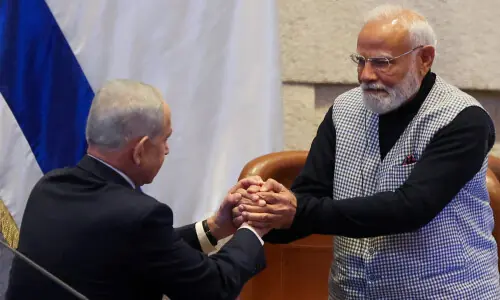
India’s moral crisis deepened when Amnesty International said New Delhi had sent Israel 2,596 shipments of military ordnance, which could be used in the Gaza genocide. Modi, on his part, has already declared India’s stand by visiting Israel just before the assassination of Iran’s spiritual leader on Feb 28.
Like India’s foreign policy, the singing of Vande Mataram was poorly timed. The recent Cockroach protests revealed that Indians are getting weary of Modi’s primeval preference for pitting the people against each other. However, the song evidently failed to shift the focus from the urgent issues of unemployed youths, rampant corruption, including the notorious heist at the Ram temple in Ayodhya, and unintelligent foreign policy choices imposed on harassed citizens.
Why does the Congress party get cold feet in challenging deliberately foisted faux religiosity?
It was troubling, though, to see the opposition Congress party looking pulverised over the divisive song. Home Minister Amit Shah accused Sonia Gandhi of seeking to stop its singing at a Congress event to mark Independence Day. The Congress made it worse by issuing an embarrassing denial that anyone tried to stop the song. The Gandhi family — Rahul, Priyanka and Sonia Gandhi — have been forceful critics of Modi’s ties with Benjamin Netanyahu and his genocide in Gaza.
Rahul Gandhi is widely accepted as an agreeable champion of the hoi polloi. He speaks clearly and forcefully on burning issues like corruption, a stymied education policy, the targeting of the poor, farmers’ distress and alleged rigging of elections. He has notably also asked why, since his great-grandfather Jawaharlal Nehru spent 12 years in British jails before becoming a great world leader, he should not be ready to go to jail for 10 years.
Bravado apart, the focus should be on sending the erring opponents to justice. But why does the Congress lose its wits when it comes to frontally challenging Hindutva? The Gandhis routinely name the BJP and the RSS as fatal for democracy. Why, then, does the party get cold feet in challenging deliberately foisted faux religiosity?
Why is it an ordeal for the Congress to take the stand expected of it, undeterred by any electoral consequences? It’s a Hindutva myth, of course, that Muslims have some special aversion to the controversial lines of Vande Mataram. The discomforting fact for Hindutva, which the Gandhis may wish to share with the party, is that a majority of Indians, including Sikhs, Jains, Buddhists, Christians, Parsis, and above all, Arya Samaj Hindus and swathes of tribespeople among others, do not subscribe to the worship of deities mentioned in the uncensored stanzas of Vande Mataram.
Its patronage by the Modi government impertinently ignores the separation of religion from the functioning of the secular state that India was conceived to be when it acquired a republican constitution in 1950. That’s how the song was trimmed — to keep the patriotic fervour in the first two stanzas while removing the divisive religious references in the remaining lines. A tuneful Vande Mataram used to be rendered every morning on Akashvani, the state-run radio, without any trouble.
It was composed and sung at a Congress function in 1911 in the soothing Raag Desh by Rabindranath Tagore. Vishnupant Pagnis later sang it in Miyan ki Sarang, while Omkarnath Thakur and V.D. Paluskar composed it in other lilting tunes. It was Tagore, author of Indian, Bangladeshi and Ceylonese anthems, who suggested that Vande Mataram be trimmed to accord with the sentiments of India’s multicultural and multireligious patriots.
For the record, the 1872 song was part of a Bengali novel that described Muslims as the enemies of the motherland and in which the Muslim ruler of Bengal was depicted as the cause of misfortune for the Hindu ascetics, the Santans. Anandmath started a troubling communal canard by airbrushing the militant role of Muslim fakirs who fought shoulder to shoulder with the Hindu sanyasis against the British and their Indian agents.
The song’s ongoing misuse by Hindutva practitioners ignores the fact that the ancient Vedic religion, the fountainhead of Hinduism, did not worship Durga or any other goddess in the song. The Arya Samajis emphasised the Vedic origins of Hinduism and banished idol worship from their practice of the religion altogether.
Thus, the RSS in recent years has been emphasising its proximity to the Sanatan Dharma. The BJP support for the mostly Sanskrit song would quite likely find most of its supporters struggling to recite or sing it in tune. But Gandhiji, too, was a follower of the Sanatan Dharma, and he was involved in relieving the song of its religious references while keeping the patriotic stanzas intact.
It is an unresolved contradiction within the Sanatan fold that Gandhi and his killers shared the same scriptures and drew totally opposite conclusions from their readings.
The writer is Dawn’s correspondent in Delhi.
jawednaqvi@gmail.com
Published in Dawn, August 18th, 2026