Pebble in the Pond: An Approach to Regional Development in Balochistan and Sindh
By Kaiser Bengali and Mehnaz Hafeez
Folio Books
ISBN: 9789697834891
185pp.
Dr Kaiser Bengali is a highly respected development economist, who has distinguished himself by forging his own path. He has generally stayed away from donor agencies and consulting assignments and has instead worked closely with two provincial governments, those of Sindh and Balochistan. He was also one of the architects of the original Benazir Income Support Programme (BISP), before it was re-designed by the World Bank.
Dr Bengali has original ideas and is articulate and blunt in his writings and his conversations. It was, therefore, gratifying to see that he has written a book on regional development in Balochistan and Sindh — both places where he has had extensive experience in planning and resource allocation. He is joined in this endeavour, Pebble in the Pond: An Approach to Regional Development in Balochistan and Sindh, by Mehnaz Hafeez, a GIS expert based in Canada, with expertise in geo-spatial investigation, and who has experience of mapping rural settlements in Balochistan. Together, they make a strong team for the purposes of their research.
The book does not disappoint. The authors have set out to identify ‘growth centres’ or development hubs in the two provinces. Essentially, they set out to identify towns or settlements where investment in infrastructure and social services would yield dividends not just for the town itself, but for surrounding settlements. The idea is to view development initiatives as “pebbles in a pond” — their impacts should not be limited to the immediate vicinity, but should generate externalities.
This thesis posits that growth-enabling investment should be concentrated in locations where a critical mass of people can benefit and “agglomeration economics” can come into play, so that the investment creates ripples, so to speak. To a great extent, this goes against the prevalent practice in Pakistan, where public investment in infrastructure or services is in the form of ‘schemes’ that are typically quite randomly located, and which are sanctioned in response to local demands rather than as a part of a wider fabric of service provision.
An insightful book by a development economist and geospatial mapping expert attempts to identify clusters of rural and urban settlements in Balochistan and Sindh that have the potential to act as engines of growth
The authors rightly point out that the basic unit for investment planning in Pakistan is an administrative unit — the division or district. Within these divisions, the concentration of population or the spread of natural resources may or may not be a factor in public investment planning. In Sindh, but particularly in Balochistan, district populations are not large and are scattered. In many cases, this makes the provision of basic infrastructure expensive and difficult to manage.
For the purposes of their research, the authors have re-classified the provinces into ‘zones’, to reflect the potential for connectivity, and the possibility of agglomeration. Looking mainly at access and resource endowments, they have come up with nine zones for Balochistan and four for Sindh.
Growth-enabling investment should be concentrated in locations where a critical mass of people can benefit and “agglomeration economics” can come into play, so that the investment creates ripples, so to speak. To a great extent, this goes against the prevalent practice in Pakistan, where public investment in infrastructure or services is in the form of ‘schemes’ that are typically quite randomly located, and which are sanctioned in response to local demands rather than as a part of a wider fabric of service provision.
The nine zones of Balochistan include Quetta (covering the districts of Quetta, Pishin, Kila Abdullah, Mastung, Nushki, Ziarat and Harnai); Jaffarabad (covering the districts of Jaffarbad, Nasirabad, Kacchi, Sohbatpur and Jhal Magsi); and Kech (covering the districts of Kech, Gwadar and Panjgur) among others. The zones of Sindh include the “North” zone (covering the area from Ghotki to Khairpur/Larkana, which includes eight districts); a “Central” zone (covering four districts, including Dadu and Shaheed Benazirabad); the “South” zone (including Hyderabad and nine other districts); and the “South East” zone, which includes only the district of Tharparkar. The authors did not include Karachi division in their analysis, as it is a densely populated urban centre and, by its very nature, is an example of agglomeration.
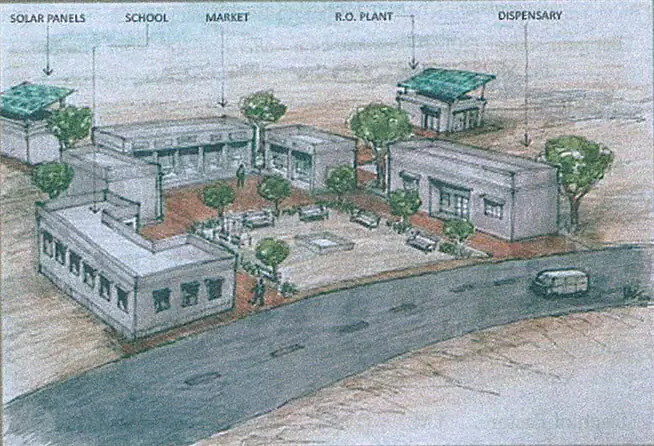
The authors go on to analyse the provincial economies in the context of the zones they identify. For example, the Nasirabad zone in Balochistan, the only canal-irrigated region within the province, is mainly dependent on crop agriculture. The Quetta and Kila Saifullah zones are known for fruit production. Mineral production is a feature of every zone in Balochistan, while natural gas is concentrated in the Dera Bugti and Loralai zones. Sindh, on the other hand, is largely an agrarian economy; with the North being the granary of the province, while the South is mainly known for sugarcane production, but also produces about a quarter of the provincial share of wheat, rice and cotton.
The authors then use GIS mapping to identify possible urban and rural growth centres in the two provinces. For rural growth centres, the authors tagged settlements with populations of more than 5,000 persons in Balochistan, and more than 10,000 persons in Sindh. In addition, they checked for distance from the district headquarters (for growth centres this should not be more than 20km), access to potable water, and connectivity through a viable road network.
For Sindh, the criteria for identifying a growth hub included the presence of at least one 10-room school and a Rural Health Centre. For Balochistan, additional criteria included settlements located at the junction of transport routes, potential mining towns and harbour towns, among others — these could be considered rural growth hubs according to the authors even if the population is less than 5,000 persons.
The authors then go through the painstaking process of pinning all the settlements which meet the criteria for the two provinces on a series of maps. In the end, 20 towns in Sindh and 14 in Balochistan were identified as urban growth hubs; while 153 rural settlements in Sindh and 165 in Balochistan were identified as potential rural growth centres.
The book ends a bit abruptly with the mapping, leaving the reader to wonder what happens next. Are the authors recommending that public investment, or ‘schemes’ as they are typically called in development budgets, should be placed in these areas only, and not scattered across the provinces? This seems to be the obvious conclusion and it certainly makes sense to avoid fragmentation in a time of constrained resources.
But it would have been good to lay out the conclusions and recommendations explicitly, and also explain whether the relevant authorities have been briefed on the findings of the research. GIS mapping is undoubtedly the way to go when it comes to resource allocation and planning. A more detailed explanation of the conclusions of this important exercise was warranted.
The reviewer is a researcher and policy analyst
Published in Dawn, Books & Authors, August 23rd, 2026