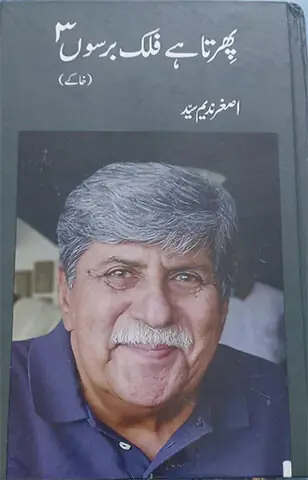
Phirta Hai Falak Barson - Vol 3
By Asghar Nadeem Syed
Sang-e-Meel Publications
ISBN: 978-969-35-3793-2
212pp.
Within the space of seven days, volumes Two and Three of Phirta Hai Falak Barson arrived at my doorstep. Like the first volume, both books are collections of literary pen portraits, bringing together famous TV playwright, poet and teacher Asghar Nadeem Syed’s personal memories of some of Pakistan’s most remarkable cultural and literary personalities. One of the books had been a bestseller in 2025, while the other has only just been published.
The tables of contents of both volumes contained an impressive list of Pakistan’s greatest literary and cultural personalities. This left me in two minds, as William Shakespeare might have said: “Which one to read, and which not to read?” In the end, I set aside the second volume, which focuses mainly on behind-the-scenes personalities — writers, poets, playwrights, and other creative minds — and picked up the third volume instead, as it features many familiar faces that we have grown up watching on television.
Readers of the first volume, published in 2023, are already familiar with how Syed depicts old Lahore, where the Alhamra Cultural Centre, the Pak Tea House and many of the city’s colleges and universities emerge as recurring characters. This volume casts light on people many of us grew up with in our homes, as characters on screen.
From puppet Uncle Sargam’s creator Farooq Qaiser to his mentor Shoaib Hashmi, from the ever-graceful actor Khalida Riyasat to the multi-talented theatre activist Madiha Gauhar, from poet-scholar Iftikhar Arif, who had a stint in the 1970s on the quiz programme Kasauti, to Kamal Ahmed Rizvi, the unforgettable Allan of Alif Noon, the book reunited me with some of Pakistan’s most beloved cultural icons. Reading these sketches was like watching a classic old film — each page brought back familiar faces, cherished memories and a bygone era that continues to live on in the hearts of older Pakistani audiences everywhere.
The third volume of litterateur Asghar Nadeem Syed’s pen portraits focuses on famous television personalities from the 1970s, 1980s and 1990s
The book revolves mostly around the 1980s and early 1990s. From writing in a tightly controlled cultural environment to expressing himself freely in private productions, Syed takes us on a trip back in time. Known for his knack for bringing out the person behind the public persona, the acclaimed playwright does not disappoint.
The opening chapter is devoted to Mustansar Hussain Tarrar and is aptly titled ‘Greek God’. Today, Tarrar is celebrated as one of Pakistan’s most popular television hosts and travel writers, but Asghar takes readers back to a time when he was regarded as one of Lahore’s most handsome and charismatic young men, turning heads wherever he went.
Their friendship forms the heart of the chapter. It was so close that Tarrar even held the reins of the horse at Syed’s wedding, as one of the groom’s attendants. Yet the portrait is not entirely nostalgic. Just as the previous volume carried a subtle undercurrent of professional rivalry in its sketch of playwright and poet Amjad Islam Amjad, this book hints at the changing dynamics of Syed’s relationship with Mustansar Hussain Tarrar.
Syed recalls their friendship with warmth and affection while honestly acknowledging the misunderstandings and distance that gradually found their way into a bond that had once seemed unbreakable.
This candour is also evident in one of the later chapters, the one on producer-director Yawar Hayat. An acclaimed showman, Hayat belonged to a family of literary giants and was the man behind Lahore Television’s landmark productions Dehleez and Samundar. Syed is openly critical of Hayat’s laidback working style and slow pace, where, I believe, his personal feelings appear to outweigh a more balanced assessment.
Among the most enjoyable chapters is the one on Kamal Ahmed Rizvi. Syed believes Rizvi was just as clever, witty and full of schemes in real life as Allan was on screen, and he hardly had to act to play the role. The “bhaag lo yahaan se” [make a run for it] anecdote involving the author himself instantly reminds readers of the humour that made Alif Noon a classic.
Kamal Ahmed Rizvi was equally remarkable for his ability to take on even the biggest giants of his time, never hesitating to speak his mind or challenge the most influential people around him. Not even the legendary Saadat Hasan Manto escaped his sharp tongue.
Who wasn’t smitten by Khalida Riyasat’s beauty? Syed readily admits that he definitely was, and even quotes the actress, who jokingly counted him among her “aashiqs” [adorers]. The chapter on Khalida Riyasat recalls the happy times they shared before moving towards the tragic end of her life because of cancer.
A similar emotional journey unfolds in the following chapter on Madiha Gauhar. Syed beautifully traces her journey, spanning more than four decades, from teaching to establishing the rebellious Ajoka Theatre and, ultimately, her battle with cancer. In doing so, he not only chronicles her remarkable career but also celebrates a lifelong friendship.
If you have only known Shoaib Hashmi as the man who made millions laugh on television in programmes such as Such Gup and Taal Matol, the chapter in this book will surprise you. Syed recounts how, at Faiz Ahmed Faiz’s funeral in 1984, his son-in-law Hashmi boldly turned away Pakistan Television (PTV) cameras, refusing to let the martial law regime turn the funeral into a staged media event. It was an extraordinary act of courage from someone better known for his wit and humour. The story behind his transfer from Lahore and one trip to jail is equally engaging.
Similarly, Farooq Qaiser was the only member of Shoaib Hashmi’s team whose work continued to be aired on PTV despite the ban on his mentor. Channelling his inner anger and frustration due to the treatment meted out to his mentor, he expressed his quiet resistance through the sharp humour and satire of his puppet characters.
Syed also beautifully captures the journey of poet Iftikhar Arif from Pakistan to the United Kingdom. He also explains how Arif transformed the themes of hijrat [migration] and Karbala into powerful poetic symbols, using them to express exile, loss, sacrifice and the emotional struggle of displacement. The Urdu Markaz in London, where Arif worked, is portrayed as the Pak Tea House of Lahore, a place for the intellectuals. Syed also candidly discusses the differences that arose between them, offering his side of the story.
Very little has been written about the comedic theatre and television actor Latif Kapadia in books, but Syed’s close friendship with him brings the man behind the actor to life here. His memories reveal the lesser-known side of Kapadia, giving readers a fresh appreciation of the warm and talented person behind his effortless performances. The hilarious incident in which Kapadia nearly led the cast of the serial Chand Girhan into a no-go area is one of the book’s funniest moments.
The book is a one-sitting read that can easily fill a weekend evening. More importantly, it is the kind of book that stays with you long after you have finished it, giving you plenty to reflect on and discuss for days to come.
Another volume is apparently already in the works. If it is anything like the first three, readers can look forward to yet another nostalgic journey, filled with insight, warmth and memorable portraits of an era that deserves to be preserved.
The reviewer writes on old films and music and loves reading books. X: @suhaybalavi
Published in Dawn, Books & Authors, August 23rd, 2026