FOOTBALL: THE UNDOING OF INFANTINO

“The game’s gone,” is a phrase thrown about all the time on social media and in football punditry. A decision didn’t go your team’s way? The game’s gone. Transfer fees bloated beyond comprehension? The game’s gone. American and petrochemical dollars buying all football clubs? The game’s gone. AFTV spewing constant nonsense? The game’s really gone.
However, a recent decision by the president of football’s global governing body in the wake of the most successful World Cup of all time really did threaten to take the game away.
THE CONTEXT
Gianni Infantino took over the presidency of Fifa in difficult times, immediately after the ousting of Swiss countryman Sepp Blatter in 2016, after the latter’s conviction on bribery and corruption charges.
Having served as the secretary-general of the European football confederation (UEFA) for seven years, Infantino steadied the ship and brought about an era in which more emphasis was put on grassroots football development in emerging countries and on the women’s game.
Just one month ago, Fifa president Gianni Infantino seemed to be cruising to a third straight unopposed re-election, on the back of the wildly financially successful Men’s World Cup. But he is now fighting for his job…
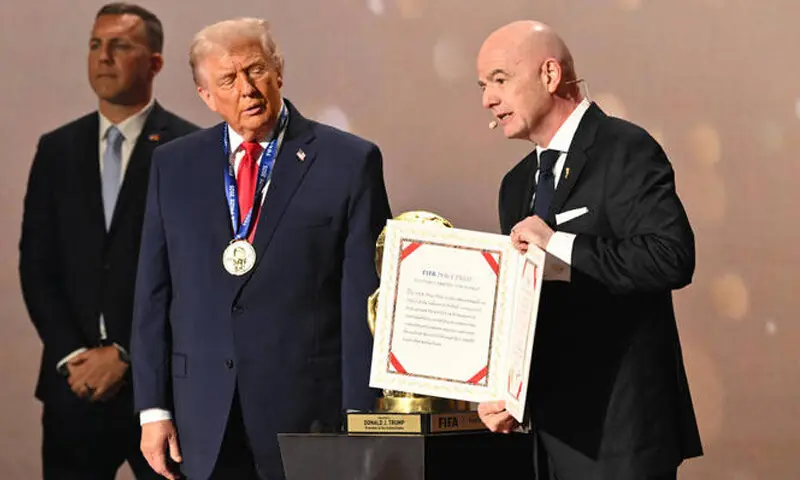
These advancements helped him continue as the president of Fifa unopposed when elections rolled round in 2019 and 2023. But it feels like the second election broke something in him. Condescending words on the eve of the 2023 Women’s World Cup final turned into a farcical desire to be cordial with US President Donald Trump, whom he very infamously awarded the made-up Fifa Peace Prize in 2025.
If you’ve read this space over the past couple of months, you’d know of the controversies surrounding the recently concluded World Cup: commercialisation, the advent of in-game advertising, disregard of sustainability initiatives and allegations of bias. Oh, and the overturning of a US player’s red card ban after Trump called Infantino.
But the World Cup also churned out a scarcely believable revenue of $15 billion, so everything’s well. For all his negativity, at least developing football nations will have more funding, right?
Hardly. They say greed knows no bounds. A week after the final, Infantino announced the formation of Fifa Forward Enterprise (FFE), a subsidiary with organisational rights over all of Fifa’s tournaments. It was valued at $20 billion, and 20 percent of the new entity’s shares would be… available for acquisition by private investors.
The World Cup, in all its grandeur, history and bigger-than-life status, was up for sale.
THE SIGNIFICANCE
Football has always been the game of the common man. Everyone can play it — you just need a ball and some friends. Its teams have always belonged to the masses, be that in domestic leagues or on the international circuit.
Even in recent times, as football clubs and subsequently football players became astronomically rich, the relationship between supporters and football teams has never been much strained, other than based on performance or administration.
The World Cup, however, has always been a different league — an entity which seems to transcend political turmoil, geopolitical instabilities, and even wars. An event where everyone forgets their differences and unites, an event where the world heals.
An event like that is not owned by a group of people, even if they are in charge of governing the game. It is owned by the people who make the event what it is. Therefore, no one has the right to sell it off. But this is a capitalistic world, where everything is someone’s property, and so as it is, the World Cup has Fifa’s name plastered before it.
Selling such an event, or part of the event, would effectively mean severing the connection between the event and the very thing which makes it so special. Football is a physical and social sport. Stripping the social aspect away would make the entire thing soulless.
Modernity has given us many examples of this phenomenon. Take social media as an example. For millennia, humans fulfilled their appetite to socialise by going out and making friends with like-minded or enjoyable people. Partners were also found the same way. Then came technology and made it possible to do all of that without leaving the comfort of one’s bedroom.
Technology provides convenience; that’s why something is invented in the first place. But it also disassociates things with the physical and social attributes that made those experiences enjoyable or meaningful. Another example is cooking food, which has been replaced by food-ordering applications; or a bonfire, where the comfort has been packed into a thermostat linked with central heating systems.
This concept is called “device paradigm” and was introduced by American philosopher Albert Borgmann in 1984. He argues that there are certain “focal practices” which cannot (or should not) be commoditised, such as playing an instrument. Sport, and football in particular, fall in the same domain.
THE REACTION
Remember how Infantino wanted Trump’s affection? When the World Cup was put for sale through the FFE, the frontrunner for the initial investment was a firm called Thrive Eternal, owned by Joshua Kushner, who is the brother of Jared Kushner. If that name sounds familiar, it’s because he’s the son-in-law of Donald Trump.
Infantino made this announcement on July 28 without consulting the six continental confederations, through letters to the 211 national federations, promising them $20 million in extra funding if they supported the proposal.
UEFA was the first to speak against it, threatening to boycott all Fifa tournaments if the idea were not rescinded. The Confederation of North, Central America and Caribbean Association Football (CONCACAF) and the Asian Football Confederation (AFC) followed suit in condemning the FFE.
Soon enough, Fifa’s own officials started speaking against the proposal, including Chief Coordinating Officer Kevin Lamour and Secretary General Mattias Grafstrom, with Infantino’s senior adviser Carlos Cordeiro resigning. Amid the uproar, Infantino dropped the idea of the FFE within four days, stating that the proposal has caused divisions in the objectives set out for it. But the backlash remained — critics said the person behind the unilateral decision must go.
Infantino called an emergency meeting of the Fifa council on August 5, wherein the board expressed backing for Infantino and an apology was circulated to all national federations on behalf of the organisation. But by now, the players’ union FIFPRO and former players had started condemning Infantino. UEFA’s lawyers sent legal notices to Infantino and his staff to preserve documents in case they press for litigation.
The Confederation of African Football (CAF) and the South American confederation, CONMEBOL, unequivocally came out in Infantino’s support, primarily backed by Argentina’s stance. Mexico and Qatar denounced their confederations to support Infantino, while New Zealand went against the Oceania Football Confederation (OFC)’s decision to back FFE. Trump also favoured Infantino, stating that his removal would be a big mistake.
And this is where we stand right now, with roughly 143 out of 211 national federations against Infantino. Elections are due in March 2027, but an emergency election can be called if Infantino resigns or around 45 Fifa members ask for it. The most powerful man in football, who a month ago was cruising to a third straight unopposed re-election, is now suddenly fighting for his job.
But don’t be too quick to jump on UEFA’s boat. Yes, they were the most vocal against this plan, but too much power within their confederation lies with their big clubs. And they’re not particularly famous for putting football fans first. Remember the push to form a European Super League?
The writer is a sports enthusiast
with a background in supply chain
management. X: @tahagoheer
Published in Dawn, EOS, August 23rd, 2026