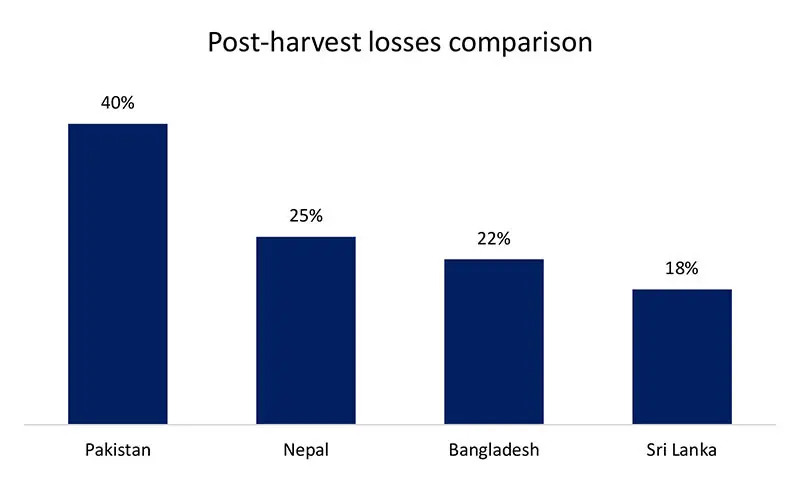

Pakistan has high post-harvest losses of $2 billion annually, according to a recent Asian Development Bank report, “Enhancing Competitiveness, Sustainability, and Resilience in Pakistan’s Agribusiness through climate-responsive strategies”.
Owing to an inadequate post-harvest infrastructure, Pakistan’s food losses are among the highest in South Asia, particularly for perishable crops such as fruits and vegetables. Stories from the field report that, owing to price volatility, it is sometimes not worthwhile for a farmer to transport the crop to market because of transport costs.
Syed Mehmood Nawaz Shah, President of the Sindh Abadgar Board, once likened growing vegetables to gambling. “There is a lot of focus when tomatoes are Rs500 a kg, but nobody talks when they are being sold for Rs5 per kg,” he says on a Dawn podcast, lamenting that at times even the cost of harvest is not covered by the selling price, prompting farmers to let the produce go to waste.
However, addressing these issues will require substantial infrastructure transformation, stricter enforcement of safety standards, and greater adoption of international certifications, the report states. For example, the report identifies that the lack of cold storage facilities alone causes $1.2bn in post-harvest losses.
No one wants to eat a spotty mango. If Pakistan had robust enforcement of international standards, it could export a range of produce and generate an additional $2-3bn. Nor is there awareness about waste reduction and management. In Pakistan, the recycling rate is less than 5pc, compared to 25pc in India. As a result, Pakistan loses out on about $1bn it could have earned from waste management technologies.
Preventing post-harvest losses is low-hanging fruit being wasted due to high upfront costs and low private-sector investment.
Published in Dawn, The Business and Finance Weekly, August 24th, 2026