
Pakistan is once again facing a wheat crisis. Despite official claims of a satisfactory wheat harvest in 2026, flour prices continue to rise, provincial governments have raised concerns about meeting supply needs, and flour millers are urging the federal government to permit wheat imports. The government is now moving towards imports to bridge the anticipated gap between domestic supply and demand.
At first glance, imports appear to be a practical solution. In reality, they expose the deep contradictions of Pakistan’s food policy. The obvious question is: How can a country that produced a reasonable wheat crop find itself discussing imports only months after harvest?
The answer lies not in production but in policy. The crisis is rooted in the FY26 wheat procurement crisis, when the federal government sharply reduced public procurement, arguing that private markets would purchase wheat more efficiently.
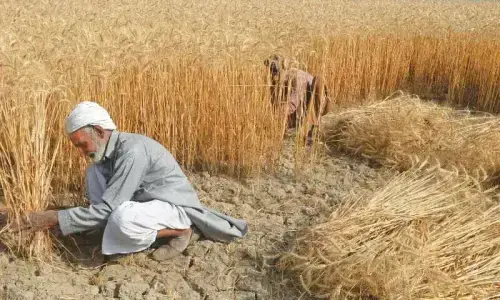
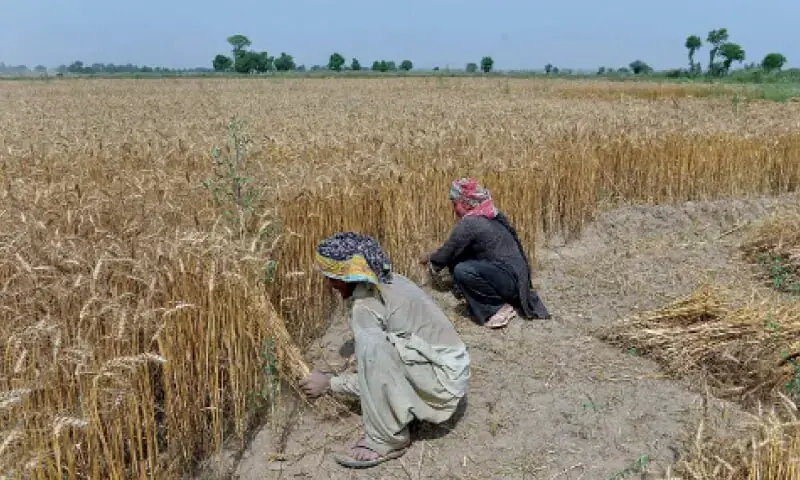
Farmers, already burdened by soaring costs of fertiliser, diesel, electricity, irrigation, pesticides and labour, were forced to sell their wheat soon after harvest, often at prices they considered below production costs. Without effective public procurement or adequate storage facilities, they had little bargaining power.
Pakistan’s wheat crisis is about who controls the country’s food system and whose interests agricultural policy serves
Private traders quickly filled the vacuum. Wheat was purchased cheaply, stored in private warehouses and gradually released as prices increased. Farmers suffered losses while consumers faced higher prices. The government, having withdrawn from the market in the name of liberalisation, now faces pressure to import wheat because private markets have failed to guarantee stable supplies at affordable prices.
The consequences extend far beyond wheat markets. Small farmers are trapped between rising production costs and declining farm-gate prices, while many are forced to sell their harvest immediately to repay debts. Landless peasants and agricultural workers suffer as declining farm incomes reduce employment opportunities and depress rural wages.
This contradiction exposes the failure of the neoliberal assumption that markets can replace public institutions in managing staple foods. When prices collapse, farmers are told to accept the discipline of the market. When prices rise and shortages emerge, the state is compelled to intervene through imports financed by public resources. Profits remain private, while the costs of market failure are socialised.
The procurement crisis is also a major test of Pakistan’s National Wheat Policy, which seeks to reduce the state’s role in wheat procurement, storage and price stabilisation while expanding private-sector participation.
Central to this shift is the declining role of the Pakistan Agricultural Storage and Services Corporation (Passco). For decades, Passco purchased wheat, maintained strategic reserves and helped stabilise markets during shortages. Instead of reforming and strengthening Passco through transparency and accountability, policy is increasingly placing faith in private markets.
The National Seed Policy is reshaping another pillar of Pakistan’s food system. By promoting commercial seed markets, stronger intellectual-property protections and greater participation of private seed companies, it shifts farmers away from farmer-managed seed systems towards dependence on corporate-controlled seeds. Farmers are consequently losing public protection in both agricultural inputs and markets, while agro-chemical corporations dominate.
These reforms cannot be separated from decades of prescriptions advanced by the International Monetary Fund, World Bank and other international financial institutions. Through structural adjustment programmes and lending conditionalities, Pakistan has repeatedly been encouraged to reduce agricultural subsidies, liberalise commodity markets, privatise or weaken public institutions, and minimise government intervention.
Presented as necessary for fiscal discipline and market efficiency, these reforms transfer power from public institutions and farming communities towards private capital and deepen the commercialisation of agriculture.
The demand to remove subsidies also exposes a profound global inequality. Pakistan is repeatedly advised to reduce support for small farmers and expose agriculture to market competition, while the United States and the European Union continue to provide massive support through agricultural subsidies, income assistance, and export incentives. Their farmers compete in state-protected markets, while farmers in the Global South are expected to survive without comparable support. This is not free trade; it is an unequal global system.
The alternative is food sovereignty: democratic control over how food is produced, distributed and consumed. This requires rebuilding public procurement, maintaining strategic grain reserves, regulating hoarding and speculation, protecting farmer-managed seed systems, investing in agroecology, ensuring fair prices for producers and guaranteeing affordable food for consumers. Passco should be strengthened rather than dismantled.
Pakistan’s wheat crisis is therefore not simply about wheat. It is about who controls the country’s food system and whose interests agricultural policy serves. The choice is between continuing neoliberal restructuring, in which food becomes a commodity increasingly controlled by markets and corporations, and reclaiming democratic control through strong public institutions, peasant rights, and food sovereignty. The struggle over wheat is ultimately a struggle for economic justice, national sovereignty and the right of every citizen to affordable, nutritious and culturally appropriate food.
The writer has an MS in Environmental Studies from York University, Canada, and is the secretary of Pakistan Kissan Mazdoor Tehreek
Published in Dawn, The Business and Finance Weekly, August 24th, 2026