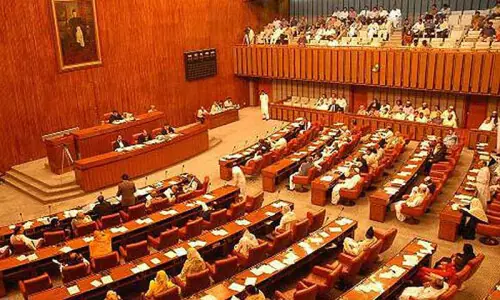
LAHORE: Punjab Assembly Speaker Malik Muhammad Ahmad Khan deferred further proceedings on the Anti-Terrorism (Punjab Amendment) Bill 2026, after opposition lawmaker Rana Aftab Ahmad Khan objected to it on constitutional and procedural grounds, including the provincial legislature’s competence.
The Punjab government has proposed sweeping changes to the anti-terrorism law that could allow terrorism cases to be tried under a highly confidential regime, including keeping the identities of judges, prosecutors, defence lawyers and witnesses secret.
Raising his objections, PTI’s Rana Aftab termed the bill “unconstitutional” and demanded open and fair trials in terrorism cases.
Meanwhile, Law Minister Rana Muhammad Iqbal maintained that the standing committee had discussed the bill threadbare and that the opposition should have raised its objections there.
Draft law would allow govt to try terrorism cases under ‘highly confidential regime’ for security reasons
The bill seeks to insert a new Section 21AAA into the Anti-Terrorism Act, 1997, creating a “special security case” mechanism for cases in which participants are considered to require extraordinary protection.
Under the proposed law, a designated authority — an officer of at least BS-20 whose identity would itself remain confidential — could declare a case or a class of cases a special security case. At the authority’s request, the chief justice of the Lahore High Court would assign the case to an Anti-Terrorism Court judge.
The bill also proposed that the identities of judges, public prosecutors, defence counsel, police officers, witnesses and other persons involved in such proceedings “shall not be disclosed”.
Judicial orders would carry official titles instead of the judges’ names, while witnesses would be identified through codes issued by the designated authority.
The proceedings could be held at secure premises or conducted through video links, including from prisons. The proposed provision would also allow the government to adopt other security measures it considers appropriate.
However, the proposed legislation raised serious constitutional and judicial concerns, particularly over the transfer of powers traditionally exercised by courts to an executive authority.
Mr Aftab’s legal and constitutional note argued that the proposed system went beyond witness protection and could create “anonymous proceedings”.
It pointed out that an accused person would not be able to challenge the constitution of the tribunal, seek the recusal of a judge or effectively question the judge’s independence if the judge’s identity remained concealed.
The proposed sealed record has also been criticised as potentially undermining the right of appeal.
The note further argued that keeping the record sealed with both the chief justice and the designated authority could make appellate scrutiny difficult.
The proposed provision also gave the designated authority a role in selecting prosecutors.
Another contentious provision allows the regime to be applied to a “class of cases”, rather than requiring a case-by-case judicial determination.
The proposal has further been questioned on the grounds that existing law already provides several safeguards for threatened participants in terrorism cases. Both, the Punjab Witness Protection Act 2018, as well as Section 21 of the ATA allow courts to hold proceedings in camera and provide mechanisms for protecting witnesses.
Published in Dawn, August 28th, 2026