• Pezeshkian warns Trump against further turmoil, vows resistance to US-Israeli demands, seeks revived deal to ease sanctions and restore oil sales
• US says no talks underway, steps up efforts to isolate Iran
• Hormuz tensions leave vessels, seafarers stranded
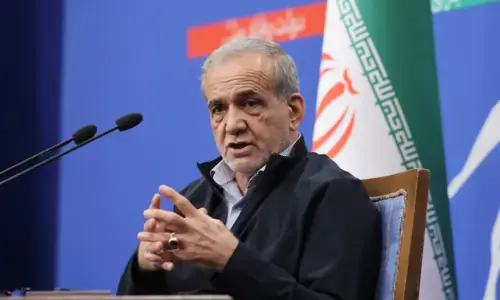
DUBAI: Iranian President Masoud Pezeshkian urged US President Donald Trump to avoid creating further turmoil, advocating for diplomacy and a return to a short-lived agreement even as he admitted that American sanctions are severely damaging the Iranian economy, Anadolu reported on Saturday.
Six months into a war launched by the US and Israel, Iranian leaders have acknowledged the economic toll of the conflict and an ongoing US naval blockade. Yet Tehran signalled no retreat, vowing to withstand pressure, pursue diplomacy and maintain control over the strategic Strait of Hormuz.
“If we proceed through dialogue and on the basis of the memorandum of understanding, we will resolve the problems and secure our rights,” Pezeshkian said at a ceremony in Tehran.
“It is in the interest of the country, the region and the world that Trump does not create turmoil and that Israel does not cause insecurity and aggression.”
Pezeshkian emphasised that Iran does not favour war but would respond firmly to any assaults.
“We do not like war, but we will stand with strength against aggression and defend ourselves,” he said, adding that no power could force a united nation determined to defend its territory to surrender.
Despite just days ago insisting the measures would achieve nothing, Pezeshkian admitted the American financial campaign is hurting the country. In a Friday television interview, he noted that foreign trade has shrunk by a third.
“Some say sanctions have no effect at all; to those people, I really don’t know what to say,” Pezeshkian said. “We are in a war situation, and we must accept these wartime conditions.”
The president told state media that Iranian exports and imports slumped nearly 35 per cent because of US sanctions and the blockade of Iranian ports. To account for the fall in trade, he suggested increasing heavily subsidised petrol prices, a politically sensitive move in the oil-producing nation.
Supreme Leader Ayatollah Mojtaba Khamenei, who has not been seen publicly since he was injured in the initial Feb 28 attack that killed his father, former Supreme Leader Ayatollah Ali Khamenei, called on the government to tackle the economic hardship.
The Iranian government pledged in a state media statement to stand firm against what it called US-Israeli “conspiracies”, saying diplomacy and defence were inseparable tools for protecting the country.
Pezeshkian called for a revival of an interim memorandum of understanding brokered by Qatar and Pakistan in June.
The deal quickly unravelled amid disagreements over the status of the Strait of Hormuz, but Pezeshkian noted Iran was able to sell about 90 million barrels of oil when Washington briefly permitted sales.
“We can solve our problems and gain our privileges with the memorandum of understanding,” he said of the document that had offered Iran immediate relief from US sanctions.
Tehran’s Oil Ministry later said Iran had transferred $7.5 billion in oil revenues from sales during the first four months of the current Iranian year to the central bank.
Iran said the funds would cover foreign currency needs from July through December and that it still had enough oil available to meet budget targets despite sanctions.
However, negotiations remain at an impasse as the Trump administration steps up efforts to punish Iran financially. US Treasury Secretary Scott Bessent laid out plans Monday for the “economic asphyxiation” of Iran, warning of dire consequences for countries that do not join the American campaign.
In a statement, US deputy press secretary Anna Kelly said Washington is not engaged in any discussions with Iran.
“There are no talks or conversations going on, or scheduled, with the Islamic Republic of Iran,” Kelly said, adding that Washington’s economic campaign, termed “Operation Economic Outcast”, is underway “to sever every remaining economic lifeline sustaining the regime.”
While US military commanders say American forces have cleared sea mines from the Strait of Hormuz, Iran’s Revolutionary Guards reiterated that the waterway remains closed to ships without Iranian permission.
The International Maritime Organisation reported that up to 400 ships and 6,000 seafarers remain stranded in the Gulf since the war began.
The UN agency has verified at least 70 attacks on international shipping since the war started on Feb 28, resulting in the deaths of 19 seafarers.
Published in Dawn, August 30th, 2026