Gul Plaza fire commission blames no single entity or person directly

KARACHI: Deploring the failure to transform available resources into effective and coordinated firefighting and rescue efforts, the Gul Plaza Judicial Commission in its report says that the deadly inferno has signified a systemic failure across successive provincial and local governments as the legal and administrative mechanisms have existed, but could not be implemented effectively.
The report of the commission, headed by Justice Agha Faisal of the Sindh High Court, was handed over to the provincial government months ago but authorities preferred not to make it public.
However, the report, which bore no signatures, was silently released on Saturday apparently against the backdrop of the tragic incident at the Pakistan Institute of Medical Sciences (Pims), Islamabad.
In the report, Justice Agha Faisal notes that the tragic incident was a grave indictment of the failure of municipal and provincial systems to translate legal duties concerning urban safety into effective protection on the ground.
In his report, Justice Agha Faisal says ‘sustained underperformance by public systems’ caused the tragedy; highlights failures of municipal and provincial systems
It also states that the people have not only lost their lives to flames, but also due to delay, darkness, locked exits and windows of the ill-fated building, absence of fire safety systems, unimplemented audits/inspections and fragmented authority.
The commission further says that Karachi Metropolitan Corporation, including its fire brigade, Sindh Building Control Authority, Rescue 1122, civil defence department, district administration and others bear institutional responsibilities for failure while material responsibility rested with the people acting as the de facto management of the building together with owners, occupants and commercial operators.
It says holistically, the evidence suggested that the prevailing administrative and emergency response set-up did not appear to be adequately trained, coordinated or equipped to deal with an incident of such magnitude.
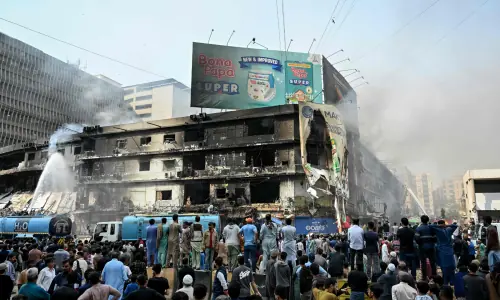
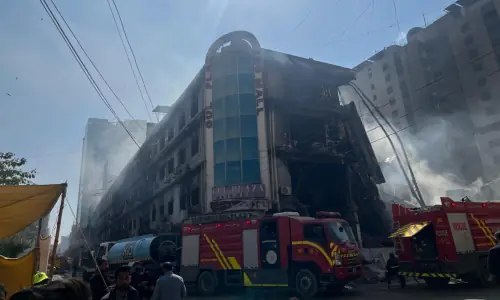
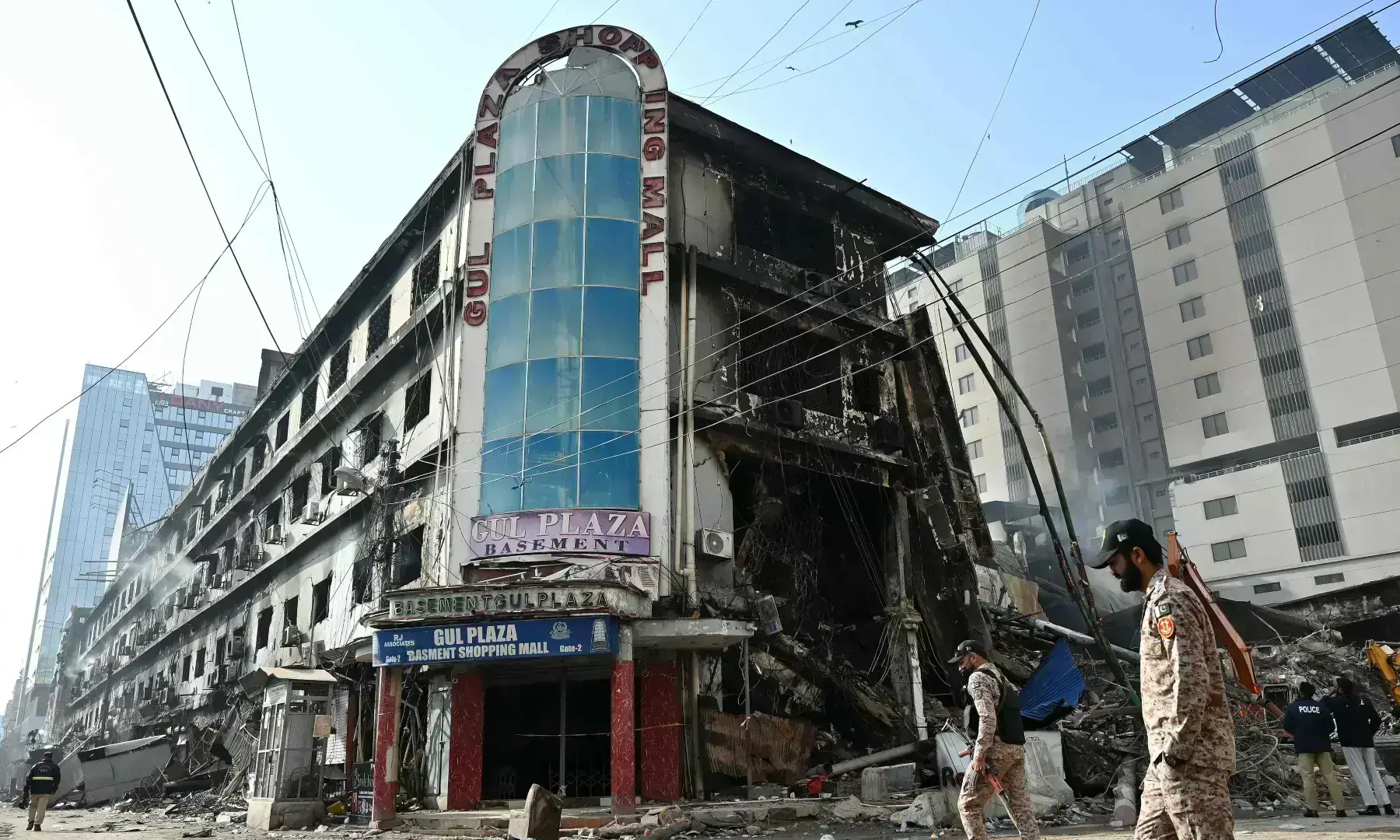
Over 70 people had lost their lives in the devastating fire which had erupted on the night of Jan 17 and took nearly two days to be fully extinguished, leaving the ground-plus-three-storey building of Gul Plaza in ruins, with some of its sections collapsed.
The Sindh government had constituted the judicial commission in February to investigate the deadly fire incident and to fix responsibility of any acts of commission or omission committed prior and subsequent to the incident. After conducting the probe, the commission had handed over the sealed inquiry report along with the entire record to the secretary law department in April.
The 78-page inquiry report of the commission, issued by the home department, says that the systemic conclusion did not exonerate the institutions concerned nor did it single out the current period alone and instead the commission recognises that the tragedy was the human cost of sustained underperformance by public systems meant to protect life.
“When a large commercial building remains unsafe despite known deficiencies, when audits do not result in compliance, when the building-control record is incomplete, when coordination structures remain on paper, and when rescue is attempted without fully exploiting available opportunities, the eventual loss is not merely accidental. It becomes the foreseeable product of systemic failure”, it adds.
The commission’s report also states that the failure was not only limited to one department or building, but it was cumulative, layered and institutional as mechanisms, audit/building-control powers, firefighting obligations, emergency response structures and court-backed coordination framework had existed, but could not be implemented and the system did not function as a system.
It further points out that the condition of the plaza, the opacity and incompleteness of its building-control history, absence of reliable inspection material at the stage of amnesty and regularisation, the persistence of audit non-compliance, the failure of coordinated enforcement and weakness of the emergency-support environment reflected a cumulative failure across successive provincial and local governments.
“The commission does not make this observation to diffuse present responsibility. It makes it because the institutional truth of this case demands it. The risk at Gul Plaza accumulated over time because municipal and provincial structures, across successive periods, did not evolve or function in a manner commensurate with the hazards of dense commercial urban development”, it adds.
The inquiry report says: “At the highest level, the case represents a systemic failure across successive provincial and local governments, in which legal and administrative mechanisms existed but were not effectively implemented.”
The commission holds that the tragedy resulted from a convergence of known and unrectified hazards, inadequate managerial judgement, ineffective enforcement, fragmented institutional coordination, delayed and constrained emergency response and a system that failed to function as an effective whole.
“The disaster was not merely the consequence of a fire. It was the consequence of a building left unsafe, warnings left unimplemented, authority left unexercised, and rescue opportunities left insufficiently exploited until irreversible loss followed”, it adds.
It also says, “Therefore, those who perished in Gul Plaza Inferno were lost not only to flame. They were lost to delay, to darkness, to locked exits, to blocked windows, to absent systems, to unimplemented audits, to fragmented authority, and to a civic order that did not protect them in time. The present case is a grave indictment of the failure of municipal and provincial systems, over time, to translate legal duties concerning urban safety into effective protection on the ground”.
Regarding the question of ignition, the material placed before the commission indicated a consistent and unrebutted position as the SSP (South) in his response confirmed the cause of fire because of children playing with and igniting matchsticks at shop No.193 in the plaza, and such fact has also been confirmed by an inquiry report of the commissioner of Karachi.
Published in Dawn, August 31st, 2026