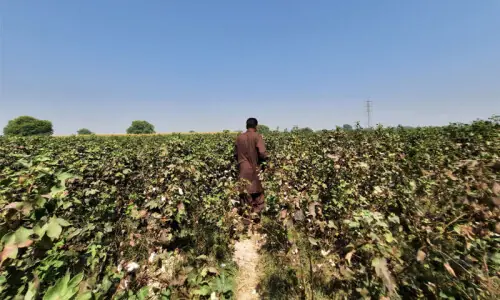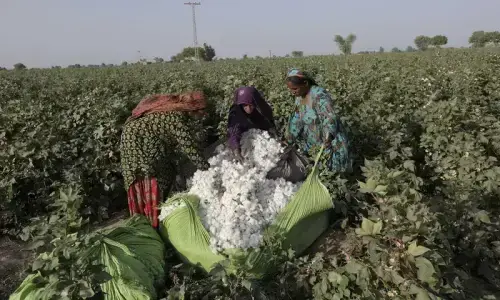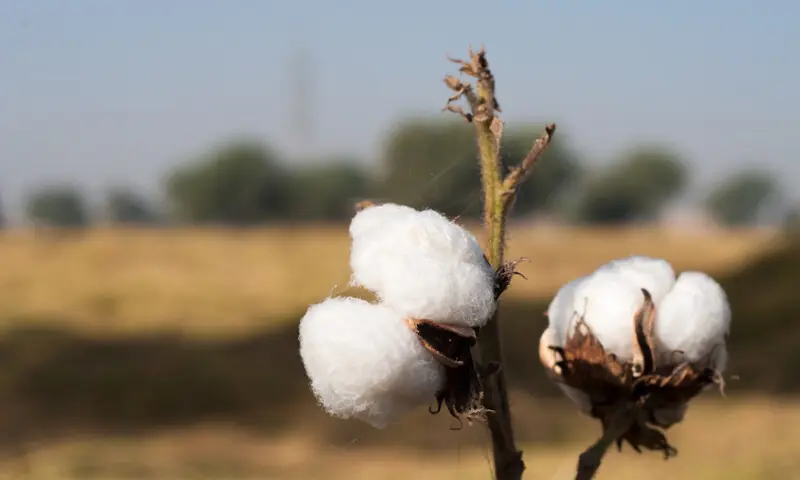

Pakistan’s cotton sector is shrinking, and the numbers explain why. Average national yields have collapsed to about 14-16 maunds an acre, down from the 40-50 maunds farmers once pulled from the same land. The shortfall is pushing growers towards more profitable rice and sugarcane instead.
Stagnant yields, weakening varietal quality and roadblocks to importing fresh germplasm have left little room to reverse the slide. “Wherever a farmer gets a bit more profit, they will naturally cultivate that crop. That is the core reason,” says Shahzad Ali Malik, CEO of Guard Agricultural Research & Services, one of the country’s largest seed companies.
He points to this year’s cropping pattern as evidence: cotton acreage has again fallen below government targets, while rice cultivation has climbed. Sugarcane has already expanded over time, though its heavy water requirement and dependence on proximity to sugar mills cap how far it can spread.
Even by the government’s own numbers, cotton compares badly with these crops. “Officials have now set 25 maunds per acre as the minimum yield for approving new cotton seed varieties, markedly down from historical norms. Even at that reduced bar, cotton cannot compete. Why would farmers grow cotton when sugarcane and rice turn bigger profits?” wonders Mr Malik.
Increasing seed productivity requires new genetic material and certification to protect existing varieties
The consequences extend well beyond the farm gate. Mr Malik says around 150 ginning factories have shut down over the past two to three years as raw cotton supplies have dried up. “If there’s no cotton, what will the ginners do?” he asks rhetorically.
The stakes are difficult to overstate for an economy where textiles account for roughly 55-60 per cent of exports. “Our cotton crop is completely struggling right now,” Mr Malik says. “We import cotton and don’t produce our own; our textile industry is already suffering.”
Independent data bears out the scale of the productivity gap. According to the International Cotton Advisory Committee’s 2025 data book, covering the 2024 harvest, Pakistani farmers produce roughly 1.7 tonnes of seed cotton per hectare, against 6.6 tonnes in China and 5.1 tonnes in Australia. In lint terms, the country’s average yield is about 734kg per hectare, or less than a third of China’s 2,125kg and Australia’s 2,265kg. Closing even part of that gap, without adding a single acre, could substantially lift national output, argues Malik.
His argument is that Pakistan has largely exhausted the yield potential of its existing cotton germplasm and needs new genetic material from abroad. He points to South Xinjiang in China, where — according to Guard Agri’s research — cotton varieties yield between 75 and 100 maunds per acre under summer temperatures comparable to South Punjab’s. “We need to test their adaptability here,” he says, cautioning that soil and climatic differences mean nothing can simply be transplanted without local trials.
“It is essential to introduce varieties yielding over 50 maunds in Pakistan,” he says. “We need a revival here, a revolution in cotton where varieties yielding above 50 maunds start coming in. We are working on that.”
However, Guard Agriculture is struggling to bring in new cotton genetics for nearly two decades thanks to bureaucratic hurdles. The company first imported 15 Bt hybrid varieties for experimental trials in 2010, under the Plant Quarantine Rules of 1967, which then permitted seed imports for research purposes only.
Two of those hybrids showed superior adaptability and were put through National Coordinated Varietal Trials at five sites in Punjab and Sindh. One outyielded standard Pakistani varieties by 30pc; the other by 86pc, producing 31 maunds per acre against 16 maunds for the check variety.
The Punjab Seed Council approved the higher-yielding variety for commercial cultivation. But when the company sought a commercial import permit from the Department of Plant Protection (DPP), the application was rejected on the grounds that the quarantine rules did not cover commercial imports. Despite Punjab government backing, efforts to get the federal rules amended went nowhere until 2018. When new regulations replaced the old quarantine rules in 2019, the company says the procedural requirements became so stringent that even experimental imports were effectively blocked.
The matter resurfaced in 2025, when Mr Malik approached the prime minister directly. The prime minister authorised imports for both experimental and commercial purposes. He then sought to commercially import the already-approved Bt hybrid, only for the DPP to say this could proceed only after a Pest Risk Analysis (PRA) was completed jointly with Ethiopia, the exporting country.
With Ethiopian authorities facing capacity constraints in preparing the dossier, the company brought in foreign scientists to draft the documentation itself and submitted it through Pakistani authorities and Ethiopian diplomats. More than 15 months after commercial import permission was granted, the PRA remains unsigned, and the DPP maintains that import conditions cannot be finalised until it is.
A separate, parallel application to import five hybrid varieties from Greece, China and Ethiopia for experimental trials has also stalled, pending DPP conditions that have yet to be framed. In one instance, the DPP rejected an application because Ethiopia has a plant disease not found in Pakistan. Mr Malik disputes that this should be disqualifying; all imported research seed undergoes biosecurity and biosafety testing regardless of origin, he says, and any material found to carry disease risk is destroyed rather than released. Same safeguards already apply to seed imports for maize, oilseeds, rice and potatoes, and that Guard Agri maintains a DPP-registered post-quarantine facility for exactly this testing.
The DPP eventually referred the question to the law division, which reportedly has advised DPP that the rules already provide a mechanism for managing biosecurity risk and that a permit could be issued. Mr Malik says the permit has still not been issued, though the company understands the DPP has now begun the process.
Mr Malik describes the formal approval pathway for any new variety as excessively long. Imported seed first undergoes biosecurity testing — grown in a contained facility to screen for foreign diseases and other biological risks — before moving to open-field biosafety trials, and finally to National Cotton Varietal Trials against approved check varieties. He puts the full process at around seven years and is pushing for it to be cut to three, without loosening biosecurity standards.
Mr Malik argues cotton should follow a path already proven in two other crops. “There are two successful models to follow: maize and rice,” he says. Multinational companies drove the introduction of hybrid maize seed from the 1980s onward; domestic private companies did the equivalent for hybrid rice. “These are two successful models; follow them for cotton.”
His team frames the yield crisis as two connected failures rather than one. The first is limited access to new germplasm; the second is the declining purity of the seed already in circulation. Even a strong variety underperforms if its seed is mixed, recycled beyond its useful generations, or contaminated with other varieties in the field. Rebuilding yields, on this account, requires both new genetic material through controlled research imports and stricter seed multiplication and certification to protect the varieties Pakistan already has.
The cotton crop, Mr Malik says, cannot out-earn rice or sugarcane at 16, or even 25, maunds an acre. Whether it can at 50 or more depends on how quickly Pakistan’s plant bureaucracy allows new genetics through the door.
The writer is a Dawn staffer
Published in Dawn, The Business and Finance Weekly, August 31st, 2026