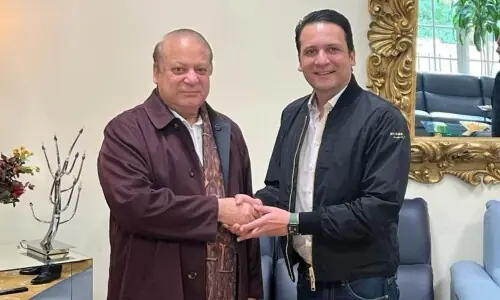

REJECTED by voters in his own constituency, lawyer Iftikhar Gillani has been chosen as the new prime minister of Azad Jammu & Kashmir. A local PML-N leader, he was elected on a reserved seat for technocrats after losing in the recently held regional elections. His nomination caught even his own party by surprise. Gillani, who had also lost the last election, is not the electorate’s choice — so, whose nominee is he?
It is an unprecedented choice even in a place where governments are made and removed from outside. But why should it surprise anyone, given the state of democracy in this area? While voicing other demands, the legitimacy of elections, which were held in the midst of a popular uprising in parts of AJK, has been questioned — even by mainstream parties like the PPP. Gillani was not nominated for the post by the party’s local chapter; he was picked by the PML-N central leadership in Lahore. Yet, he could not have been elected to the top-most position in this highly sensitive and troubled region without the blessing of the powers that be.
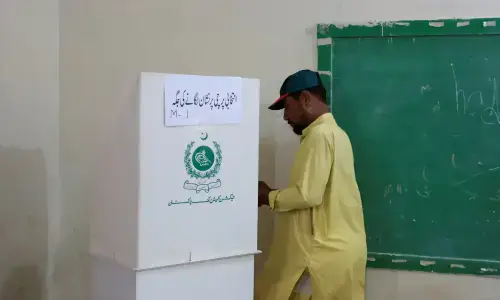
Gillani’s election in defiance of democratic norms reinforces the contention that the reserved seats are tools for manipulating the system and installing a government of the choice of Pakistan-based political parties and the establishment. The PML-N has emerged as the single-largest political party in the controversial elections, helped by the eight seats for Kashmiri refugees in Punjab. Polling could not be held on seven seats in Rawalakot and some other districts because of the continuing protests by the outlawed Joint Awami Action Committee (JAAC), leaving the House incomplete.
It has now been more than three months since the group — comprising mainly youth, traders, and other sections of society — took to the streets with various demands, including the abolition of the refugee seats. The demand was not new; it had been raised regularly by other political parties in the past but was never heeded. Many of those elected on these seats had questionable bona fides yet held ministerial posts. The sham has cast doubt on the entire democratic process in AJK.
Controversial polls and the installation of an indirectly elected PM were bound to fuel anger.
There has been a media blackout on news from the troubled districts, where several people have reportedly been killed in violent clashes with law-enforcement agencies. The government has barred international media from the area after an Al Jazeera report showed violence and low turnout at the elections. Human rights groups have also been prevented from visiting the troubled districts. Protesters have continued to hold their ground. Internet and mobile services have been disconnected for months. These punitive measures and the state’s use of coercive methods have alienated the population.
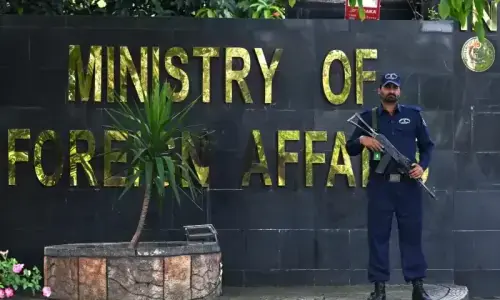
Against this background, the controversial elections and the installation of an indirectly elected prime minister were bound to fuel public anger. The very perception of an unrepresentative government being propped up risks complicating the country’s stated support for Kashmir’s right to self-determination. Kashmiri leaders everywhere have expressed concern over the rights situation.
The protests have also reverberated in Britain, which is home to a large Kashmiri diaspora drawn mainly from the troubled districts. Many Muslim MPs are descendants of migrants from Mirpur, which has also witnessed protests along with other districts. Protest rallies have been reported in recent weeks in front of the Pakistan High Commission in London. The Kashmiri community in Britain is the main voice against the Indian occupation of Jammu and Kashmir. It is also the main source of remittances from Britain to Pakistan. The use of force to silence those demanding basic rights carries the risk of eroding the community’s support.
The controversy surrounding the latest elections, and the installation of a prime minister rejected by his own constituency will only reinforce concerns that local autonomy is being undermined. The irony is that those raising their voice against undemocratic practices are being branded as anti-state, as seen in the recent measure to ban a civic platform like the JAAC.
Under these conditions, it will be difficult for the AJK government, headed by a leader who has yet to prove his credentials, to handle a grave political crisis. Many view the arrangement as an overreach by the centre, which could create complications for the state’s principled position on the Kashmir dispute.
The picture reflects the autocratic mindset of a hybrid dispensation which routinely resorts to kinetic means to crush protests in the country. The state must learn its lesson from the eruption of public discontent and not repeat its mistakes in Azad Kashmir. Local autonomy must be respected so that the Kashmiris can decide their own future, without being subjected to arrangements that have been shaped from the outside.
The use of force is never the solution in any situation; political reconciliation and the restoration of democratic rights, not only in Azad Kashmir but also in Pakistan are the need of the hour. Unlike genuinely representative governments, imposed set-ups do not have the capacity to deal with serious challenges. Kashmiris living under Indian occupation across the Line of Control, have always looked towards Pakistan in their struggle for the right to self-determination. That trust must be preserved.
Meanwhile, instead of banning the JAAC, the state would have been better off trying to resolve the crisis through negotiations. There is no time to lose. Further delay in redressing matters could push the situation to a point of no-return.
The writer is an author and journalist.
zhussain100@yahoo.com
X: @hidhussain
Published in Dawn, September 2nd, 2026