Afghan war victims left ‘without justice’, says UN
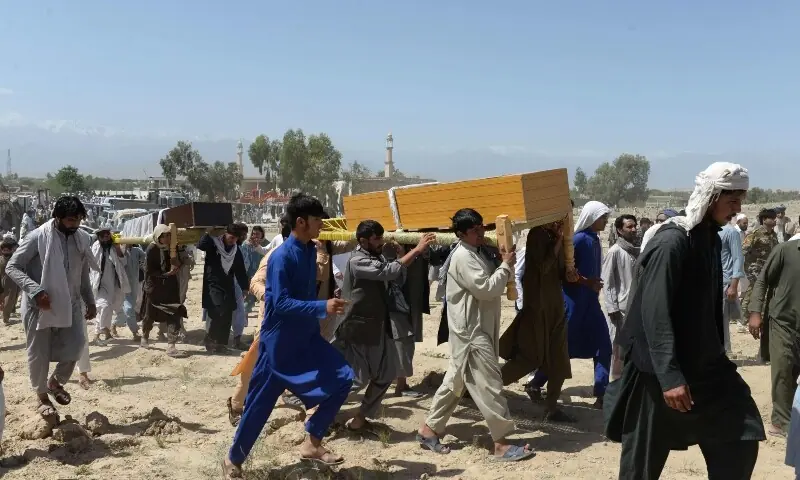

KABUL: Most civilian victims of Afghanistan’s 2001-2021 war have been left “without justice, reparation or even acknowledgement” of their suffering, the United Nations said on Tuesday, with one man in Kabul saying “the world has forgotten us”.
The US launched a military intervention in Afghanistan following the Sept 11, 2001, attacks, ushering in two decades of conflict in which civilians suffered widespread violence and abuses.
More than 40,000 civilians were killed and 77,000 wounded in attacks by Taliban insurgents, the militant Islamic State (IS) group and also during operations by the armed forces of the Afghan Republic or the international coalition led by the United States, the UN mission in Afghanistan (UNAMA) said. The UN mission has documented civilian casualties since 2009 in one of the most exhaustive studies on victims of the 2001-2021 war.
Tapa-e-Shuhada (Martyrs’ Hill) in Kabul bears witness to part of the tragedy. One of its slopes is covered with graves, many belonging to members of the Hazara community, which was repeatedly targeted in attacks by the Taliban insurgents and IS.
One gravestone visited by the reporter of this news agency in late August belongs to bespectacled 21-year-old Suhaila, who died in an attack at Kabul University. Another is in memory of Muhammad Hadi, 17, who lost his life in an October 2020 attack claimed by IS against a school preparing students for university entrance exams.
Mohammad, 25, was wounded in the same school attack. From a modest family, he dreamt of becoming a computer engineer to “change his life”, he said, withholding his surname because “the fear is still there”.
He now works off and on as a tailor. “I have lost my focus,” he said. “I couldn’t continue my studies because of psychological problems.” “The world has forgotten us,” he added.
In their small living room, his mother sighs: “He still has nightmares at night, and I am getting weaker day by day.” From memory loss to depression and suicidal thoughts, 95 percent of the nearly 200 victims interviewed by UNAMA “experienced psychological harm”.
‘No one listened’
In Logar province, south of Kabul, 46-year-old farmer Khan Yousufi recounts how his eight-year-old son was playing in front of the house when an Afghan Republic police tank opened fire, killing him instantly. “My wife rushed toward her child; they shot her too,” gravely wounding her, he added, tears rolling down his cheeks.
He filed complaints with authorities under the former Republic and “tried so hard” to get justice, but “no one listened”. He has had no more success since the Taliban authorities returned to power.
“If the person who did this had been brought to justice, it would prevent someone else from inflicting the same suffering on others… because people would know that there is justice,” Yousufi said. Most of the victims interviewed who attempted to obtain justice “were unsuccessful”, UNAMA said.
Published in Dawn, September 2nd, 2026