
The array of colours and fragrances is what compels most growers to cultivate flowering plants in their gardens. The plants are not only good for the eyes, their flowers also attract pollinators, such as bees, butterflies and even small birds. They help pollinate not only flowers but also surrounding plants and are an important part of the life cycle of plants.
A garden’s ability to stop people in their tracks often comes down to its unusual specimens — an unexpected colour, an oddly shaped leaf, a bloom nobody quite recognises. Be it a white or purple plant, a red cabbage or punched out leaves — anything different would stop one in their stride.
This is what happened the other day, as my colleagues and I were walking through a garden on our way to a meeting. Several of them bumped into each other, so awestruck they were by a plant. To them, it was “some sort of red chilli with dual shades” growing on a small plant. A closer look revealed that it was a flower that none of them had seen before: fuchsia.
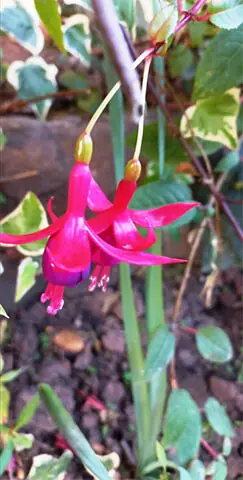
Fuchsia is a popular flowering plant that looks like a chilli in the bud stage and resembles a bell when in bloom, since it hangs upside down on its stalk. The resemblance is especially uncanny in the red fuchsia variety, so much so that it is sometimes referred to as the bell plant. It’s also called the lady’s eardrop, since the dangling flowers resemble them.
Mistaken for a chilli in bud and a bell in bloom, fuchsia’s dual-toned flowers are unlike anything else in the garden, but growing them requires some care…
The flower is scientifically known as fuchsia — a broad term which encompasses more than 100 species, and belongs to the Onagraceae family. The flower is often misspelt as fuschia.
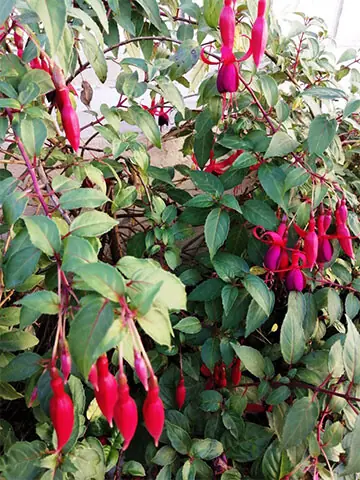
The fuchsia flower, similar to the rest of the plant, is remarkably glossy, giving it an almost artificial, plastic-like look. The vivid colour tone is also distinctive, with contrasting dual shades, such as baby pink, magenta, red, blue, purple, white, violet and orange, running across the flower. The flower has two distinct coloured whorls. The outer whorl is made up of sepals, while the inner whorl has petals with contrasting colours.
Multiple varieties of the fuchsia flowering plants exist. It can be grown as a border for sidewalks, as a hedge, in pots as small plants and within a garden as a small bush. The bush variety of fuchsia can be pruned and shaped as per one’s liking. Its tender variety can also be grown in hanging baskets to decorate the house. The fuchsia plant can be grown through propagation — using cuttings of its stems — or by sowing its seeds.
Fuchsia’s ornamental appeal extends beyond the bloom itself: in many varieties, the branches, stems and leaf mid-ribs take on the same reddish-purple hue as the flower, instead of the usual green — a detail that makes the plant visually distinctive even without its blooms.
Both the flower and the berry it produces afterward are edible, with the berries’ shape and flavour varying slightly by variety; some gardeners grow fuchsia specifically for this fruit, using it in jams or eating it fresh off the plant, though the taste is generally mild and slightly peppery rather than sweet.
Fuchsia is neither a hardy plant and nor is it easy to grow, relative to other flowering plants. On the contrary, this slow-growing plant is a high maintenance plant and quite fussy, requiring regular tweaks to its dedicated care protocols in different stages of its plant life-cycle. In optimal conditions, religiously following the gardening tips and tricks, one can grow the captivating fuchsia plants with their dangling flowers at home as well.
Please send your queries and emails to doctree101@hotmail.com. The writer is a physician and a host for the YouTube channel ‘DocTree Gardening’ promoting organic kitchen gardening
Published in Dawn, EOS, September 6th, 2026