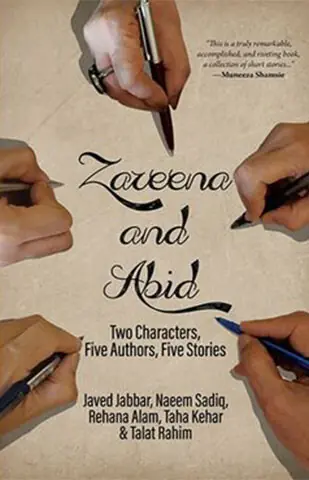
Zareena and Abid: Two Characters, Five Authors, Five Stories
By Javed Jabbar, Naeem Sadiq, Rehana Alam, Taha Kehar and Talat Rahim
Liberty Publishing
ISBN: 978-627-7626-84-6
170pp.
The premise of Zareena and Abid: Two Characters, Five Authors, Five Stories is definitely an interesting one. Five writers were brought together and asked to write a story featuring two characters called Zareena and Abid. There were only two other conditions: each story could not exceed 30 pages and the deadline was June 30, 2025.
In one short story, Zareena and Abid are siblings; in another, servant and master. In yet another, they are cousins and in two they are lovers. Each story, of course, has a new set of supporting characters, relationships, settings and circumstances, lending the collection a variety.
This literary experiment is innovative and holds promise. However, its result is somewhat uneven and does not fully achieve its potential.
Javed Jabbar’s ‘The Dizygotic Duo: A Never-Ever Story’ is an unconventional starting point to the anthology. Zareena and Abid, not yet born, are two babies in their “22nd week of pre-birth life.” Their lively exchanges leap from Mirza Ghalib to William Shakespeare, from education systems and belief to art, patriarchy and misogyny, taking in a kaleidoscope of other topics along the way. At one point, they even dub themselves the “Tyrant Twosome” or “The Twins of Today.” The story also sheds light on the twins’ perception of their parents, their voices and the world they are about to enter.
Five writers, two recurring names and five distinct narrative worlds make for an intriguing storytelling experiment — but the idea is often more compelling than the result
The premise is engaging, yet the narrative would have benefitted from granting the children more distinctive voices. Their dialogue is abundant, but distinguishing between the two characters is challenging at first. This is particularly important given that the story relies entirely on their interaction.
Naeem Sadiq’s ‘Change the Story’ moves into a very different world. Zareena is an 11-year-old girl whose father drops her off at Abid Sheikh’s house to work. She has been promised a comfortable room but, instead, her laughter and play are soon replaced by scrubbing floors, washing dishes and ironing clothes.
The story also focuses on Abid Sheikh’s life. Although he was not a particularly good student, Abid eventually became a prominent government official, through whom Sadiq shines a light on corruption in Pakistan. For example, government employees work in his house instead of their designated offices, and most of his other employees are severely underpaid. Quite obviously, Abid is not a very ethical or decent man.
His son, Ramez, who returns from England as a lawyer, becomes antagonistic towards his father’s way of life. There is an interesting story here, particularly in the contrast between the father’s attitude and the son’s reaction to it. But one wonders how Ramez could have remained so unaware of his father’s behaviour earlier. After all, he had grown up in the same household before leaving for the US to study at 15.
While the five stories demonstrate just how differently the same two names can be used, they also made me wonder if the experiment might have been more interesting had the writers been given a predetermined relationship and a few basic details about the two characters before they began writing,
The story sets out with promise, but soon sprints ahead, shedding its vibrancy and drama. Scenes that cry out for depth are whisked away, leaving the narrative feeling rather mechanical towards its second half.
‘Time and Tide’ by Rehana Alam sweeps us into the chaos of Partition and centres on the lives of two cousins, Zareena and Abid, as they build new lives in Pakistan after migrating from what is now India. The story brings that period of history alive for the reader.

Several moments in this story are memorable, yet the narrative does not sufficiently explore pivotal events. The emotional impact of losing a child during the migration to Pakistan, as well as the psychological trauma experienced by Abid’s father following Partition, which leads him to never speaking to anyone as he once did, could have been examined in greater depth. Other sparsely described moments similarly leave the reader wanting a more immersive experience.
Taha Kehar’s ‘The Understudy’ centres on Zareena, who has been looking after her sister-in-law’s business, her mother and her brother’s daughter while her brother has been away in the UK and estranged from the family. When he returns, he brings his nurse, Abid, with him, and Zareena eventually develops a romantic relationship with him.
As the narrative unfolds, complexities emerge. Zareena’s concealed actions gradually come to light, altering the reader’s perception of her character. Her own deceit introduces additional complications to the relationships within the story. The story interweaves themes of deceit, love and irresponsibility, resulting in a somewhat complex dynamic, especially compared to most other stories.
‘A Match Made in Heaven’ by Talat Rahim shifts the mood to a breezier one. Zareena, working at an ad agency, meets the charming Abid, and sparks fly as a light-hearted romance blossoms. However, the romantic connection between the protagonists seems a tad unsubstantiated. The narrative asserts their attraction without effectively conveying the reasons behind it, resulting in a lack of emotional resonance.
While the five stories demonstrate just how differently the same two names can be used, they also made me wonder if the experiment might have been more interesting had the writers been given a predetermined relationship and a few basic details about the two characters before they began writing, rather than just the two names. That, in my opinion, kills the whole Zareena and Abid phenomenon — as they could have been anyone.
And this is perhaps where the collection’s central problem lies. You don’t really form a relationship with the characters and, by the time the book ends, it is difficult to recall what drove these Zareenas and Abids, what they really wanted or what made them distinctive.
This limitation, of course, has to do with the constraint regarding the number of words that a short story was limited to. However, effective short stories quickly engage the reader and foster investment in their protagonists. Concise, well-selected details often reveal more about a character than extensive exposition. The collection also stumbles due to a lack of careful editing. Awkward sentences and typos crop up throughout, and the book would have benefitted from a sharper editorial eye.
Ultimately, Zareena and Abid is an interesting literary experiment, glimmering with moments of promise and hints of deeper stories. Yet, the collection never quite lingers in the mind — its characters, for the most part, slip away like shadows.
However, the experiment need not end here. Imagine five writers being handed the two fully realised characters and asked to explore their own versions of them. That could spark a truly fascinating form of collaborative storytelling.
The writer is a member of staff. He can be reached at mamun.adil@gmail.com
Published in Dawn, Books & Authors, September 6th, 2026