How Pakistan may line up at Edgbaston after chaotic shake-up
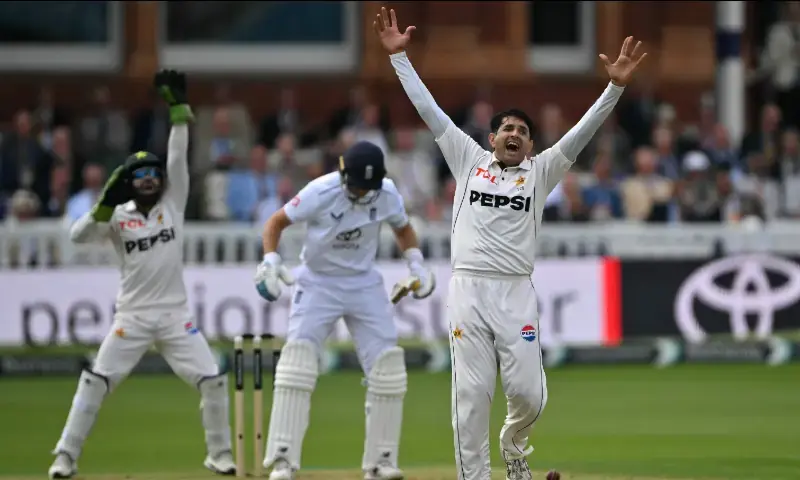

Mike Hesson was characteristically casual when he remarked that Pakistan players are used to a little bit of chaos.
“The guys are probably more used to a little bit of chaos than I am,” the interim head coach told reporters at Edgbaston on Friday. “There is no doubt they have been disappointed, incredibly disappointed. We have had to park that and go ‘righto, where to from here?’”
However misplaced the observation may have appeared, it was the truth. By the time the third and final Test against England begins here on Wednesday, the upheaval of the past week — seven players released, the coaching staff overhauled — will already feel like old news. Attention will shift, as it invariably does in Pakistan cricket, to the eleven who take the field.
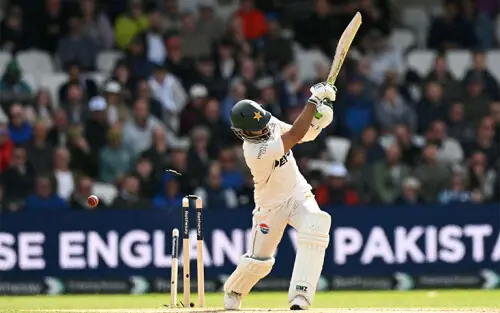
The series is already lost 2-0 after an innings-and-103-run thrashing at Headingley and a 194-run defeat at Lord’s.
Pakistan remain rooted at the bottom of the World Test Championship standings, and a 3-0 sweep would only consolidate their more-than-evident Test woes.
Yet the match still offers an opportunity to restore pride and to test whether a radical mid-tour reset can produce a more competitive side under Hesson’s temporary stewardship.
“I’m coming in at the moment as interim,” Hesson confirmed. “Things have obviously happened very quickly. I was actually just in Japan preparing for the Asian Games. I was back in Lahore and then I was brought over here relatively quickly because changes were going to take place.”
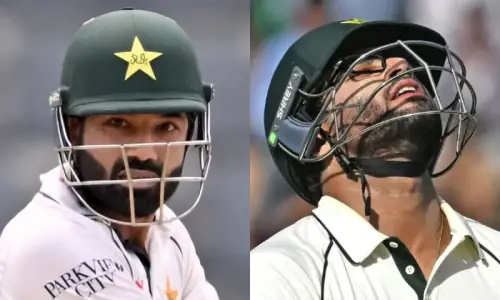
Those changes were severe. Out went Mohammad Rizwan, Imam-ul-Haq, Salman Ali Agha, Ali Usman, Aamir Jamal, Mohammad Awais Zafar and Khurram Shahzad. In came Saim Ayub, Abdullah Fazal, Arafat Minhas, Mohammad Imran Jnr, Saad Baig, Mohammad Imran Randhawa and Razaullah — five of them uncapped at Test level. Head coach Sarfaraz Ahmed and bowling coach Umar Gul both departed; Hesson and Ashley Noffke stepped in.
The question now is what shape this new-look Pakistan takes.
Edgbaston in early September tends to reward seam movement under cooler skies while still offering enough later in the match for a spinner who can contribute lower down the order. Sides that have succeeded here have generally favoured balance over specialisation — enough batting depth to resist collapses, enough seam options to exploit the conditions, and a spinner who plays more of a supporting role.
That is the accommodation Pakistan must now seek.
Hesson has been explicit about it. “Pakistan is known for the pace, unusual actions, mystery spin — we haven’t really been able to present any of that,” he said. “From my perspective, it is about putting a balanced squad together, not only for this Test, so we actually have some variety in our attack.”
A realistic XI that aligns with the available personnel, the conditions and Hesson’s stated priorities would look like this:
- Azan Awais
- Abdullah Shafique
- Saim Ayub
- Babar Azam (captain)
- Saud Shakeel
- Saad Baig (wicket-keeper)
- Mohammad Imran Randhawa
- Arafat Minhas
- Mohammad Ali
- Mohammad Abbas
- Ubaid Shah
This fields five specialist batters, a wicketkeeper, two bowling all-rounders, three specialist pacers and one spin-bowling all-rounder. It mirrors the balanced combinations that have repeatedly proved effective in English conditions and matches the variety Hesson has publicly sought.
The most significant selection call is the return of Saim. The 23-year-old has eight Test caps and was specifically recalled for this dead rubber — however amid his fiery form for Jamaica Kingsmen in the ongoing Caribbean Premier League.
He offers an aggressive option at number three that Pakistan have lacked; his presence allows Abdullah Shafique to settle into a more natural second-wicket role after a difficult series.
Shan Masood, the former captain, may have to make way — a harsh but necessary decision for a side that has failed to cross the 200-run mark in any of their four completed innings across the series.
The wicket-keeping dilemma is equally testing. Ghazi Ghori was a part of the original squad but Saad Baig arrives with an outstanding domestic season behind him — exactly 1000 runs in the 2025-26 Quaid-e-Azam Trophy, making him the competition’s highest run-scorer.
He is widely regarded as the superior batsman of the two, and his glovework is considered comparable. In a side starved of lower-order runs, Saad’s batting edge is persuasive.
The bowling combination hinges on Hesson’s rejection of a non-batting finger-spinner in English conditions.
“The ability to play a finger-spinner in a playing XI in England at this time of year, who doesn’t bat, is unlikely,” he had said reflecting on Usman’s ouster, despite the spinner putting up a five-wicket show in the first Test.
Arafat, a left-arm spin-bowling all-rounder with useful lower-order batting and white-ball international experience, fits that brief far better, potentially leapfrogging Sajid Khan into the line-up.
The choice may bring in balance with a bowling attack that can compete in seamer-friendly conditions while still possessing enough batting depth to avoid the collapses that have plagued Pakistan.
Three specialist pacers — Abbas, Ali and Ubaid Shah — supported by the medium-pace all-round option of first-class veteran Imran Randhawa give Pakistan the seam threat the surface is expected to reward.
Razaullah, the other pace-bowling all-rounder called up mid-tour, provides a bench option if Pakistan want to strengthen the seam department further, though his inclusion would risk lengthening an already fragile tail.
Pakistan’s batting has been frail throughout the series, and the scale of that frailty is measured in the extraordinary figures of England’s Ollie Robinson.
The seamer has taken 16 wickets in the series at an average of 7.18, dismantling Pakistan’s top order twice.
Against that backdrop, Saud Shakeel’s determined 97 at Lord’s stood out as a rare glimpse of positivity. On a surface that offered a degree of balance, where the bounce remained largely predictable, Saud showed the value of patience, sound technique and a clear game plan.
In what is effectively a last chance to salvage something from a dispiriting tour, Pakistan’s other batters would do well to take lessons from Saud’s approach. If they can emulate his composure on what is expected to be another relatively true surface, the top order of Awais, Abdullah Shafique, Saim and Babar may finally find a measure of stability.
“We worry about things we can actually control and we prepare as well as we can,” Hesson said. “There are some fresh faces as well… And that will bring plenty of energy to the group and excitement. And a bit of variety to our bowling attack, which I think is really important for us moving forward.”
For Pakistan fans, the hope is that the chaos becomes merely the backdrop. The seven who departed will soon be yesterday’s story.
On Wednesday the focus will return, as it always does, to the eleven who walk out — and whether the balance of one batting all-rounder, one spin-bowling all-rounder, three specialist pacers and a reinforced batting group can at least ensure the final Test is not another one-sided affair.