Tehran puts onus on Washington for easing tensions

• Araghchi says US return to Islamabad commitments could restore ‘normal conditions’
• Insists ‘significant progress’ made in talks with Oman over Hormuz
• Iranian security official warns of maritime exclusion zone if US ‘economic warfare’ continues
• Pezeshkian vows continued resistance ‘until aggressors brought to complete regret’
TEHRAN: Iranian Foreign Minister Abbas Araghchi said on Monday that a US return to its commitments under the Islamabad memorandum of understanding could help ease regional tensions, as Tehran and Washington continued to trade warnings amid renewed military confrontation.
He made the remarks during a phone call with Japanese Foreign Minister Toshimitsu Motegi, said Iran’s foreign ministry, according to a TRT World report.
Araghchi blamed the current tensions on what he described as Washington’s failure to honour its commitments under the memorandum, stressing that US compliance could pave the way for a return to “normal conditions”.
The two ministers also discussed bilateral relations and the latest regional and international developments.
Araghchi briefed his Japanese counterpart on negotiations between Iran and Oman over the Strait of Hormuz, saying the two countries had made “significant progress” towards establishing a temporary transit route through the strategic waterway. He said consultations would continue on mechanisms for managing the route in the future.
Motegi expressed “deep concern” over the resumption of attacks between the United States and Iran and called for early de-escalation and a return to negotiations. He urged Tehran to exercise “maximum flexibility” and restraint, particularly over attacks on civilian vessels.
Japan also called for the restoration of free and safe navigation through the Strait of Hormuz without additional costs.
The Islamabad memorandum was signed in June following mediation by Pakistan and Qatar, establishing a framework for ending hostilities and negotiations between Tehran and Washington.
Gulf tensions remain high
Despite the diplomatic exchanges, tensions remained high as a senior Iranian security official warned that continued US “economic warfare” could lead to the establishment of a maritime exclusion zone across the Gulf.
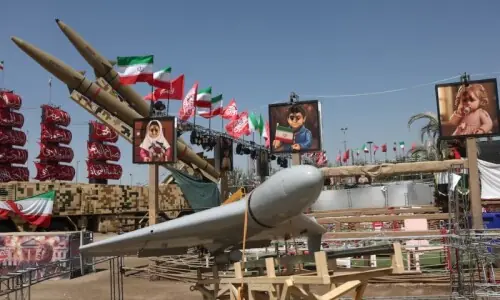
Mohsen Rezaei, secretary of Iran’s Supreme National Security Council, said Washington had received a “clear warning” in recent days from Iran’s new missiles.
“Economic warfare will be met by a maritime exclusion zone across the Persian Gulf to the blockade perimeter,” Rezaei said in a post on X, according to Anadolu news agency. He said Tehran had “fundamentally recalibrated” its operational posture towards US warships and bases.
His warning came as US President Donald Trump said Iran had been “punished greatly” by Washington and reiterated that Tehran would not be allowed to acquire a nuclear weapon.
“We’re right now fighting because we have a certain nation that wanted a nuclear weapon; they were very close to getting it, and now they have no chance at getting it,” Trump said at an event in Washington. “Iran will not have a nuclear weapon … and they’ve been punished greatly. As you know, we’ve really taken it to them,” he added.
Trump also reiterated that the US naval blockade of Iran was “so powerful and so effective”.
Pezeshkian vows resistance
Meanwhile, Iranian President Masoud Pezeshkian said Tehran would continue resisting until the aggressors were “brought to complete regret”.
In a post on X, Pezeshkian said Iran had “always opposed war” and believed that protecting the interests of its people and regional security required avoiding further escalation.
Separately, Iran’s state broadcaster IRIB reported that the Iranian Navy had captured an unmanned US Navy submersible at the entrance to Hormuz.
Iranian media reported that a US missile struck a tanker off the coast of Kharg Island. “A small Iranian tanker was targeted by a missile attack by the American terrorist army four miles from Kharg Island. The tanker was hit by a projectile from American forces in Kharg Island anchorage,” Tasnim said.
Published in Dawn, September 9th, 2026