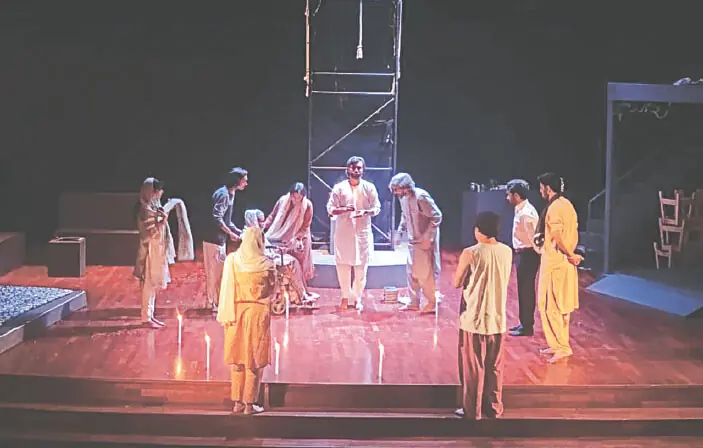
KARACHI: A play based on true events titled Bargad written by Yogeshwar Karera and directed by Ali Junejo began its four-day run at the National Academy of Performing Arts (Napa) on Saturday evening. The participating actors are members of the academy’s graduating class of 2026.
The posters for the play that were being used for its promotion prior to its premiere carried a trigger warning: themes of death, grief and emotional distress — viewer discretion advised. Yes, the story has an overarching serious theme and some very intense moments. But if you’re a regular theatre-goer, you would know that these are the subjects — death and grief, for example — that have been touched upon before. The director’s effort in creating an atmosphere that signals an indescribable tragic end from the first sequence of the drama bears fruit… in patches.
Bargad tells the tale of a family who is led by a man that is no more in the world for more than a decade. His incapacitated wife, three middle-aged sons Vikas (Yogeshwar), Sanjeev (Hajan Khan) and Manoj (Junaid Sidhu) and their children live in the house at the heart of which lies a bargad (banyan) tree. The tree was grown by that physically non-existent head of the family, contrary to his wife’s wish who wanted a tulsi tree.
When the play begins, a bit of a celebratory mood is in the air because a daughter of one of the brothers, Reema (Raana Kazmi) will soon get married to Vinay (Zain Chohan). Soon, the celebratory spirit dissipates and seriousness takes over.
There’s a diary in which the brothers’ father had left instructions for the family. Vikas is the one who is now leading the way and reads from it. It turns out that all of them are waiting for their old man’s return — the old man whose ashes are still intact. The situation reaches a point where Vikas reveals that in order for his father to return and set things right for the family, he needs to leave his body for the old man’s spirit to come back. Things move towards an unnerving end when Reema starts to question the whole exercise. She is opposed by Vikas and the rest of the family. Does she succeed?
Save for some tiny initial exchanges of lines between the younger members of the family, Bargad keeps a sombre tone and tenor for as long as the play runs. It is hard to tell whether it’s praiseworthy or not. There are some intense moments in the last 20 minutes or so, but they’re the kind of moments that don’t necessarily require viewer discretion.
Published in Dawn, September 14th, 2026