Trump claims 'sick conspiracy' against AI companies amid calls for slowed development
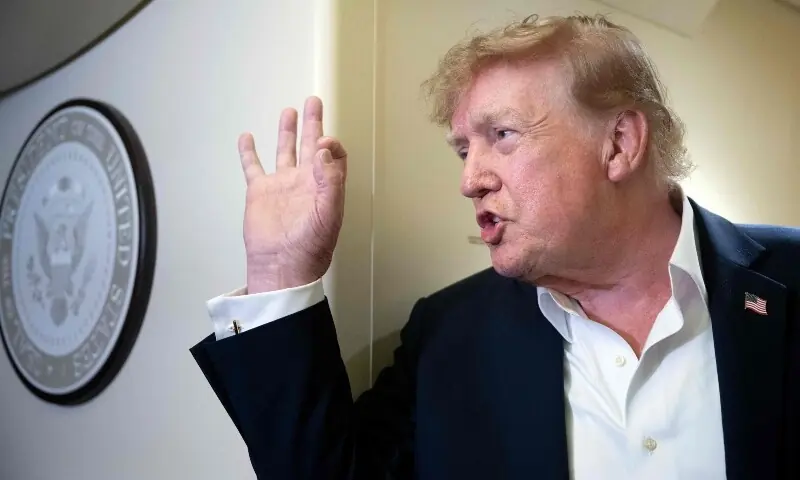

US President Donald Trump on Monday claimed that there was a “sick conspiracy” against the leaders of artificial intelligence (AI) companies, amid calls from industry leaders and international organisations to slow AI development due to “unprecedented risks”.
The development came after Anthropic CEO Dario Amodei on Saturday called on artificial intelligence (AI) firms to slow down the development of the powerful technology, amid mounting worries over the risks of “superintelligent” computer systems; a view that OpenAI boss Sam Altman and xAI chief Elon Musk both agreed with.
In a post on Truth Social, he wrote, “The only control or ‘guardrails’ that AI needs is a strong and smart (high IQ!) president, and the USA has that, in spades!”

Trump added that his administration has stopped AI industry figures “from doing bad, or potentially bad ‘things’“, and that it will continue to do so.
“We already have tremendous criminal and regulatory power over these companies!” the US president added. “There is a sick conspiracy going on against AI and data centres, and the only one that is happy about it is China.”
Noting that “whoever wins AI, wins”, Trump reiterated his claim that the US is leading the globe in AI development and will continue to do so.
“Conspiracy theorists, treasonists, traitors, and leakers, beware!” the post concluded.
China’s spy chief warns of national security risks from AI
The head of China’s spy agency warned today that AI endangers the country’s national security, with foreign powers potentially using the technology to threaten social order.
“Hostile forces” were abusing generative AI technologies to “fabricate political rumours and spread harmful information”, Minister of State Security Chen Yixin wrote in an article published online on Sunday.
“They launch public opinion wars and cognitive warfare against China, directly threatening our political security, institutional security and ideological security,” he added.
The warning came ahead of Chinese President Xi Jinping’s visit to Washington this month, where he is expected to meet Trump and discuss AI governance and safety, as calls mount for greater oversight of the technology.
Chen warned that AI was now “the main battleground for global technological competition and a new track for major power strategic rivalry”.
He did not mention existential risks or putting the brakes on technological advances, but singled out Anthropic’s Claude Mythos and OpenAI’s ChatGPT-5.5-Cyber for their advanced hacking capabilities that potentially “pose serious risks to China’s critical information infrastructure”.
“Foreign intelligence agencies are deeply using technologies such as intelligent web crawlers, intelligent data mining, and intelligent profiling analysis to extensively collect and acquire sensitive information such as key national data, trade secrets, and citizens’ personal privacy,” Chen said.
The US-Iran war has also demonstrated AI’s key role in the military, with better technology offering battlefield advantages, he said.
China must “ensure independent control of key core technologies” — including the advanced computer chips vital to training AI models — to secure its technology sovereignty, Chen wrote.
UN calls for ‘urgent action’ to rein in AI development
The United Nations rights chief called for countries and “frontier” AI companies to act urgently to rein in a technology he warned posed “unprecedented risks”.
In a letter sent to countries and AI developers and shared with the media, Volker Turk cautioned that the world was “on the cusp of irreversible change, affecting not just us but generations of humanity to come”.
“The current race towards ever more powerful AI is a step change towards greater existential risks to every aspect of our lives,” he wrote in the letter, sent at a time when worries over the risks of “superintelligent” computer systems have been on full display.
Superintelligence is the theoretical point when AI’s capabilities exceed human intelligence.
“In today’s world, we are almost entirely reliant on a small number of powerful companies to make the right choices on Al development for all of humanity,” Turk lamented.
“I call on States and companies to mobilise urgently through multilateral fora to chart a path for action to govern advanced, frontier AI models, grounded in international human rights law.”