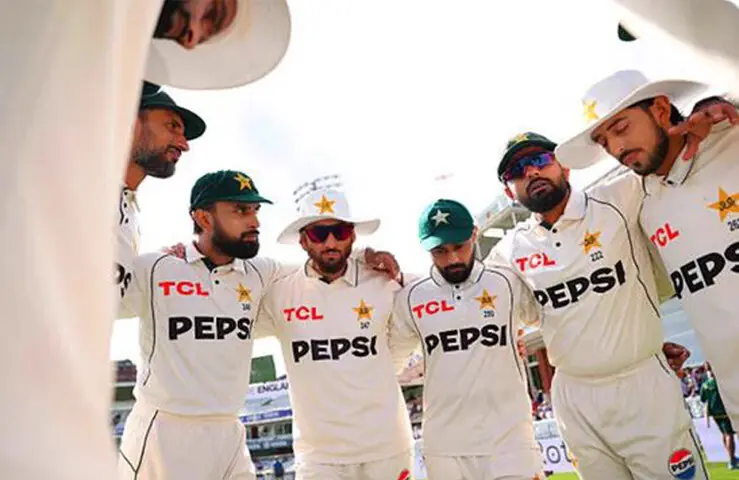
Pakistan Test captain Babar Azam flew back to Lahore from London with seven teammates missing from the squad he flew out with and only one World Test Championship (WTC) point after a five-Test tour of the West Indies and England. Pakistan had earned 12 WTC points from their lone Test win in the Windies, only to lose 11 of them during the England 3-0 whitewash.
The England tour has been compared with the 2010 spot-fixing scandal, even without any such case this time. It has been an absolute humiliation not just for the team but also for the fans sitting in front of their television screens. The English media called it the worst Pakistan team to tour England in 50 years, and many Pakistanis who initially criticised the British media for making such statements eventually agreed with them by the end of the tour.
Pakistan Cricket Board’s (PCB’s) Director of High Performance and selector Aaqib Javed, who expected at least one victory from the five Tests on the tours of England and the West Indies, also had to justify changes to the squad and coaching staff after Pakistan called two coaches and seven players back home and sent replacements during the tour.
We cannot even call this Pakistan team’s journey a rollercoaster ride, because a rollercoaster at least has some upward spikes, unlike Pakistan’s current record, with the team sitting at the bottom of the World Test Championship points table.
During the just-concluded tour, the English media labelled the Pakistan cricket team as the worst to tour England in 50 years. By the end of the series, most agreed. But the team’s failures on the field were only the tip of the issues…
Every player on this tour has been a separate story. It starts with Salman Ali Agha, who led Pakistan in the first Test at Headingley in the absence of Babar Azam. He was not part of Pakistan’s playing XI for the next Test at Lord’s, and it shocked the world when he was dropped from the squad after the second Test, when Pakistan made wholesale changes following the series defeat. At one point, when the Pakistan team already had a scheduled meeting with the King of the United Kingdom, they did not even know which group of players would be on Pakistan’s bus when it arrived at the Palace.
However, even if we agree that changes to the squad during the tour were inevitable, it was still difficult to digest the decision to drop the captain of the first Test. Salman Ali Agha has been among Pakistan’s top three Test run-scorers since his debut, and we have seen him rescue Pakistan’s batting line-up several times during collapses and difficult situations in Test cricket.
Agha was not the only major player to be dropped. Imam-ul-Haq and Mohammad Rizwan were even more severely penalised, and sent back to Pakistan on the first available flight after the defeat at Lord’s, where Pakistan had a great record previously. However, they could not protect their 5-4 lead against England, which has now become 5-5 in their head-to-head Test record. Allegations of a fake injury involving Imam and disciplinary violations involving Rizwan are still being investigated by the National Cyber Crimes Investigation Agency in Pakistan.
This was not a series defeat that we were completely unprepared for, but Pakistan’s failure to even put up a fight appeared to exhaust the PCB’s patience. It led them to drop even Ali Usman and Awais Zafar, who were on their maiden Test call-ups. Ali Usman had become the first spinner in 32 years with a five-wicket haul at Headingley, while Awais Zafar had only just made his Test debut in the West Indies. Yet both were dropped following Pakistan’s poor performances in the England series.
Usman, with the experience of 57 first-class matches, was replaced by Arafat Minhas, who had played just 17 first-class matches, taking only 22 wickets at an average of 32. That decision was probably influenced by his batting ability, as Pakistan also had a new head coach, Mike Hesson, along with seven new players in the squad.
Historically, Hesson has been inclined towards all-rounders, both while coaching Pakistan in white-ball cricket and Islamabad United in the PSL. That may also explain why Pakistan called up Saim Ayub, who had been playing in the Caribbean Premier League and had even scored a T20 century before receiving this Test call-up.
However, former England captain Nasser Hussain called the decision disrespectful to Test cricket, questioning the logic of calling up a player who had been playing T20s in the heat of the Caribbean and suddenly bringing him to England’s 10-degree conditions to face the Dukes ball at the top of the Test order.
After all the chaos and among all the changes, Razaullah remains perhaps the only major positive from this series. He touched 90mph with the ball, allowing Pakistan fans to finally breathe a little easier, after the team had struggled for a long time with the declining pace of its fast bowlers.
But Razaullah added another dimension with his batting when he lit up Edgbaston with a fiery knock that included nine sixes, eight of them coming against fast bowlers. With only eight first-class matches behind him, Razaullah made his mark on the international stage after a sudden Test call-up.
What made his performance even more impressive was that Pakistan had been using the cold weather and lack of acclimatisation as explanations for their struggles in the first two Tests. Yet, this young player impressed the world just four days after arriving in the UK. He is not accustomed to playing a lot of long-form cricket, so it will be extremely important to see how the PCB manages him and his workload if they want to develop him into a long-term prospect.
If we ignore all the changes to the playing squad, the sacking of the head coach and bowling coach during the tour still stands out. We may have to go back years to find another incident involving changes of this magnitude in the middle of a tour. Sarfaraz Ahmed and Umar Gul, who were appointed head coach and bowling coach respectively just before the Bangladesh tour a few months ago, are no longer part of Pakistan’s dressing room.
Following the 3-0 whitewash, rumours about Babar Azam’s removal as Test captain are even more concerning. Pakistan moved from Babar to Shan Masood as Test captain three years ago, and then brought Babar back before this tour. Yet Pakistan’s bowling is still conceding long partnerships to tailenders, the batting line-up is still collapsing, and the results are still not going in Pakistan’s favour. So how would another captaincy change fix these fundamental issues?
If we cannot tolerate the failures of players like Salman Ali Agha and Mohammad Rizwan, who have carried Pakistan’s batting for years, then how can Pakistan build a Test team that combines experienced players with young talent and performs consistently?
Babar Azam and Shan Masood are the only two players in the current set-up to have played more than 50 Tests for Pakistan. Especially when Pakistan does not have ready-made replacements waiting on the bench, the only realistic way forward is to persist with a core group of players and benefit from the experience in which Pakistan has already invested for years.
The same principle should apply to the coaching staff. If a coach is not even given a complete WTC cycle, how can he be held fully accountable for the team’s results after just three series?
The writer is a cricket correspondent and digital
content creator. X: @abubakartarar
Published in Dawn, EOS, September 20th, 2026