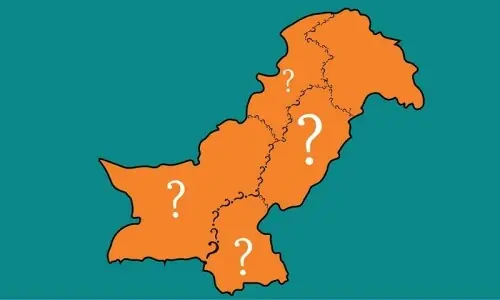

TRUE to tradition, a ‘plan’ to ‘reset’ the country’s entire structure has come down like an epiphany from apparently ‘non-political’ quarters. The plan envisages creating multiple provinces and changing the country’s very tapestry — its geography, topography, demography, ethnic relations, resource distribution, power sharing, and broader political calculus. The situation raises critical questions.
Why new provinces? The interior minister, who announced the plan, hasn’t held forth on the reasoning or offered an acceptable justification for adopting such an extreme and hazardous course. However, he has mentioned bad governance, population implosion, and systemic failures as some of the causes. Nor are there any official authoritative studies proposing a close nexus between good governance and smaller administrative structures. In fact, the global landscape reveals a mixed pattern. Some countries have fewer or territorially larger constituent units, and yet they are stable, functional, even enviable. Others have multiple small units/ provinces, but are perennially afflicted with broken, inept and even failed political systems.
The factors that generally determine the performance and vitality of a state are the legitimacy and efficacy of its political system, the character and ability of its leadership, and the maturity and capacity of its institutions — not only to deliver better governance, but also to meet the continuing challenges thrown up by ever-changing societal and state imperatives. In revitalising the ‘failed’ political systems, we don’t know if the so-called plan contemplates these factors.
Who is demanding them? Interestingly, most of these ideas have originated outside regular political processes, whether as One Unit, Basic Democracy, ‘Islamisation’, enlightened moderation, or hybrid governance. People have always been on the receiving end of new-fangled ideas and their pernicious consequences. The call for a structural ‘reset’, too, appears to have similar origins. So far, none of the governments — federal, provincial or even local — or the mainstream political leaderships have called for restructuring the provinces. However, there is near-consensus across the political spectrum on creating provinces in south Punjab, and KP’s Hazara belt. In fact, the Punjab and KP assemblies passed resolutions for these provinces, but they went nowhere.
Instead of new units, the country needs softer options to heal societal wounds.
Reorganising the state structures would be an extremely risky exercise. India’s Congress party had included the ‘linguistic’ provinces in its manifesto as early as 1917. Yet, after Partition, both prime minister Jawaharlal Nehru and home minister Vallabhbhai Patel were reluctant to reorganise the states, fearing balkanisation of the fledgling country. It was many months of intense political agitations across the country, expert studies, judicial commissions, and a much-mourned fast unto death by Telugu nationalist Potti Sriramulu that finally brought the government around. Still, the Reorganisation Act of 1955 was not passed to improve governance but to group various linguistic communities in their own separate states. In other words, distinctive ethno-cultural identities were recognised and restored, rather than brutally denied and suppressed as would have been the case if the states had been broken up in a manner that dispersed the historically located ethno-cultural communities — something that is being contemplated here.
Is referendum feasible? Perhaps encouraged by the smooth passage of the controversial 26th and 27th constitutional amendments, and not expecting a large section of the political establishment to oppose the proposed move, some elements here had appeared confident of securing the required numbers to ensure restructuring. However, the JUI-F, ANP, PTI, and even the ruling party’s major coalition partner have dug in their heels. In fact, even the prime minister and his party seem reluctant to support the restructuring, though some government ministers are backing it, albeit without the cabinet’s approval. Likewise, the Sindh Assembly has also rejected the break-up of the province.
As a result, other means are being sought — preferably, a referendum to execute the plan. But a referendum would not validate the wholesale reorganisation of the state. It lacks legitimacy and credibility. It cannot be used to circumvent or be a substitute for the mandatory constitutional amendment. People will not accept it because every military dictator has used it to legitimise their rule. Instead, a referendum will be seen as farcical and incite public anger, triggering a maelstrom of pushback.
Will the ‘plan’ succeed? Any idea, policy, or law that is imposed on the people has miserably failed to achieve its objectives; in fact, it has often led to disasters. Steamrolling the restructuring of provinces — against the will of the people — will further aggravate identity-driven politics across a fragile multiethnic landscape. It may even ignite the tinderbox the country has become, particularly for poor and disgruntled youth who have endured the harrowing realities of failed systems. The numbers are dreadful. Half the population lives in poverty, around 28 million children are out of school, four out of 10 children suffer from stunted growth, three-fourths of the populace is consuming contaminated water, and the increasingly murky security environment scares away local and foreign investors.
In these dire circumstances, the country desperately needs softer options to heal societal wounds — options that recompense the people through justice, equity, peace, opportunity, and development, which are democracy’s tested tools. The yawning fault lines — ethnic, social, political, inter-provincial and centre-province — must be mended, and federal democracy, which remains buried under the hybrid regime, restored.
The system does need a ‘reset’. But the reset should mean building efficient and accountable institutions, strengthening rules-based governance, and allowing legitimate and representative leadership to run political and public offices. That requires a continuous process of fair, free elections held on time, so that dead wood can be replaced with a fresher, cleaner leadership at the federal, provincial, and local levels.
Finally, a ‘reset’ would be fatal if it ignored the emotional, even spiritual, bonding of the various ethno-cultural communities with their respective provinces. This bonding goes beyond ideology or politics. It is the product of the centuries-long interplay between these communities and their distinctive land, history, culture, language, literature and art. This bonding leads many in Sindh to conceive their province as an indivisible historical entity — a firmer federalised version of Scotland or Quebec.
The writer is a lawyer.
Published in Dawn, September 17th, 2026