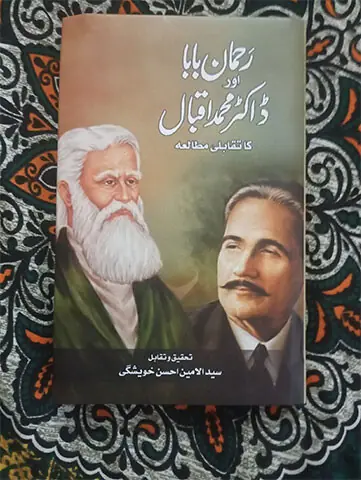
Rahman Baba Aur Dr Muhammad Iqbal
By Syedul Amin Ahsan Kheshgi
Pashto Adabi Tolana Kheshgi, Nowshera
ISBN: 978-627-7788-14-8
368pp.
The literary, intellectual and cultural landscape of Khyber Pakhtunkhwa has always been deeply rooted in a profound spiritual consciousness and an enduring tradition of poetic expression. When examining this region’s extensive intellectual heritage and that of the wider Subcontinent, two towering figures consistently emerge as structural anchors of Eastern thought: the celebrated 17th-century Pashto Sufi poet Rahman Baba and the 20th-century philosopher-poet of the East, Allama Muhammad Iqbal.
While these two great thinkers are separated by centuries, vastly different geopolitical environments and distinct literary languages, their creative expressions undeniably spring from exactly the same spiritual reservoir. Both of them look at the chaotic human condition and prescribe a remedy rooted in Divine love, moral elevation and inner transformation.
To fully appreciate the impressive, multi-layered academic depth and structural integrity of Rahman Baba Aur Dr Muhammad Iqbal, one must first understand the unique intellectual trajectory and scholastic stature of the researcher behind it. The author, Syedul Amin Ahsan Kheshgi, is a scholar of remarkable linguistic facility, possessing an enviable, comprehensive command over Pashto, Urdu, Arabic, Persian and English. This multilingual competence serves as an essential toolkit that lets the reader engage with primary texts in their original syntax, bypassing the diluted interpretations of secondary translations.
In this expansive volume, the study consciously avoids standard academic traps that often weaken comparative literature. Rather than dwelling extensively on well-documented biographical details, tired historical anecdotes or the familiar public personalities of the two poets, the focus is squarely on their core ideas, philosophical outlooks and essential poetic visions.
What connects a 17th-century Pashto Sufi poet with a 20th-century Urdu philosopher-poet? A new, immensely researched book in Urdu by a scholar traces the common spiritual and intellectual currents that can be found in the works of Allama Iqbal and Rehman Baba
This deliberate methodological choice elevates the book from a simple and descriptive account to a rigorous work of pure literary criticism. It enables the discerning reader to look past the immediate historical contexts of 17th-century Pashtun tribal society or 20th-century British India, and see the exact points of conceptual convergence between the two thinkers.
The need for such a comparative framework becomes clear when we consider the vastly different worlds these two men inhabited. Each hailed from a distinct cultural, civilisational and historical milieu.
Reflecting on the bleak, war-torn realities of his 17th-century world, Rahman Baba famously observed life with characteristic dervish melancholy. The renowned research scholar Prof Dr Mohammad Humayun Huma is rightly quoted on the book’s back-flap to underscore the historical gravity of the region’s poetic lineage: “The home, the grave and Peshawar — all three have become one.”
Conversely, Allama Iqbal, writing in the thick of 20th-century modernisation, felt the friction of a completely different crisis, characterising the cold, hyper-rational spirit of his modern epoch as the “reign of machines.”
Yet, despite these contrasting backdrops — one an era of physical dislocation, the other an age of mechanised spiritual estrangement — their works beat with a shared, profound internal depth. Undertaking a comparative analysis of these two visionary poets across such a horizon was an exceptionally challenging academic endeavour. Yet, drawing upon a sharp intellect and a vast repository of research experience, this comparative study has been masterfully executed with elegance and distinction.
The book’s thematic architecture is carefully and logically constructed around several pivotal subjects and common themes, where the intellectual universes of Rahman Baba and Allama Iqbal intersect. Among these pillars, the foremost is their deep, unwavering spiritual devotion to the Holy Prophet Muhammad (Peace Be Upon Him) and their continuous, direct recourse to the cosmic guidance of the Holy Qur’an. For both poets, prophetic love is a dynamic, revolutionary and transformative force, capable of rejuvenating both the individual human soul and the collective consciousness of a decaying society.
By successfully illuminating the common threads within their philosophical frameworks, this piece of research sets a definitive benchmark. It stands as a physical testament to relentless diligence, patience and academic integrity.
Furthermore, the study provides a deep and thorough comparative analysis of the philosophy of love or ishq and the profound concept of ‘spiritual poverty’ — one’s absolute dependence on the Divine — or faqr. In Allama Iqbal’s philosophical framework, ishq is the vital driving force of the human ego or khudi, the essential existential spark that propels humanity forward toward self-discovery, moral courage and Divine proximity. Similarly, in the mystical, fluid verses of Rahman Baba, love is identified as the ultimate reality that effortlessly dissolves the illusions, greed and anxieties of the material world.
The accompanying concept of faqr — which denotes a total inner detachment from worldly wealth and an absolute reliance solely on spiritual truths — is shown to be a deeply shared ideal between the two, though expressed differently. Rahman Baba practically lived this spiritual poverty in his daily existence, choosing the life of a reclusive dervish on the outskirts of Peshawar.
Allama Iqbal, on the other hand, conceptualised faqr as an essential psychological and ethical trait for his idealised, self-actualised individual, Mard-i-Momin [true person of faith]. Through this analysis, we see that while one lived it as a personal sanctuary, the other preached it as a weapon for societal awakening. Yet, both drew water from the same spiritual well.
The research study also delves deeply into the aesthetic, structural and linguistic dimensions of their poetry, exploring the pervasive, undeniable influence of the classical Persian poetic tradition on both writers. The study expertly tracks how Rahman Baba and Allama Iqbal adapted these inherited Persian tropes to serve their specific localised audiences and universal messages.
Beyond its rich thematic explorations, the scholarly credibility and long-term research value of this study are anchored by an exceptionally rigorous academic apparatus. The volume concludes with an expansive bibliography, featuring nearly 500 diverse, cross-referenced sources, spanning multiple languages. For future researchers, university students and literary historians working in the expanding fields of Iqbal Studies, Rahman Baba Studies, or broader comparative Eastern literature, this reference list makes the book an invaluable academic roadmap.
By successfully illuminating the common threads within their philosophical frameworks, this piece of research sets a definitive benchmark. It stands as a physical testament to relentless diligence, patience and academic integrity.
A work of such high calibre deserves to be widely read, debated and integrated into university curricula. While massive libraries of commentary exist for both Allama Iqbal and Rahman Baba individually, substantial, high-quality comparative works that bridge the linguistic and cultural divide between Pashto and Urdu with such analytical precision are exceedingly rare. The fluent, elegant and highly accessible Urdu prose ensures these complex philosophical arguments remain readable and engaging for general lovers of literature.
The arrival of this book should bring immense joy to those who advocate for the serious preservation, study and celebration of regional intellectual heritage. It serves as a timely reminder of the enduring relevance of classical thinkers in navigating the fragmenting anxieties of the modern world.
Watching a dedicated homegrown scholar bring out this massive project to fruition — from early days of intense reading and isolated research to physical publication — fills one with immense hope for the future of literary criticism and academic publishing.
The reviewer is a Peshawar-based contributor.
X: @Shinwari_9
Published in Dawn, Books & Authors, September 20th, 2026