

Global growth at risk, warns WTO chief
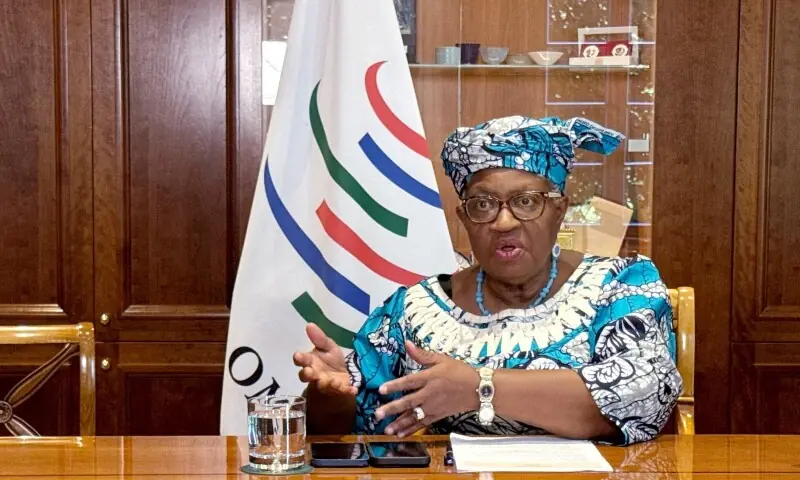

GLOBAL trade is facing its worst disruption in 80 years as supply chain bottlenecks in the Strait of Hormuz threaten global food and fertiliser prices, Anadolu reports, citing the World Trade Organisation’s (WTO) director-general.
Ngozi Okonjo-Iweala, speaking on the sidelines of the WTO’s Public Forum in Geneva, tells Anadolu that the global trading system remains resilient, but the ongoing Middle East conflict presents a major test for the organisation’s 166 member countries.
She notes that global trade in goods has grown by an unexpectedly strong 4.6 per cent this year despite geopolitical pressures, while 72pc of all global commerce continues to operate under WTO rules.
The initial projection for overall goods trade growth is 1.9pc for the entire year, but the first-quarter growth of 3.2pc outpaced expectations.
Ngozi Okonjo-Iweala says Hormuz disruptions pose worst threat to trade in 80 years, risking food security
She stated that a significant portion of the momentum was driven by the surging trade in artificial intelligence, which in turn was driven by low- or zero-tariff agreements covering $3 trillion in global semiconductor and chip shipments.
She urged caution over the sustainability of the trend, while warning that the economic benefits of this booming trade remain concentrated in North America and East Asia, raising concerns about global market inclusivity.
Okonjo-Iweala said national reserves temporarily shielded markets from the shocks that the Strait of Hormuz disruptions have caused thus far, but prolonged blockades in the vital waterway will inevitably lead to higher agricultural costs.
The WTO’s previous estimates showed that crude oil prices reaching $90 per barrel could drive down overall trade growth by 0.5 points, while current crude oil prices have exceeded that threshold.
Maritime shippers maintained trade volume by rerouting vessels via alternative routes, but these lengthy detours are adding steep premiums, calling into question the long-term stability of the current supply chain, Okonjo-Iweala warned.
Governments around the world are drafting contingency plans to protect their economies from future chokepoint failures, while the combination of supply chain instability and rapid shifts in technology has furthered internal WTO talks over the need to overhaul global trade rules for this century.
She noted that comprehensive institutional reform is key to equitable global development, and that the current framework of the WTO has frequently failed developing nations.
Okonjo-Iweala urged developing countries to help draft modernised policies so they can seize economic opportunities, while the proposed reforms would target failing institutional mechanisms and help prevent these countries from being left behind.
A recent WTO report unveiled as part of its Public Forum estimated that a collapse in multilateral cooperation and a failure to modernise regulations could wipe out up to 10pc of potential global economic growth by 2050.
Published in Dawn, September 19th, 2026


























