Gulf energy supplies have been disrupted. The Middle East war that erupted in February, after US and Israeli strikes on Iran triggered regional retaliation, has now drawn Yemen and Saudi Arabia into the conflict. The Saudi East-West pipeline is also shut, limiting Riyadh’s ability to bypass disruptions around the Strait of Hormuz and causing oil supply shortages. With the Bab al-Mandab and Hormuz chokepoints both under pressure, energy flows through two of the world’s most important chokepoints face growing uncertainty.
Supply disruptions and the surrounding tensions are already suppressing shipping traffic and raising costs along the Europe-Asia trade route. Global energy prices remain elevated, while the course of both fronts over the coming weeks is impossible to predict with confidence.
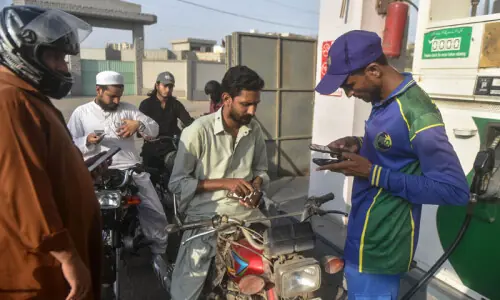
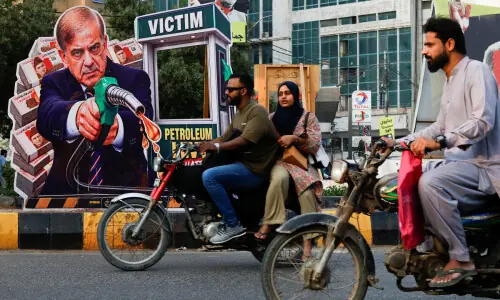
Against that backdrop, Islamabad’s response to the emerging regional situation has two parts: austerity measures to curb consumption, and a Rs75 billion fuel-relief package for motorcycle and small-car owners. Neither is designed well enough to do what it claims.
Start with relief, since that is where the money is going and where the design flaw is clearest. The logic behind the subsidy is simple: motorcycles and small cars are proxies for lower-income households, so subsidising their fuel protects the vulnerable. The logic is wrong.
Opaque savings from austerity measures and subsidy design flaws fall short of reforms needed
Vehicle ownership measures ownership, not need. A household running a motorcycle for a small business may be far better off than a family with no vehicle at all, paying whatever a crowded van or a shared rickshaw charges after fares rise. The second household gets nothing from this package. It is arguably worse off, since bus and van fares move in step with fuel prices, and public transport in Pakistan has no comparable relief mechanism.
This is not a minor design flaw. It is the difference between a subsidy that reaches the poor and one that reaches vehicle owners, who are not the same population. Pakistan already has a functioning instrument for the first task: the Benazir Income Support Programme (BISP) National Socio-Economic Registry, built and tested through cash transfer programmes over the past decade. Cash support disbursed through that registry goes to households ranked by actual economic vulnerability, and it lets each family decide whether the money is better spent on petrol, bus fare, food or a medical bill. A motorcycle subsidy makes that decision for them, and makes it badly.
Targeted cash transfers under the BISP would allow poor, vulnerable families to decide how best to use the support, whether for food, transport, electricity or other essential needs. This is more flexible than subsidising a particular commodity and allows assistance to reach households without distorting prices or consumption decisions. It would also make the cost and coverage of the relief easier to track.
There is also a fiscal question the government has largely avoided. The petroleum levy is one of the few revenue tools that does not require parliamentary approval to adjust, and cutting it further would open a fiscal gap the government cannot easily close elsewhere. So instead of using that lever, it has opted for a fuel subsidy funded separately — an outlay that does not touch the levy but still needs financing from somewhere. Where that financing comes from, and what it displaces, has not been explained.
None of this means relief is unnecessary. Higher fuel prices do not stay at the pump. They move into freight costs, then into food prices, then into the cost of nearly everything transported or manufactured. Some form of compensation for that chain is justified. But justified relief and well-targeted relief are different things, and the government has offered the first while calling it the second.
Austerity fares only slightly better. Earlier market closures, cuts to official vehicle use, and restrictions on non-essential government travel and procurement are reasonable in principle: they target discretionary consumption rather than productive activity. But “reasonable in principle” is not the same as “measured.”
The government has not published projected savings for any of these interventions, nor committed to reporting actual savings once they are implemented. Without that, austerity is a set of notifications, not a demand-management programme people can hold the government accountable to.
Provincial governments complicate both sides of this picture, though their role is secondary to the design problems above. Commercial activity, transport, education and public administration fall substantially within provincial jurisdiction. If Islamabad restricts fuel use in federal offices while provincial departments, markets and transport networks continue as before, the aggregate savings will be small relative to what the crisis demands.
The same applies to relief: federal cash support does little if provincial governments allow bus and van fares to rise unchecked, since that is where the actual burden on non-vehicle-owning households is landing.
Provinces could contribute more directly than they currently do by financing or administering targeted transport relief, monitoring fare increases, and using their own regulatory tools against profiteering by transporters and food suppliers passing on cost increases beyond what is justified. None of this requires new legislation. It requires provincial governments to treat the current shock as a shared problem rather than a federal one, which so far they have not.
But provincial follow-through cannot fix a badly targeted subsidy. That correction has to happen federally, and it has to happen by shifting the relief mechanism itself — from vehicle ownership to the BISP registry, from a flat subsidy to a needs-based transfer.
The current shock will end. Global prices will ease, supply disruptions will resolve, and the immediate pressure will pass. Sooner or later. The vulnerability underneath it will not. Pakistan’s dependence on imported fuel, the absence of meaningful storage capacity, and the lack of affordable public transport in most cities are structural conditions that will produce the same crisis again under a different name. Treating this as a one-off emergency, addressed through a subsidy tied to what people drive rather than what they need, guarantees that the next shock finds the same gaps.
The writer is a Dawn staffer
Published in Dawn, The Business and Finance Weekly, September 21st, 2026