Afghanistan's situation demands continued attention in view of implications for regional peace, Dar tells OIC moot
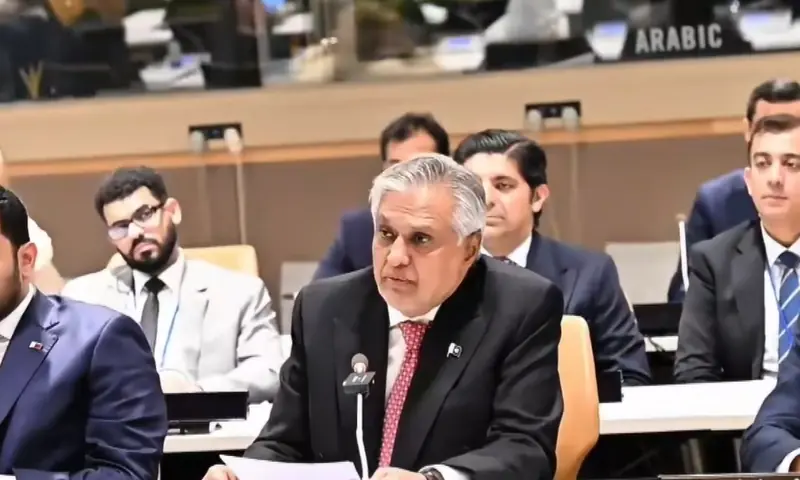

Deputy Prime Minister and Foreign Minister Ishaq Dar told a meeting of the Organisation of Islamic Cooperation (OIC) on Tuesday that the situation in Afghanistan demanded continued attention, particularly considering its implications for regional peace, security and stability.
Dar was addressing the meeting of the OIC’s Contact Group on Afghanistan on the sidelines of the 81st session of United Nations General Assembly in New York.
Dar recalled that in Aug 2021, Afghanistan saw a “watershed moment” as the US troops withdrew from the country and the Afghan Taliban returned to the helm in Kabul.
He said Pakistan was the first country to “open its doors to our Afghan brothers at the time”. Dar added that Pakistan had also hosted an OIC session in December 2021 to garner Muslim countries’ support and mobilise international support to address the humanitarian situation in Afghanistan.
“It was hoped that the Taliban would honour Afghanistan’s international obligations and their own commitment for eliminating terrorism, promoting inclusivity and protecting the human rights of its citizens. However, the expectations of the OIC members and the larger international community have remained unfulfilled,” he said.
He said the Afghan Taliban had failed to seize the opportunity to integrate Afghanistan with the wider world and the improve the lives of the Afghan people “due to their misplaced priorities and flawed ideologies”.
“We can help Afghanistan and should help Afghanistan to integrate into the international community,” he said, adding that the Afghan Taliban were required to first take steps for creating a conducive environment to this end.
These steps included concrete and verifiable action to prevent the use of Afghan soil for terrorism against any neighbouring country, particularly Pakistan. These attacks, he said, were planned and orchestrated from Afghanistan from “external backing to destabilise the region”.
Dar said Pakistan was “seriously concerned” about the presence of over two dozen terrorist groups in Afghanistan that threatened regional international peace and security.
He said law enforcers in Pakistan were making “enormous sacrifices” to counter terrorism as Pakistanis continued to be targeted by terrorist groups from Afghanistan.
In this connection, he also mentioned the recent attack in the old Police Lines in Khyber Pakhtunkhwa’s Kohat. The attack claimed over 20 lives and injured about 100 others. Eight terrorists were killed during an overnight clearance operation launched to clear the area.
Dar also thanked Qatar, Turkiye and Saudi Arabia for their mediation efforts to “counsel the Taliban to find an amicable and peaceful solution”.
“As a collective voice of the Muslim world, the OIC has a vital role in addressing the situation in Afghanistan,” he said. “This group must urge the Taliban to eliminate terrorism holistically and with sincerity, and end their patronages of terrorist groups.”
Dar also asked that the OIC call on the Afghan Taliban to honour their international obligations and commitments, curb trafficking through illegal smuggling networks, lift all restrictions on women and girls that ran contrary to Islamic principles and norms of Muslim society and rethink policies that denied fundamental freedoms to ordinary Afghans “who have already suffered enough from civil war and conflict”.
He called for a politically inclusive process of government in Afghanistan and the facilitation of resettlement and integration of Afghan returnees to their homeland, noting that the international community also had a responsibility to share this burden.
He also stressed the need for adequate international funding to meet humanitarian aid requirements and for socio-economic developments in Afghanistan.
“No country desires normalcy and stability in Afghanistan more than Pakistan, and no country has suffered from the consequences of instability and insecurity in Afghanistan more than Pakistan,” Dar said.
He reaffirmed Pakistan’s commitment to supporting efforts to achieve a stable and peaceful Afghanistan, while highlighting the need for “mutual respect, sincerity and demonstration of necessary political will by the Taliban”.
Tensions between Islamabad and the Kabul have remained high, punctuated by cross-border clashes over the past year.
Islamabad has repeatedly urged the Taliban administration in Kabul to dismantle terrorist sanctuaries on Afghan soil, particularly those linked to the banned TTP, that are used for attacks in Pakistan. Officials say those appeals have gone unheeded.
Last week, Pakistan told the UN Security Council on that it would respond to terrorist threats emanating from Afghanistan in self-defence as and when needed and in accordance with international law.
Earlier this month, the Foreign Office (FO) declared that meaningful progress in relations with Kabul would depend on the Taliban taking concrete and verifiable action against TTP and other terrorist groups operating from Afghan territory.
It maintained that while Islamabad welcomed China’s continuing engagement, the external facilitation could not substitute for action by Kabul against terrorist infrastructure.
According to a UN Security Council-mandated monitoring report — covering the period from Dec 16, 2025 to June 9, 2026 — Afghan Taliban’s continued support for TTP has contributed to a rise in the frequency and lethality of terrorist attacks in Pakistan, even as Kabul has taken some initial steps to rein in the group.
The report also pointed to growing operational and facilitation linkages among the TTP, Al Qaeda, Islamic State-Khorasan (ISIL-K) and the Baloch Liberation Army (BLA).
More to follow