Every literary age has its questions, peculiar to its historical moment. One such question today is whether the novel’s global prominence will survive the age of ‘digital abundance’ and artificial intelligence (AI).
In my view, the present boom is likely to decline, but the novel, which I perceive as humanity’s greatest literary invention, will survive, though it will undergo a metamorphosis.
Over the past few decades, the novel has occupied an unusually prominent position in global literary culture, often at the expense of poetry, non-fictional and intellectual writings. It has assumed the throne of the literary kingdom, overshadowing other genres but appropriating their creative resources, from styles and techniques to modes of thought and representation.
In the early 20th century, the distinction between a story (events) and discourse (narration) redefined the novel. Postmodern novels prioritised discourse, discarding traditional narrative rules to blend diverse narrative techniques, along with absorbing philosophy, history, myth and psychology. By merging fact with fiction — creating ‘faction’ — the novel gained immense cultural prestige, readership and elite recognition, such as with the Nobel Prize.
The novel’s cultural authority has rested on many claims, including its relationship with truth. It is fiction, yet it portrays, represents and, in a sense, creates truth. Fictionality is not simply an escape from reality — it can be a means of apprehending reality and its layered complexity.
With artificial intelligence able to churn out words instantaneously, even imitating and combining the stylistic and technical features of the masters, can humanity’s greatest literary invention retain its position of cultural prominence?
The Urdu novel followed a comparable trajectory. It became immensely popular, attracting poets, short story writers, journalists, dramatists, academics, critics and retired people. Many appeared dazzled by the glitter of its throne and treated novel-writing as a route to rapid literary recognition. In the first 26 years of the 21st century, hundreds of Urdu novels have appeared, yet it is difficult to identify a single work that has achieved uncontested, global canonical stature.
Nevertheless, Shamsur Rahman Faruqi’s Kai Chaand Thay Sar-i-Aasman, Mirza Athar Beg’s Ghulam Bagh, Hasan Manzar’s Habs, Anis Ashfaq’s Khwaab Saraab, Akhtar Raza Saleem’s Jagay Hain Khwaab Mein, Rahman Abbas’ Nizhdaan Syed Kashif Raza’s Chaar Darvesh Aur Aik Kachhwa and Khalid Javed’s Naemat Khana deserve mention.
The present boom, however, appears especially vulnerable in the age of AI because AI has intensified the condition that already defines our cultural moment: abundance.
There is an abundance of almost everything: commodities, books, paintings, music, ideas, debates, films, documentaries, series, vlogs, posts, comments and, of course, novels. Yet, every abundance contains the seeds of crisis. The boundary between abundance and chaos is porous — abundance can become unmanageable.
The novel, as a story, possesses the remarkable power to turn a chaos into coherence, but not necessarily the chaos. It is now surrounded by forms of abundance that challenge not only its popularity but also its traditional claim to cultural and epistemological authority.
Abundance extends beyond products to how they are made, shared and consumed. Text, audio and visual media have exploded across platforms such as Facebook, X, Instagram, Threads, YouTube, Netflix, Amazon and HBO. Books, for example, exist on paper and screens, or in audio, complete with summaries, reviews and commentary. AI accelerates this cycle as both a consumer and creator of media. It feeds on existing digital abundance to generate instant new content — simultaneously offering a solution to information overload while contributing to it.
The first law of abundance is that it has no ultimate limit. In certain respects, abundance resembles capitalism and human desire: all three are endlessly innovative but indifferent to permanence. They privilege ephemerality over immortality. As things become old or unfashionable, they make room for new things. Abundance does not mourn what has passed. It privileges the present, retaining memory and tradition only insofar as they can adapt to present conditions.
Surrounded by abundance, writers may find it increasingly difficult to sustain the impulse to create works intended to outlive their moment. They are tempted to produce works that are immediately received and consumed. Yet, the desire for literary immortality relates to the human instinct for survival. Writers seek survival in the contemporary literary world through attention, popularity, prizes and awards — they seek survival in history by attempting to defeat time. The two forms of survival are rarely achieved together.
Historical survival demands an encounter with reality’s complexity through genuinely new aesthetics — requiring solitude and reflection, away from the world of abundance.
The second law of abundance makes traditionally novelistic themes — history, love, war, complex characters and fantasy — instantly available anywhere via AI chatbots, social media, streaming platforms and YouTube. Streaming culture draws on classic novels and explores new themes that AI can now also generate, multiplying both stories and motifs.
This immediate availability threatens the novel’s popularity and cultural authority. In an era where attention is the most coveted commodity, new novels struggle to compete against more instant and accessible media formats offering the exact same content.
The styles, techniques and worldviews of major novelists, from Thomas Hardy to Leo Tolstoy, Fyodor Dostoevsky to Franz Kafka, Jorge Luis Borges to Gabriel García Márquez and Milan Kundera, are now widely accessible in original editions, translations, audio and film. AI can imitate or recombine many of their stylistic and technical features. What was once scarce, exotic or difficult to reproduce is becoming increasingly reproducible. When the originals themselves are so abundantly available, the attraction of imitation becomes harder to sustain.
AI testifies to Michel Foucault’s argument that writing is a function governed by rules and conventions that can be understood, reproduced and codified. Producing a novel through functions associated with a great writer, or generating a new work by combining existing functions, is therefore no longer the miracle it once appeared to be. This abundance offers unprecedented convenience, but it poses a serious challenge — not to the existence of the novel, but to its royal seat and stature.
The third law of abundance is monotony. While instant access to every great book alongside its summaries and reviews seems convenient, consuming literature this way becomes monotonous. Monarchy and monotony now work in tandem. The literary monarchy produced by the novel boom and intensified by the monotony of algorithmic abundance, is consequently vulnerable. Yet, the novel itself is not.
A rebirth is possible if the new novel engages both abundance and AI, without rejecting or merely absorbing them but forging alternative, genuinely human paths. Writers who surrender their style and ideas to AI risk letting machine intelligence overwhelm their own.
The essential human element is ‘struggle’. Before AI, writers could spend hours or days searching for the right word, character or form. This struggle has two dimensions: artistic and existential. Artistic struggle means discovering the most aesthetically effective way of narrating a story; that discovery is experiential, not merely technical. Existential struggle means discovering unexplored and sometimes terribly shocking truths about human existence, history and destiny. How can this human struggle simply be outsourced to an AI tool?
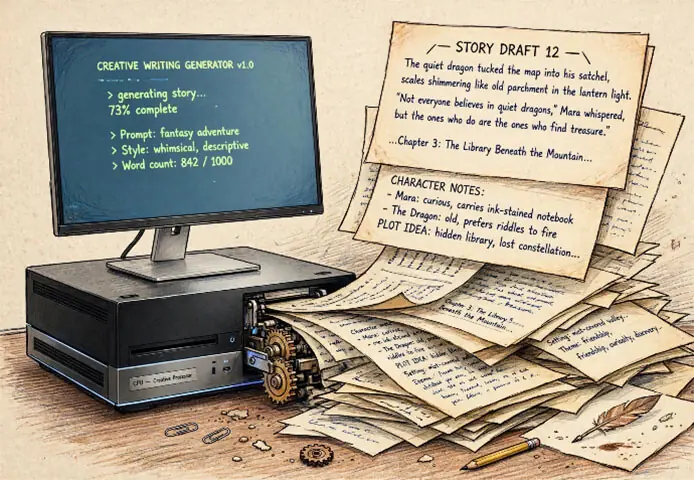
AI is therefore becoming a rival rather than merely a supporter. AI systems are already capable of generating long fiction, and the possibility of AI-generated novels entering the literary marketplace in substantial numbers is no longer remote.
The novel, however, possesses one feature that remains difficult to replace: the experience of reading. Reading differs fundamentally from seeing and listening. Through reading, we encounter language at a level where necessary yet unexpected flaws, hesitations, rhythms and ambiguities may disclose something recognisably human — or reveal its absence. Nothing is more deceptive than language, yet sensitive reading can still make us alert to the difference between human intelligence and mechanical reproduction.
The novel’s newness will lie not in employing new technology but in exploring what is happening to humanity as it is crushed beneath an abundance of things, while a significant part of humanity continues to suffer from their absence. Its deepest subject may thus be the defining paradox of our age: an excess of everything alongside a scarcity of almost everything that matters, ‘humanly’.
The writer is a Lahore-based Urdu critic and short story writer.
The Journey of Ideas is his latest publication
Published in Dawn, Books & Authors, September 27th, 2026