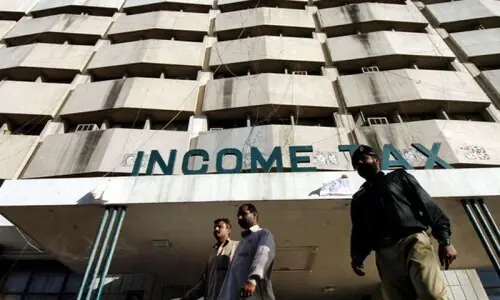
ISLAMABAD: In what marks a major reform of the tax machinery, the Federal Board of Revenue (FBR) has established the National Faceless Centre (NFC) in Islamabad, where audits and assessments will be conducted by “faceless” wings set to begin operations in October.
The centre, initially staffed with 27 officers, has been tasked with auditing and assessing third-party data of 300,000 to 400,000 individuals under a pilot project. This data will be provided to the NFC in phases following the completion of initial compliance checks.
The NFC will deal only with medium-to-individual cases. No corporate entities or associations of persons will be taken up under the new system.
The second phase of the NFC will take effect in June 2027, centralising the audit and assessment functions of all regional tax offices (RTOs).
New system established in Islamabad to focus initially on air travel, luxury vehicles and lavish houses
On Friday, the Board in Council, a body headed by FBR Chairman Rashid Mahmood Langrial, approved the rules for the operation of the NFC, to come into effect from Oct 1. The NFC has been set up on the premises of the RTO Islamabad.
The initiative has been taken under Pakistan’s New Tax Operating Model and was approved by the government in principle in June this year.
High-value purchases
A senior tax official told Dawn that the NFC would initially focus exclusively on third-party data, particularly related to air travel, purchases of luxury vehicles and lavish houses.
Under the new system, a notice will be issued to individuals requiring them to explain or provide proof of such high-value purchases.
If individuals are able to justify their expenditures, the case will be dropped. However, if they fail to provide justification, they will be required to pay the applicable tax and revise their returns. The system will also feature a digital, AI-based option for tax payment.
The centralised and faceless tax model is similar to systems used in the UK, Australia, the Netherlands, Singapore and India. It is designed to eliminate physical contact between tax authorities and taxpayers to prevent corruption.
India has operated a similar system since 2019, dealing primarily with individual cases, the tax officer said, adding that the model had proven more effective in curbing taxpayer harassment and reducing corruption among tax officials in such cases.
An official announcement by the FBR said that until now, “a taxpayer whose return was picked for audit had to deal with a particular officer in a particular office, often in person”. “Under the new system, that contact will end,” it added.
“Cases will be selected by a computerised, risk-based system rather than by any officer. Each case will then be assigned automatically to an officer who may be sitting anywhere in the country,” it said. “The taxpayer will not know who the officer is, and the officer will have no say in which case comes to them.”
The statement said that each case would pass “through three separate hands”.
“One officer will conduct the audit, a second will make the assessment, and a third will review the work for quality before any order is issued. No single officer will control a taxpayer’s case from start to finish,” it added.
Published in Dawn, September 26th, 2026