Tehran puts onus for ending war on US
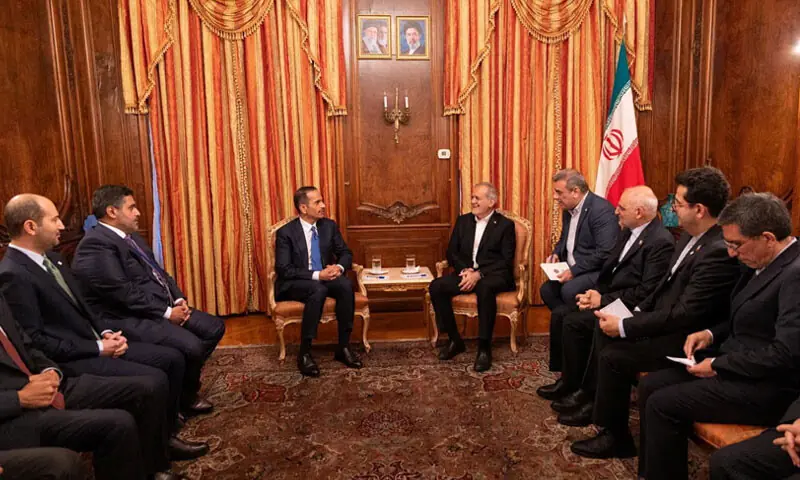

• Pezeshkian signals readiness for talks, says US ‘must choose’ whether to end war
• Araghchi offers seven-day plan to halt fighting, reopen Hormuz
• Najaf suspends all Iranian flights to enforce sanctions
WASHINGTON: Iran’s President Masoud Pezeshkian declared on Friday that it is now up to Washington to decide whether to bring the countries’ war to a close, insisting that Tehran has no appetite to continue the conflict.
“When we can resolve issues through dialogue, we shouldn’t resort to killing one another. But with the instigations conducted by Israel, they have imposed this war on us,” Pezeshkian said on Fox News.
“But we do not wish to continue. It’s America that must choose whether it wants to end this or not,” Pezeshkian insisted, saying Iran is ready to strike a deal with Trump.
“If the current American government, within international legal frameworks, wishes to reach an agreement, fine. If not, before the [US midterm] elections or after the elections, what difference does it make for us?” He also maintained that Yemen’s Houthis do not take direction from Tehran’s government, despite accusations from Washington and Saudi Arabia that Iran backs the movement. “The Houthis are responsible for their own actions,” he said.
Diplomatic manoeuvring
The diplomatic overture was reinforced by Iran’s Foreign Minister Abbas Araghchi, who told reporters in New York that Tehran had put forward a formal proposal to end hostilities and reopen the Strait of Hormuz within a week.
“If certain conditions are met, the strait will be open within seven days and talks will start,” Araghchi said.
The plan calls for a cessation of all hostilities in the Middle East for seven days, the release of at least $12 billion in frozen Iranian assets, the lifting of sanctions on Iranian oil and an end to the US naval blockade. On the seventh day, Iran would reopen Hormuz.
A previous agreement in June broke down after Iran fired on commercial ships in the waterway. Araghchi, who met Trump’s envoy Steve Witkoff on Tuesday, said he was waiting for a US response and maintained that China supported the proposal.
In ongoing mediation efforts, Qatar’s foreign ministry said that top diplomat Sheikh Mohammed bin Abdulrahman Al Thani spoke with Pezeshkian about de-escalation and conditions for dialogue. The pair met on the sidelines of the UN General Assembly, where they reviewed efforts to create a conducive environment for dialogue, the ministry said in a statement. Separately, US Ambassador to China David Perdue said on Friday that Trump made clear during White House talks with Chinese President Xi Jinping that Chinese help for Iran is unacceptable.
“We made it very clear to them weeks ago that, you know, any help that they would give Iran, whether it be direct or indirect, whether it be intelligence or parts or military equipment, was totally unacceptable,” Perdue told CNBC.
Perdue later told Fox News that Washington received assurances from Beijing on Thursday that it would stop assisting Iran.
As diplomatic talks continued, Iraq’s Najaf airport suspended all Iranian flights on Friday, enforcing US sanctions and leaving travellers scrambling.
Airport director Hussein Muhanna said all flights between Iran and the holy city of Najaf were halted following a directive from the prime minister’s office. A government source confirmed all Iraqi airports enforced the ban after Treasury Secretary Scott Bessent said Iranian airlines will shut down.
Published in Dawn, September 26th, 2026