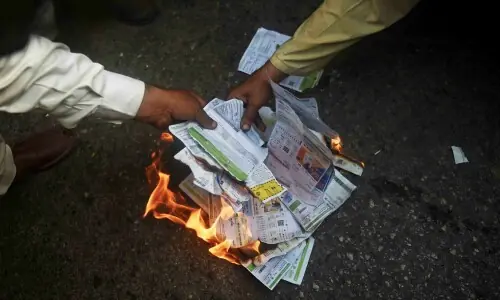
This season, growers across Khyber Pakhtunkhwa have been setting fire to their own cured tobacco. In Swabi, Charsadda, and Buner, farmers who invested a year of their lives and substantial capital in their crop have been left with no choice but to burn it because buyers are not coming forward. A farmer does not burn an asset he can sell. Those fires are the clearest price signal the tobacco marketing system has produced over the years.
Pakistan Tobacco Board (PTB) statistics confirm that 45,000 farmers are in Khyber Pakhtunkhwa out of nearly 80,000 tobacco farmers nationally. The province produces 98 per cent of the country’s high-quality flue-cured Virginia on roughly 26,500 hectares across Swabi, Mardan, Charsadda, Buner and Mansehra. Tobacco is sown on less than 1pc of the country’s cropped area, while its contribution to the national exchequer is highest.
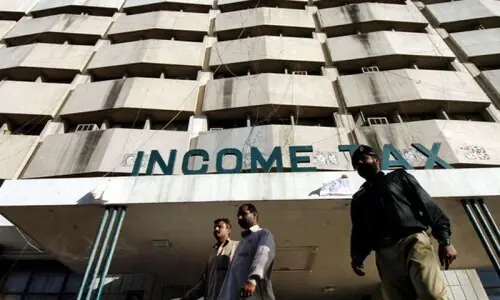
The fiscal significance of the tobacco value chain is striking. Federal excise duty from locally produced cigarettes and tobacco stood at Rs237.3 billion in FY24, up from Rs66.3bn in FY17. This cannot be compared directly with agricultural income tax, which is a provincial tax on farm income rather than an excise on manufactured products. But the contrast holds. Tobacco occupies a tiny fraction of Pakistan’s cropped area, and the industry built around it generates one of the country’s largest federal excise streams. A value chain of that size ought to sustain a working market for the farmers who supply its raw material.
However, very little of this financial significance extends to protecting the interests of the grower who produces the business’s raw material. The sector is getting no subsidy or support. The grower bears the cost of seedlings, fertilisers, pest control, labour and the curing process himself. Moreover, farmers put in a lot of working capital without knowing the price or whether their whole crop will be lifted. Therefore, they carry the burden of production and marketing risks until the depot gate.
Pakistan needs a leaf ecosystem that honours contracts, discovers prices in the open and pays growers on time
The issue here is not whether tobacco farmers are entitled to subsidies. It is about the fact that there should have been some form of enforceable purchasing commitment, price discovery, and payments, at least given that the crop is regulated and has the capacity to create an export- and tax-earning value chain. Instead, declared buyer demand has continued to contract while the marketing system has failed to provide an orderly adjustment for growers.
That contraction is measurable. Quota allocation for the 2026 crop has been set at 61.63 million kg, the fourth consecutive annual cut, down from 85.5m kg for the 2023 crop, then 77.3m and 74.8m. National output has been running near 140m kg. Roughly half the crop has no declared buyer before a single leaf is cured.
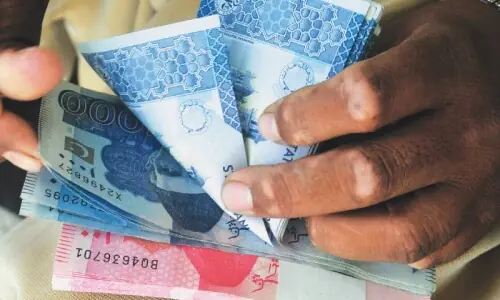
What happens to that half is predictable. The board sets a weighted average price for the contracted quota and a significantly lower support price for any surplus quantity. In the surplus category, farmers are offered between Rs300 and Rs500 per kg against a cost of production growers estimate at Rs750. Selling at Rs350 is not a marginal decision; it amounts to losing half your investment. Even a signed contract guarantees nothing. Some growers hold one and the company has not lifted a single leaf, while payment for last year’s sale remains overdue.
The federal excise duty collected by the Federal Board of Revenue in FY25 from tobacco and cigarette sales alone fell by 48.3pc in one year, from Rs237.3bn to Rs121.2bn. The share of domestic federal excise fell to only 19.4pc.
Put the two trends side by side. Documented excise collection fell, and declared demand from formal buyers contracted in the same period. The leaf did not disappear. A grower with a financed crop, no storage, and one or two buyers will sell to whoever pays cash. If that leaf ends up in illicit cigarettes, the farmer is underpaid, and the exchequer collects nothing.
That leakage is not inevitable. Raw tobacco and its product exports are small, at roughly $170m in 2025 across more than 40 markets. But a structural surplus of 50m-70m kg is precisely the supply base an export push requires, particularly when Pakistani yields per hectare run well above the world average. Instead, that surplus is ending up in stockpiles and bonfires. No government can ask an economy to export while writing off its surplus at the farm gate.
India shows what the alternative looks like. Its Tobacco Board sells flue-cured Virginia by open electronic auction, bale by bale. The growers watch the bidding on screen, and are paid directly into their bank accounts within about nine days of sale. Pakistan does the opposite. The administration sets the price, while the buyer’s own leaf manager grades it at his depot. A downgrade therefore becomes both a quality judgement and an immediate price cut, made by the very party that benefits.
The first requirement is immediate. The crop stacked in godowns across Khyber Pakhtunkhwa is finished product, and it must be lifted. Under the law, the board can compel buyers to purchase what they themselves declared. This is the right time to use that power this season. Every week of delay turns a marketable product into a distress sale. Growers owed money from last year must be paid immediately.
Secondly, the market needs to be widened. Firms have a total monopoly in most growing areas. The government must issue licences to the new buyers instead of watching the old ones withdraw. Threshing operators and exporters should be allowed to buy directly from farmers. Competition among buyers will strengthen the market and improve growers’ negotiating position.
Thirdly, the marketing system itself needs to be rebuilt. Transfer the marketing of flue-cured Virginia tobacco to auction marketing with grading. This should begin on a pilot scale in two districts next year under a system of publicly declaring prices of individual bales.
Payments should come through the board or an escrow mechanism, with a mandatory settlement date. Public declaration of demand and a district-wise contract list should take place before sowing. The farmer will know in December that he has no buyer instead of in August with his godown full. Treat the surplus as export stock to be marketed where Pakistani leaf is sold.
Pakistan does not need to promote smoking to protect tobacco farmers. It needs a leaf market that honours contracts, discovers prices in the open and pays growers on time. A crop on a tiny share of the country’s land supports a value chain that matters to both exports and federal revenue. A government serious about revenue would be building that market. Instead, it stands back while growers burn what they spent a year producing.
The writer is a research economist at the Pakistan Institute of Development Economics. Email: wajidislam@pide.org.pk
Published in Dawn, The Business and Finance Weekly, September 28th, 2026