
Pakistan’s climate future faces a very tough financing demand. This is a critical moment to decide what to prioritise. How can a country facing substantial climate risks, constant fiscal stress, and competing development priorities mobilise the resources needed to protect its people and sustain economic growth? The challenge is not simply to identify climate finance needs, but to determine who will finance them, through which instruments, and under what institutional arrangements.
Pakistan’s current fiscal space is limiting its capacity to finance climate action. A big burden of debt servicing, social protection needs, energy sector pressures, especially under a recent war-like situation, and demands for economic recovery compete for scarce fiscal resources.
Climate-related investments usually need extensive upfront expenditures, while their benefits, which come in the form of improved ecosystems, avoided disaster losses, and collective resilience, may materialise over longer periods.
Another big challenge is that Pakistan has not yet estimated its financing needs for comprehensive climate action. According to our latest Nationally Determined Contributions 3.0, Pakistan must reduce 50 per cent of its projected emissions by 2035, which requires $565.7 billion. This estimate has been made by the World Bank.
One of the challenges is that Pakistan has not yet estimated its financing needs for comprehensive climate action
So far, Pakistan has accessed less than half a billion from all available international sources: the Global Environment Facility, Green Climate Fund, Adaptation Fund, and related forums. Imagine the needs and the amount, as this is not simply a small amount; rather, it indicates that Pakistan’s capacity to mobilise resources is constrained.
Financing within the system comes from public spending through annual budget allocations. Budget FY27 confirmed a significant reduction from Rs716.7bn in FY26 to Rs214bn. Consequently, the adaptation budget has been reduced to Rs70.4bn from Rs85.4bn, while the mitigation budget has been reduced to Rs124bn from Rs603bn.
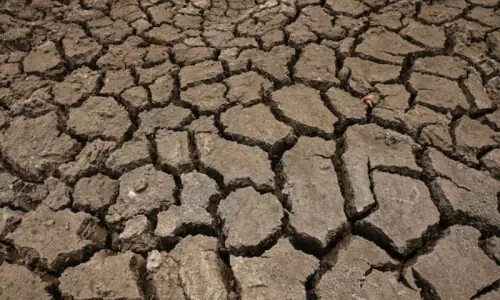
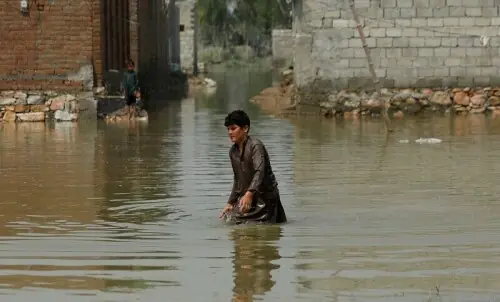
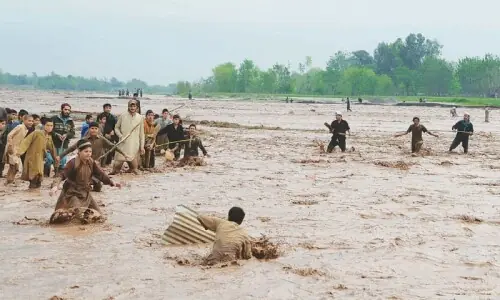
So, on one side, hazards are intensifying: more heat waves, more droughts, a rise in temperature, especially nighttime temperature, irregular precipitation with more and violent floods, while on the other side, fiscal space is limited, and access to international resources is narrow.
Given this context, each rupee redirected toward climate action is a rupee not available for debt servicing, health, education, or immediate disaster response. Moreover, every additional dollar of climate-related borrowing adds to a debt burden; this is itself becoming a constraint on future climate investment.
According to the latest NDCs, Pakistan must reduce 50pc of its projected emissions by 2035, which requires $565.7 billion, but so far, we have accessed less than $500m from all available international sources
This is the trap Pakistan’s climate finance strategy must now steer: climate risk is rising, and fiscal space is dipping. The strategic way forward is to channel climate finance from where it can realistically come from, and how efficiently Pakistan can channel what already exists.
There are multiple structural barriers limiting available financial opportunities. Firstly, climate responsibility has been devolved to provincial governments, while international commitments and carbon market coordination remain with the federal government. This devolution has resulted in overlapping mandates and insufficient coordination, with gaps in governance both vertically and horizontally.
Secondly, our technical capacity to prepare bankable climate projects is inadequate. That’s why we often fail to present fundable proposals, which is a primary requirement, even when funding windows are open.
Thirdly, there is almost no consolidated system that can track non-budgetary flows such as international, private, or blended finance. This undermines Pakistan’s ability to quantify its own needs and credibly negotiate internationally.
The fourth constraint is about the limited fiscal space. Low savings and investment ratios, high public debt, and currency risk on foreign-denominated finance constrain both domestic mobilisation and the terms on which international finance can be absorbed.
The fifth constraint is about private-sector capital. As public funds still account for the overwhelming share of adaptation finance, private investors lack the tools to price climate risk and adaptation projects and, unlike renewable energy, often lack a clear, commercial return. This limits the private sector appetite precisely where public finance is rarest.
Pakistan has established its climate finance strategy around establishing a climate finance taxonomy and expanding budget tagging to non-budgetary flows, screening public investment for climate risk and prioritising resilient infrastructure, building a bankable projects pipeline through an integrated climate action platform and an operational Pakistan Climate Change Fund, which will help mobilise domestic capital through carbon markets, green and sustainability-linked bonds, blended finance, and climate-aligned public-private partnerships, and developing green skills and innovation capacity through a proposed green university and startup ecosystem.
Pakistan is also deepening its existing channels at the international level, including the World Bank’s $40bn country partnership framework for 2026-35, the Asian Development Bank’s climate commitment of around $2.43bn for 2022-24, the International Monetary Fund’s $1.3bn Resilience and Sustainability Facility tied to climate-informed public financial management reforms, and a better-prepared pipeline of proposals.
However, none of these instruments, alone, will close the gap. What is required at the top is credible coordination, a single national system to track needs and allocations, project screening, and directing both domestic revenue and international finance toward the same prioritised pipeline.
Pakistan’s climate future requires a strategic, predictable, and development-oriented financing framework: no aid, no loans, but grants and concessional loans, so that we can protect vulnerable populations while supporting economic transformation.
The writer is an assistant professor at the Pakistan Institute of Development Economics
Published in Dawn, The Business and Finance Weekly, September 28th, 2026