Israeli occupiers storm Al-Aqsa Mosque in East Jerusalem as Palestinian shops forced to close for Jewish prayers
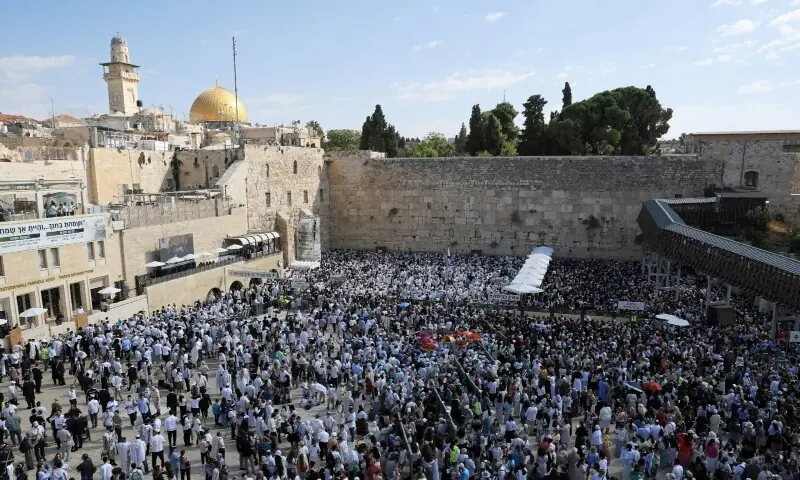

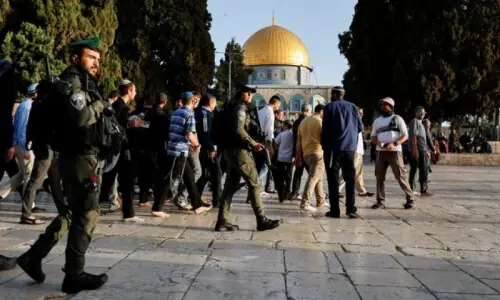
Scores of Israeli occupiers stormed Al-Aqsa Mosque in occupied East Jerusalem on Monday, as Israeli authorities forced Palestinian businesses in the Old City to close to allow Jewish prayers during the Sukkot holiday.
Videos posted by occupiers on social media showed scores storming the flashpoint site and performing Talmudic rituals, prayers and singing. The rituals were concentrated in the eastern part of the mosque compound.
On Sunday, more than 1,500 Israeli occupiers, including National Security Minister Itamar Ben-Gvir, forced their way into the Al-Aqsa Mosque to celebrate Sukkot under police protection, according to the Islamic Waqf Department in Jerusalem and Palestinian media.
The incursion triggered widespread condemnation, with Palestinian presidential spokesman Nabil Abu Rudeineh describing it as “playing with fire and a dangerous provocation to the feelings of Muslims around the world”. He also warned of a “religious war” that Israel was seeking to ignite in the region.
Al-Aqsa Mosque is the world’s third-holiest site for Muslims. Jews call the area Temple Mount, claiming it was the site of two Jewish temples in ancient times.
The flashpoint site has seen an increase in occupier incursions since the start of the Jewish holidays, accompanied by Talmudic rituals and prayers inside its courtyards under heavy protection from Israeli police and forces.
The Jewish holiday period began with Rosh Hashanah on Sept 12-13, followed by Yom Kippur on Sept 21-22. Sukkot runs from Sept 26 to Oct 2, followed by Simchat Torah on Oct 3.
Closures
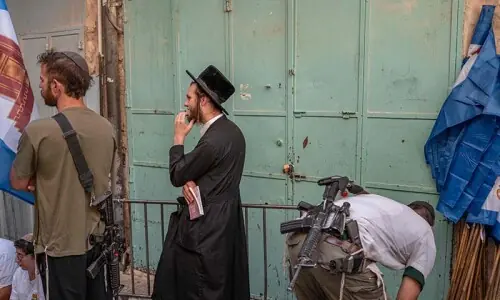
Monday’s intrusion came as Israeli authorities forced dozens of Palestinian shopkeepers to close their businesses and residents to remain inside their homes in the Cotton Merchants Market, which leads to Al-Aqsa Mosque, to allow Jewish prayers during Sukkot.
“Dozens of Palestinian owners of shops, cafes and restaurants in the Cotton Merchants Market in Jerusalem’s Old City were forced to close them during the Jewish Sukkot holiday to make way for Jewish prayers in the market,” the Association for Civil Rights in Israel said in a statement.
The authorities also ordered around 200 Palestinians living along the prayer route not to leave their homes while the prayers were being held, the association said.
Traders said this was the first time they had been ordered to close their businesses throughout the holiday period, with previous closures limited to certain hours.
The Cotton Merchants Market lies on a route leading to Al-Aqsa Mosque and contains 56 shops, cafes and restaurants, according to the association.
Israeli police informed traders of the closure by phone last week before officers later visited the businesses and told owners directly that they had to close during most days of the holiday, it said.
Police did not provide a written order or instructions regarding the closures, telling traders only that the measure was intended to allow Jewish prayers to be held in the market, according to the association.
“The situation did not involve a security event that would justify restrictions of such severity for consecutive days,” it said, adding that police could instead alter the prayer route, shorten prayer hours or deploy forces to protect traders and their businesses.
“It is unacceptable for dozens of Palestinian traders to be forced to close their businesses throughout the holiday period and for hundreds of residents to be told to remain in their homes in order to hold Jewish prayers in the Old City,” said Tal Hassin, an attorney with the association.
“The police are turning things upside down: instead of protecting residents, ensuring the continuation of their daily lives and protecting their property, they are making them pay the price,” she added. “These instructions must be cancelled immediately and the businesses allowed to open.”
Palestinians regard East Jerusalem, where Al-Aqsa is located, as the capital of a future Palestinian state, based on international resolutions that do not recognise Israel’s occupation of the city in 1967 or its annexation in 1980.