Finance minister kicks off talks with visiting IMF mission
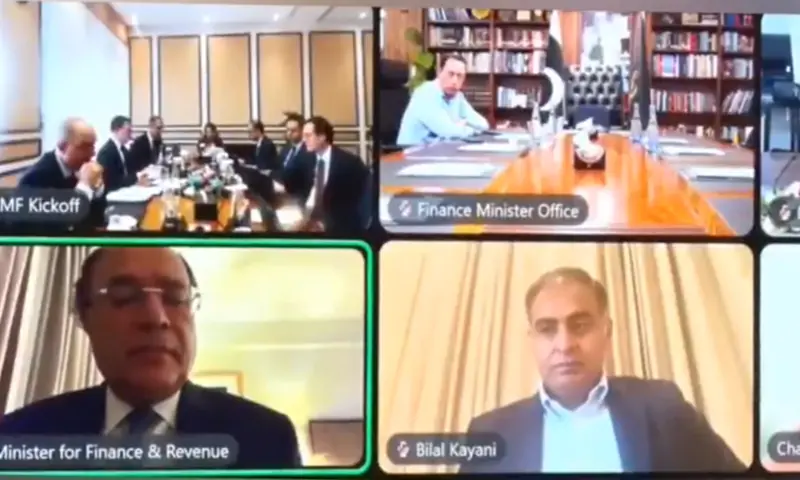

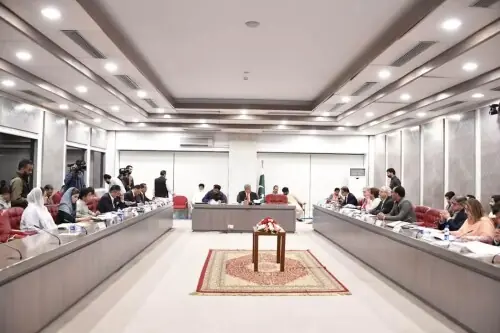
ISLAMABAD: Minister for Finance and Revenue Muhammad Aurangzeb held a kick-off meeting on Tuesday with a visiting staff mission of the International Monetary Fund (IMF).
The IMF mission, led by Iva Petrova, is in Islamabad for the fourth review of Pakistan’s $7 billion Extended Fund Facility (EFF) arrangement and the third review of the $1.4bn Resilience and Sustainability Facility (RSF).
Aurangzeb, in a virtual meeting, briefed the IMF team on the latest macroeconomic indicators, improvements in credit rating and overall investment climate amid a challenging outlook emanating from prolonged Iran conflict.
On the successful conclusion of talks, Pakistan will be entitled to disbursement of about $1.2bn under the two programmes: $1bn under the EFF and $200 million under the RSF by the end of October or early November, but may require waivers from the IMF’s executive board for slippages on structural benchmarks.
The authorities are in continuous breach of structural benchmarks regarding the sovereign wealth fund (SWF) law that was originally missed in March.
The federal government already notified new procurement rules on Monday, two days ahead of the deadline, ie, Sept 30.
The SWF law is part of the discussions with the visiting IMF team. Authorities are in breach of an end-March 2026 structural benchmark on amendments to the Sovereign Wealth Fund Act to adopt governance mechanisms and safeguards for seven state-owned enterprises (SOEs), involving an asset portfolio of about $8bn.
Most of them are blue-chip entities listed on the stock exchange but remain outside normal reporting requirements. They include OGDCL, Pakistan Petroleum Limited (PPL), Mari Petroleum, National Bank of Pakistan (NBP), Govt Holdings, Pakistan Development Fund, and the Neelum-Jhelum Hydropower project. The amendments are pending parliamentary approval.
The IMF team has been in Pakistan since Sept 23. It spent the initial days in Karachi for engagements with the State Bank of Pakistan (SBP) and other stakeholders.
The staff mission has so far held engagements with officials from SBP, the finance ministry, the Federal Board of Revenue (FBR), the Establishment Division, and the finance secretaries of Khyber Pakhtunkhwa and Punjab.
New procurement rules
Against this backdrop, the government notified the Public Procurement Rules 2026 to promote greater transparency and competition in public procurement while keeping certain exemptions for direct contracting with SOEs and limiting the bidding to national firms.
The IMF had certain reservations over the preferential treatment of SOEs for direct contracting.
Rule 32 of the new rules provides that a procuring agency may engage through EPADS (E-Pak Acquisition and Disposal System, a digital system developed and enforced by the Public Procurement Regulatory Authority) to manage and administer the process of procurement in direct contracting with SOEs for the procurement of such works and services, including consultancy services, which are time-sensitive, scattered, remotely located and in the public interest or in case of urgency and provided they do not sub-let those contracts initiated prior to the commencement of the new rules continuing under the 2004 framework.
The new rules make the use of EPADS mandatory for public procurement and disposal by federal procuring agencies, provide for the establishment of dedicated procurement cells, and introduce mechanisms to discourage conflicts of interest through third-party validation, evaluation, and pre-shipment inspection for large procurements.
The new rules further strengthen the enforcement mechanism through the provision of blacklisting and cross-debarment, independent grievance redressal committees with an appellate mechanism at PPRA to clearly identify material deviations and mis-procurement, including deliberate procurement outside EPADS, failure to constitute prescribed committees, tailor-made specifications, violation of advertisement and response-time requirements, and failure to follow prescribed evaluation criteria.
The rules allow other efficient methods of procurement such as gallop tendering and alternative procurement methods, including shopping and negotiated tendering, subject to specified conditions.
Efficiency measures have been embedded in the framework, reducing response times, shortening standstill periods, and streamlining tender processing cycles to enable faster contract awards.
The rules also emphasise sustainable procurement, encouraging inclusiveness of SMEs and marginalised groups, and aligning procurement practices with environmental policy.
EFF and RSF packages
Pakistan and the IMF had reached the 39-month $7bn aid package deal in July 2024, with the programme set to allow the country to “cement macroeconomic stability and create conditions for stronger, more inclusive and resilient growth”.
In March 2025, the two sides reached a staff-level agreement (SLA) on the first biannual review of the EFF programme and on unlocking the $1.3bn RSF arrangement.
Subsequently, in May that year, the IMF’s Executive Board allowed a $1bn disbursement under the EFF — bringing total released funds under the package to about $2.1bn — and also approved the RSF loan.
In October 2025, the government and the Fund reached an SLA on the second review of the EFF, securing another $1bn under the programme and $200 million under the RSF after the Board’s approval in December.
A Petrova-led mission held talks with Pakistan in March this year for the third review of the EFF and the second review of the RSF, but the two sides failed to reach an agreement and decided to continue negotiations.
Then in May, the IMF’s Executive Board allowed Pakistan to draw about $1.1bn under the EFF and about $220m under the RSF, bringing total disbursements under the two arrangements to roughly $4.8bn.
An IMF mission, also led by Petrova, last visited Pakistan from May 13 to May 20, with the visit focusing on “recent economic developments, reform implementation, and the budget strategy for fiscal year 2027”.