IMF-linked plan to boost local currency bond market unveiled

ISLAMABAD: The government on Tuesday announced that the general public would be allowed to trade government securities, including treasury bills and bonds, through the stock market as part of efforts to improve compliance under the International Monetary Fund (IMF) programme currently being reviewed by a visiting staff mission for the disbursement of around $1.2 billion.
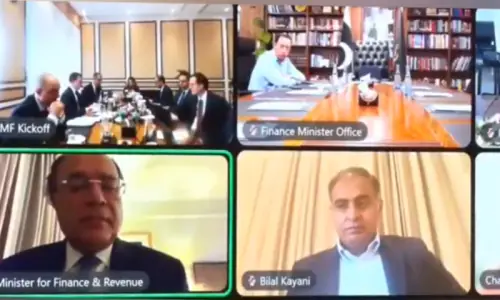
The announcement of a strategic action plan for development of the Local Currency Bond Market (LCBM) followed a customary kick-off meeting between Finance Minister Muhammad Aurangzeb and an IMF staff mission led by Iva Petrova.
The mission held discussions with the authorities on power-sector developments, privatisation, petroleum-sector issues, the Federal Board of Revenue (FBR) and the automobile sector, particularly the medium-term automobile development plan.
The finance minister is reported to have briefed the mission on the latest macroeconomic indicators, improvements in credit ratings and the overall investment climate amid a challenging outlook stemming from the prolonged Iran conflict, including its impact on revenues.
On successful conclusion of the talks, Pakistan would be entitled to disbursement of about $1.2bn under the two programmes — $1bn under the Extended Fund Facility (EFF) and $200m under the Resilience and Sustainability Facility (RSF) — by the end of October or early November. However, the country may require waivers from the IMF executive board for slippages on structural benchmarks.
The finance ministry said announcement of the strategic plan for the LCBM by Sept 30 was required under the IMF programme.
The plan sets out reforms the government, regulators and market institutions will undertake to build a deeper, more liquid and resilient market for government and, over time, corporate securities denominated in Pakistani rupees. It is based on a joint IMF-World Bank diagnostic study of Pakistan’s LCBM.
Commercial banks currently hold 78 per cent of government securities, while sovereign paper accounts for about 62pc of banking-system assets. This concentration supports government securities auctions but favours holding securities over trading them, while limiting banks’ capacity and incentives to finance the private sector.
The joint study noted that Pakistan had built much of the institutional framework of an emerging LCBM, but market outcomes remained closer to those of a developing market.
Development was uneven across six pillars, with money market and financial infrastructure foundations comparatively advanced, while primary-market predictability, secondary-market liquidity and the legal and regulatory framework remained below the practices of larger emerging markets. The narrow investor base was identified as the biggest gap.
Therefore, the plan seeks to develop a liquid, transparent and diversified LCBM to reduce the cost and risk of government financing over the medium term, support effective monetary-policy transmission and provide a reliable benchmark yield curve for private-sector financing.
It pursues five strategic objectives, including strengthening institutional capacity and coordination, ensuring clear ownership and accountability, and making primary issuance more predictable and market-based through a published benchmark policy and a well-informed medium-term debt strategy. It also seeks to build executable secondary-market liquidity and a functioning private securities-financing (or repo) market, broaden the investor base across institutional, retail and foreign investors, modernise market infrastructure and remove legal and tax impediments to trading and secured funding.
Under the plan, eligible bank customers would be allowed to trade exchange-listed government securities through their banks under the supervision of State Bank, Securities and Exchange Commission of Pakistan, Pakistan Stock Exchange and Central Depository Company.
The Ministry of Finance and SBP would also review the primary dealer framework for the fiscal year 2027-28 so that secondary-market performance, including quote performance drawn from E-Bond, is taken into account.
The plan envisages a securities-lending facility for primary dealers, covering its operating model, eligible securities, risk controls and fiscal implications.
Published in Dawn, September 30th, 2026