
Every month, Idrees sends money home from Dammam in Saudi Arabia. His wife pays the children’s school fees, the electricity bill and the cost of his parents’ medicines and buys food, fuel and clothing. She puts aside what she can. Some months, there is barely anything left. Other months, she manages enough to feel they are getting somewhere.
When they have saved enough, a relative suggests buying a plot. It would be theirs, he says. Idrees can already picture taking his wife and children to see it, pointing out the boundaries and telling them that, one day, they might build a house there. For now, it would be something to hold on to while Idrees keeps working abroad, as proof that the years away from his family are building towards something.
Idrees and his family are fictional, but their choice is not an anomaly. A plot feels solid in a way a bank balance may not, particularly to families that have watched inflation eat into their savings and the rupee lose value. It can take years of money put aside and it can be passed on to children.
When Idrees’ family buys, the price recorded on the property documents may be lower than what they pay. His wages came home through a bank, but the full value of the purchase may never appear in the records. Multiply that gap across transactions and the question becomes much bigger than one family’s choice of where to save.
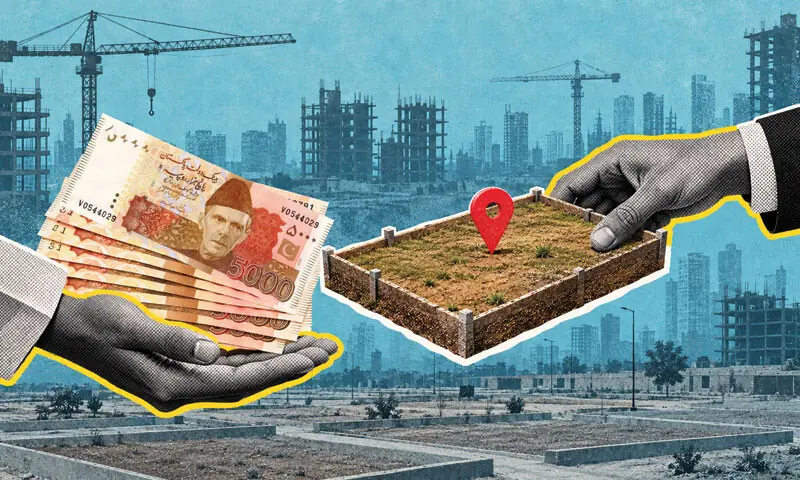
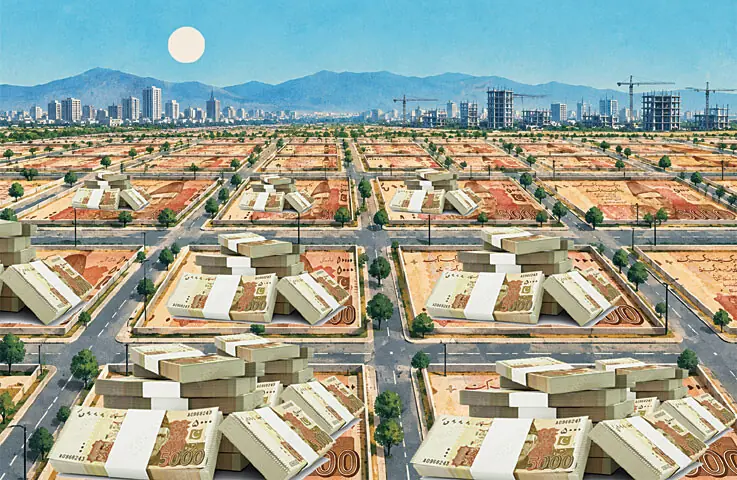
Pakistan’s property market may be worth Rs7 trillion a year, yet much of its real value remains invisible. As families pour their savings and remittances into plots, a weak mortgage system, under-valued transactions and a cash-heavy economy are turning property into the country’s default savings vehicle and diverting capital away from productive investment…
A RS7 TRILLION MARKET WE BARELY MEASURE
The plot Idrees’ family buys may have two prices: the one on the paperwork and the one they pay. Pakistan records the former. No national database captures the latter across residential, commercial and agricultural property, or how buyers settle the bill.
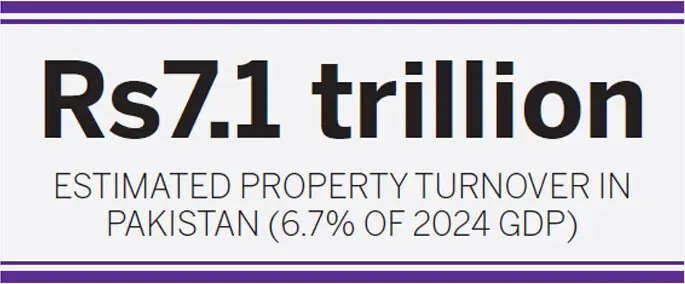
We estimated the market’s value using publicly available data. Administrative records for fiscal year (FY) 2023-24 show 1.695 million documented property transfers. Combining federal withholding-tax collection, provincial stamp duty and mutation data, official valuation tables and the estimated gap between official and market values, we put the annual property turnover at about Rs7.1 trillion, which is close to 6.7 percent of FY24’s gross domestic product (GDP).
The estimate draws on two starting points. Federal collections under sections 236C and 236K, given assumptions about the mix of filers and non-filers, imply a taxable property universe of about Rs3 trillion. A second anchor comes from provincial recorded or deputy commissioner (DC) values, at about Rs2.54 trillion. Neither is a market price. Official valuations usually sit below what buyers pay, though the gap varies by locality. Transfer taxes reward under-declaration and valuation tables struggle to keep pace with the market.
Adjusting each base with explicit recorded-to-market ratios gives an estimate of Rs7.1 trillion, assuming a discount of 35 percent between the market value and the arbitrary DC value that exists in a parallel universe.
Then comes the harder question, which is how much of this is paid in cash?
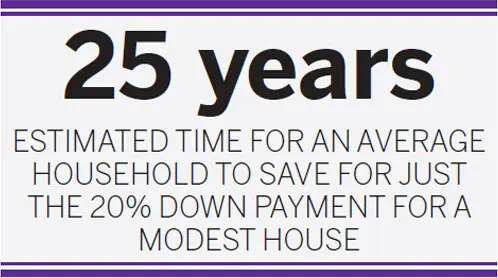
No dataset records how the full value of each transaction is settled, so we modelled it. In the modelled scenario, 75 percent of the recorded value moves through banks, while only 20 percent of the premium above it does.
On those assumptions, about Rs2.81 trillion is bank-settled and about Rs4.28 trillion, roughly 60 percent, moves through cash or cash-like channels. Around 85 percent of that cash sits in the gap between the declared value and the real one. That is more than Rs4 trillion in estimated payments over a year, whose full value may never appear on the property documents.
Rs4.28 trillion is an estimate of cash or cash-like payments over a year, not a stock of currency buried beneath Pakistan’s plots. Sellers may spend, deposit or reinvest what they receive. We cannot assume that every rupee stays outside the banking system, or that none goes on to finance a business.
The more consequential finding is that the transaction records may miss a vast property market that can operate without the full price of its assets being recorded, or the way they were paid for being known.
That is where the property story becomes bigger than just property.
Over the last three decades, more than 200,000 families in Karachi alone have seen their savings vanish as project developers either disappeared or projects were stranded. Families take enormous risks, but such risks are not captured in any real estate database or any statistical handbook. Even when the building is completed, the arrangement puts the greatest risk on the buyer. The family pays before the flat exists.
A PLOT IS NOT THE OPPOSITE OF SAVING
Buying a plot does not mean a family has failed to save. It has saved, then exchanged cash for an asset. Nor is every property transaction unproductive. A new house adds to the country’s housing stock and so does upgrading a crumbling one, while a rental flat produces a service that people pay for.
The distinction is between buying an existing asset and financing a new one. Let’s assume I buy Idrees’ plot for Rs4 million. Through this transaction, Pakistan has not gained Rs4 million of investment. Ownership has changed hands, as Idrees holds the cash, I hold the land. If the same money finances 50 new flats, a factory shed or a machine that did not exist before, the economy’s productive base has grown.
Pakistan has struggled to generate investment on that scale. In FY2025-26, national savings were about 14.1 percent of GDP and investment about 14.4 percent, well below 30 percent for other emerging markets. Meanwhile, credit to the private sector was just 10.7 percent of GDP in 2025. Currency in circulation stood at nearly Rs11.94 trillion at the close of FY2026. Against scheduled-bank deposits of Rs31.27 trillion, cash was 25.7 percent of broad money, which effectively includes all currency in circulation and bank deposits.
These numbers measure different things. Moving a rupee from a plot into a bank does not create another rupee of national saving. Idrees’ family saved that rupee when they chose not to spend it. What matters now is where it can go. Banks and other financial institutions can pool savings to finance a business’ machinery or a family’s home over time. When savings keep circling through cash and existing plots, that route to building something new narrows.
Pakistan has made property an attractive refuge, while its banks have found a ready borrower in the government. Idrees’ family is not the villain for buying a plot. They are trying to protect what years of work abroad have earned them. The question is, why, after all that sacrifice, a patch of land feels like their safest choice.
The family that is saving for a plot does not need to be told to be more sophisticated, but it needs to be provided a credible alternative, one that can take the same monthly sacrifice and turn it, reliably, into a finished home, an income-producing asset or capital for someone building something new. Pakistanis continue to save but at a great personal cost, because our financial system largely failed them.
WHY THE PLOT WINS
Consider what a working mortgage system would offer Idrees’ family.
They would save for a down payment, a lender would verify their income and a developer would have their own construction finance instead of relying on buyers’ instalments to keep building. After checking the title, the family could buy a completed flat with a long-term mortgage. The construction lender would be repaid, while the mortgage could eventually be refinanced by pension or insurance funds seeking long-term investments.
Pakistan has fragments of this chain and whatever is the missing link is bridged by cash. It is estimated that total mortgages in the country are less than 0.5 percent of GDP, almost half of these being to bank employees themselves. Allowing for newer schemes does not change the picture, as mortgage finance is a rounding error next to a property economy measured in trillions.
So families improvise as they save in cash, borrow from relatives, join a ‘committee’ (a savings’ group), sell a mother’s jewellery, lean on an inheritance or a brother abroad. Buying from a developer, they pay instalments over three or five years, only to find out that the developer either ran away with the money, or the project got delayed and so on.
Over the last three decades, more than 200,000 families in Karachi alone have seen their savings vanish as project developers either disappeared or projects were stranded. Families take enormous risks, but such risks are not captured in any real estate database or any statistical handbook.
Even when the building is completed, the arrangement puts the greatest risk on the buyer. The family pays before the flat exists. The developer uses those payments as working capital and construction may depend on the next round of instalments. The household that is least able to assess the title, construction costs, or the developer’s ability to deliver ends up financing the riskiest stage.
The family saves for a home, bankrolls its construction and bears the risk of never receiving it. Pakistan has left ordinary buyers to do the job of lenders and regulators and then wonders why they would rather buy a bare plot.
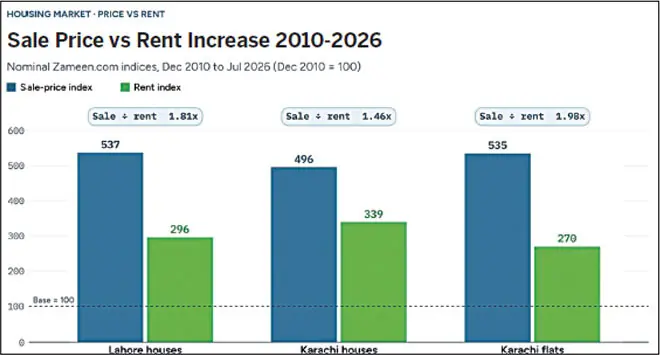
THE REMITTANCE-TO-PROPERTY PIPELINE
Pakistan received a record $41.6 billion in workers’ remittances in FY2025-26. Those dollars keep households fed and the external account afloat, while also being one of the country’s largest recurring pools of money that families can actually invest.
A review of the Household Integrated Economic Survey (HIES) 2024-25 demonstrates that foreign remittances increase the housing demand in large cities. Fewer than one in 10 households report receiving remittances, yet those households account for about 29 percent of measured construction and home-improvement spending.
A conservative triangulation puts the identifiable remittance-linked property and construction flow at roughly Rs0.4-0.6 trillion per annum. This is a modelled range and not a national-accounts identity, but it remains consistent with the wider evidence.
But Idrees’ years away from his children have a cost no balance sheet captures. His wages arrive as foreign exchange, but Pakistan offers families like his few trusted ways to turn years of remittances into a diversified savings plan, a mortgage-backed deposit or finance for a newly built home. The plot fills that gap. It becomes a savings product because the financial system has given the family so little to choose from.
The question is not whether Idrees should want a home. It is whether his savings help build one through a chain in which the money and the property can be accounted for, or merely push up the price of land already there.
THE HOME OWNERSHIP PARADOX
According to the 2023 census, 81.9 percent of households live in homes they own. Even in cities, the figure is 71 percent, with about 24 percent renting. On paper, this does not look like a country with a housing-finance crisis.
But the census measures who occupies a house, not who could buy one today. An inherited family home, a crowded ancestral house shared by multiple families, or a newly mortgaged flat, all count as “owned”. The gap between those who already own and those trying to get in is enormous.
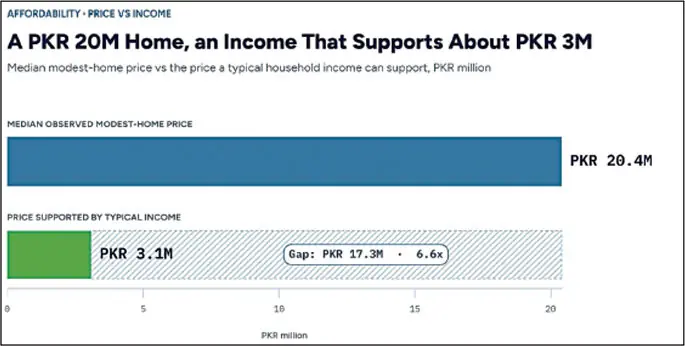
We built a district affordability layer from HIES and Labour Force Survey income anchors, local economic structure and current market prices for modest homes. It is not a national house-price index and district incomes are modelled rather than directly surveyed. Across the priced sample, a modest house costs about 19 times annual household income.
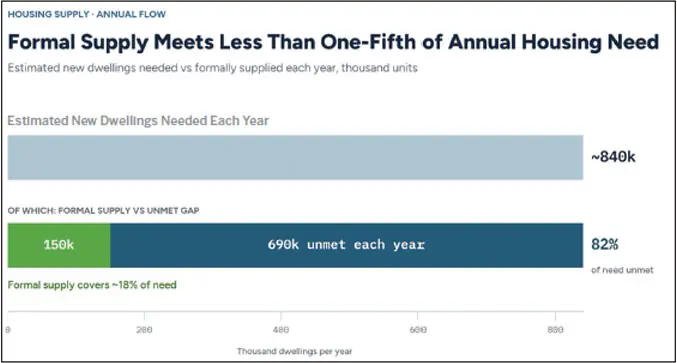
The 20 percent down payment required for a potential mortgage equals roughly 46 months of the family’s entire income. Saving 15 percent a year, it would take about 25 years just to gather that deposit, assuming prices never rose and the savings earned nothing. A 20-year mortgage at 12 percent and 80 percent loan-to-value would demand around 201 percent of household income every month.
In human terms, a young schoolteacher and a bank clerk, married, both working, doing everything right, cannot buy a modest home in their own city on their salaries — neither in 10 years, nor in 20. Even if they can muster up some capital, there is a high chance that a scheming developer might disappear with their hard-earned savings, while the sovereign, like clockwork, pretends to be shocked.
Local economic and demographic realities reframe the high ownership figure. Our household balance-sheet work puts the residential-asset-to-income multiple of existing owners at around 2.3 times, against roughly 19 times for a new buyer in today’s market. Pakistan can be a nation of homeowners and a nation locked out of homes at the same time, and therein lies the contradiction.
What bridges the two generations is no longer income, but it is inherited capital, parents, ancestral land, the sale of another property, family pooling or a sibling abroad. If you already have property, property helps you buy more. If you are starting with a salary alone, the arithmetic remains brutal.
AND WE STILL NEED MORE HOUSES
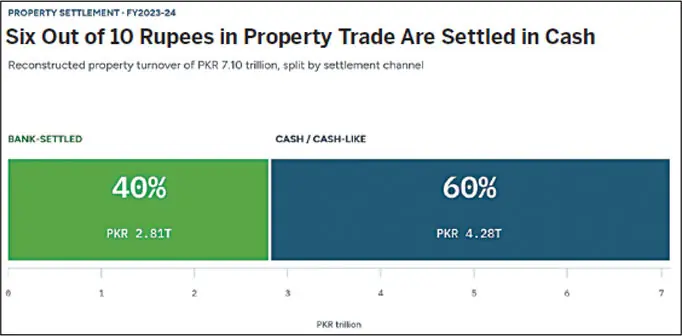
The 2023 census counts about 241.5 million people nationwide in 38.3 million households, with population growing at two percent a year. So, even holding average household size constant requires roughly 840,000 net new dwellings annually. Against a planning figure of about 150,000 formal units a year, the gap is incredibly vast.
Separately, around 12.45 million existing homes are semi-pakka [made of brick or concrete] or kachcha [made of mud or temporary materials], a quality deficit that should not be mistaken for the 12.45 million homeless families.
This is why the headline ‘housing shortage’ is a misnomer, as it bundles together several disparate problems. Effectively, new households need new units, while some families are overcrowded, and millions of homes need upgrading rather than replacing.
Moreover, serviced urban land is scarce and local municipalities have not left any stone unturned in ensuring that basic municipal services remain a luxury rather than a fundamental right.
FROM A PARALLEL SAVINGS SYSTEM TO AN INVESTMENT SYSTEM
A great case study to evaluate is that of Singapore where, as a matter of principle, house ownership is separated from land ownership.
Singapore’s Central Provident Fund lets workers use accumulated savings for a housing down payment and to service the loan, while rules protect retirement balances and require money used for property to be restored in specified circumstances when the home is sold. The core lesson here is that savings, housing finance and supply need to be designed as one system rather than three disparate systems operating akin to headless chickens.
Pakistan treats them as separate files on separate desks. There can be low savings in one ministry, housing shortages in another, remittances in a third, cash and documentation somewhere else, developer regulation and mortgages in yet another corner, or non-existent. The lack of coordination ensures that everyone continues to operate in silos, all while ordinary citizens suffer. The family experiences all of them as a single decision, but the policy framework refuses to acknowledge the same.
At present, the plot wins by a mile, compared to any financial product. But a better alternative is possible and the same has been done numerous times in various jurisdictions, resulting in better housing outcomes for ordinary citizens.
This requires radical change, with the most basic building-block being moving property valuation tables closer to market prices, while requiring full-value bank settlement above a minimal threshold, such that the rupees changing hands are recorded and captured as part of the formal economy. Cash needs to be discouraged for any such transactions, with full economic value being captured through a formal transfer rather than opening cash arbitrage opportunities.
Similarly, households need to be safeguarded from fraud. There needs to be escrow and unit-level identification of buyer money, such that a family’s instalments fund its own flat rather than the developer’s next launch or a villa in Dubai.
Financial institutions and legal frameworks need to evolve in a way that mortgage eligibility is assessed during construction, such that a completed unit moves straight into a mortgage or rental finance. A deliberate remittance-to-housing bridge needs to be designed, wherein diversified savings and deposit-building products are structured for overseas families, linked to financing for newly built homes rather than existing plots. There was some movement in this regard, but it remained a half-hearted effort.
Finally, it is necessary to have reliable titles and transaction records, without which none of the above can be priced. The primary and secondary markets for the trading of ‘files’ need to be eliminated, and any such trading needs to be deemed as securities trading, such that it remains regulated, and ordinary citizens can be saved from fraud that happens on a recurring basis, with little to no acknowledgment by the sovereign or relevant regulators.
As financial intermediation (channelling savings into productive investments through banks or financial institutions) takes root in housing, surplus capital can be redirected towards industrial activity, to generate more productive output and exports, while also generating jobs in the process.
It is simply impossible to develop an industrial base without having in place a vibrant capital base. It is through financial intermediation of housing, and moving capital away from a cash-sink for undocumented income that we can develop that vibrant capital base for industrialisation.
ASKING TOO MUCH OF ONE ASSET
Pakistan’s real estate problem is not simply that ‘too much money goes into property’ but that property has been asked to do too many jobs. For many households, it is an inflation hedge, a pension, an inheritance plan, a store of undocumented cash and, occasionally, a home.
The family that is saving for a plot does not need to be told to be more sophisticated, but it needs to be provided a credible alternative, one that can take the same monthly sacrifice and turn it, reliably, into a finished home, an income-producing asset or capital for someone building something new. Pakistanis continue to save but at a great personal cost, because our financial system largely failed them.
The question is where those savings go next. A country does not become capital-rich by accumulating valuable land. Instead, it becomes capital-rich when yesterday’s savings can keep financing tomorrow’s assets, and continue generating more output and income. This is effectively the difference between saving in plots and building an economy.
The writer is a macroeconomist and professor of practice at IBA, Karachi. He can be reached at ammar.habib@gmail.com
Published in Dawn, EOS, October 4th, 2026