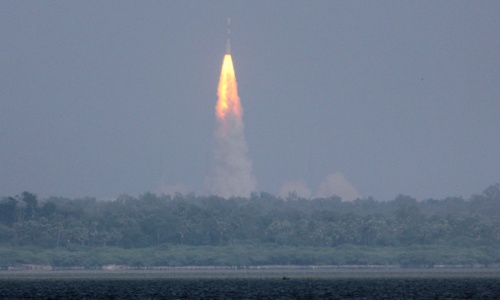
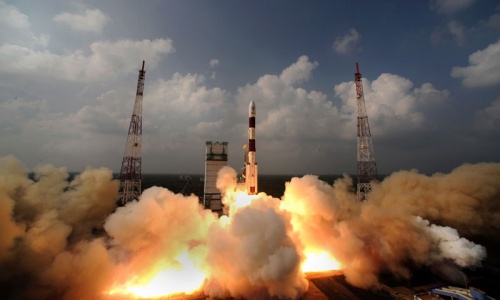
NEW DELHI: India's first mission to Mars left Earth's orbit early on Sunday, clearing a critical hurdle in its journey to the red planet and overtaking the efforts in space of rival Asian giant China.
The success of the spacecraft, scheduled to orbit Mars by next September, would carry India into a small club, which includes the United States, Europe, and Russia, whose probes have orbited or landed on Mars.
India's venture, called Mangalyaan, faces further more hurdles on its journey to Mars.
Fewer than half of missions to the planet are successful.
“While Mangalyaan takes 1.2 billion dreams to Mars, we wish you sweet dreams!” India's space agency said in a tweet soon after the event, referring to the citizens of the world’s second-most populous country.
China, a keen competitor in the space race, has considered the possibility of putting a man on the moon sometime after 2020 and aims to land its first probe on the moon on Monday.
It will deploy a buggy called the “Jade Rabbit” to explore the lunar surface in a mission that will also test its deep space communication technologies.
China's Mars probe rode piggyback on a Russian spacecraft that failed to leave Earth's orbit in November 2011.
The spacecraft crumbled in the atmosphere and its fragments fell into the Pacific Ocean.
India's mission showcases the country's cheap technology, encouraging hopes it could capture more of the $304-billion global space market, which includes launching satellites for other countries, analysts say.
“Given its cost-effective technology, India is attractive,” said Rajeswari Pillai Rajagopalan, an expert on space security at the Observer Research Foundation think-tank in Delhi.
India's low-cost Mars mission has a price tag of 4.5 billion rupees ($73 million), just over a tenth of the cost of NASA's latest mission there, which launched on Nov 18.
Big Achievement
Homegrown companies — including India's largest infrastructure group Larsen & Toubro, one of its biggest conglomerates, Godrej & Boyce, state-owned aircraft maker Hindustan Aeronautics Limited and Walchand Nagar Industries — made more than two-thirds of the parts for both the probe and the rocket that launched it on Nov 5.
India's probe completed six orbits around Earth before Sunday's “slingshot”, which set it on a path around the sun to carry it towards Mars.
The slingshot requires precise calculations to eliminate the risk of missing the new orbit.
“Getting to Mars is a big achievement,” said Mayank Vahia, a professor in the astronomy and astrophysics department of the Tata Institute of Fundamental Research in Mumbai.
India's space agency will have to make a few mid-course corrections to keep the probe on track.
Its next big challenge will be to enter an orbit around Mars next year, a test failed in 2003 by Japan's probe, which suffered electrical faults as it neared the planet.
“You have to slow the spacecraft down once it gets close to Mars, to catch the orbit, but you can't wait until Mars is in the field of view to do it – that's too late,” Vahia said.
India launched its space programme 50 years ago and developed its own rocket technology after Western powers levied sanctions for a 1974 nuclear weapons test.
Five years ago, its Chandrayaan satellite found evidence of water on the moon.
By contrast, India has had mixed results in the aerospace industry.
Hindustan Aeronautics has been developing a light combat aircraft since the early 1980s, with no success.
The Mars probe will study the planet's surface and mineral composition, besides sniffing the atmosphere for methane, a chemical strongly tied to life on Earth.
NASA mission Curiosity did not find significant amounts of the gas in recent tests.
China is still far from catching up with the established space superpowers, the United States and Russia, which decades ago learned the docking techniques China is only now mastering.
Beijing says its space programme is for peaceful purposes, but the US Defence Department has highlighted China's increasing space capabilities, saying it was pursuing ways to keep adversaries from using space-based assets during a crisis.