
THE state of public education in Pakistan has been abysmal for years. But instead of just bemoaning the sorry condition of this critical sector, it is more constructive to spot the many weaknesses of the system and work towards rectifying these inadequacies.
And reports such as Alif Ailaan’s District Education Rankings help identify the weak spots. The advocacy group recently launched the 2015 edition of the rankings, examining the state of education in the country’s 148 districts and agencies.
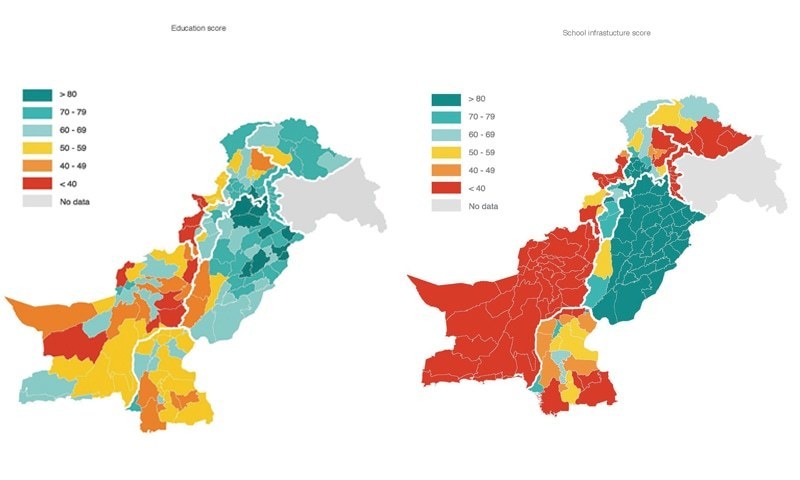
This effort is important as it gives a district-wise picture. The overall prognosis is that while some parts of the country are marching on despite obstacles such as weak infrastructure and limited resources, other areas are either stagnant or deteriorating further.
Take a look: State of education not any better this year
Sindh’s performance, for example, has been described as “poor” and the report is critical of the provincial government’s failure to address the situation. Even in Punjab — which tends to lead on many counts — the study says there are “stark” differences between the province’s southern, central and northern districts.
Azad Kashmir, on the other hand, has overtaken Punjab and now stands as the second best-performing region. In fact AJK and Gilgit-Baltistan have been praised for trying to improve their performance despite poor infrastructure. Balochistan’s performance can be described in one word: “abysmal”. On a brighter note, the study praises the Khyber Pakhtunkhwa administration for improving its enrolment, retention and gender parity indicators.
The key problems as identified by the report are that learning outcomes in Pakistan are poor and that education quality remains low. In other words, for the most part, our children are not getting a quality education in the public sector even if they make it to school and manage to stay in class.
One area that has been highlighted for improvement is the allocation of funds. The country currently spends just around 2pc of GDP on education, whereas the desired figure is at least 3pc. But even the money that is spent is not delivering satisfactory outcomes.
However, as some areas are making an effort to improve themselves — GB, Azad Kashmir and KP, for example — it may prove beneficial to see what sort of practices these governments have adopted to address the education crisis.
Clearly, unless the provincial administrations make it their priority to deliver quality education to all children in all districts, there will be slim chance of Pakistan’s education emergency abating anytime soon.
Published in Dawn, May 11th, 2015
On a mobile phone? Get the Dawn Mobile App: Apple Store | Google Play