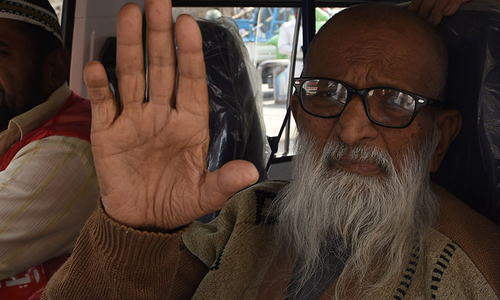
It almost feels as if our only chance at redemption is lost. Because that is what Abdul Sattar Edhi has been for Pakistan for a very long time: her unwarranted redemption.
Our one chance to tell ourselves that, in spite of all of our faults and failings, some cosmic lottery of chance allowed for a man like him to be born in a land like ours.
And yet, we are not worthy of him, but lucky for us, he didn’t seem to care about that too much.
See: Edhi: A life less ordinary
It is said that countries get the leaders they deserve; I am inclined to believe this is true. As Pakistanis, we bemoan our lack of leadership almost daily but we seldom stop to ask whether we even deserve better. How many of us rise to help the disenfranchised when needed?
Nearly all of us perform our faith rather than practice it, so then where did Edhi come from?
A citizen, not a leader
Perhaps it helps that Edhi was not a leader. He served as a citizen — taking to the streets when he needed money to help the country’s unwanted — and it was this role that he lived and died by.
He cared on a deeply fundamental level that most of us can barely conceive.
Today, kindness is a political act — it involves giving without exception or expectation, and to do so consistently is perhaps the hardest thing in the world.
Edhi abhorred power. This is perhaps why we could not relate to him and why we failed him so deeply.
We failed him in life and continued to do so in his death as protocol and barricades cordoned off his body from the very people he had devoted himself to in life, while the generals and politicians he had always held at arms length angled for a last minute photo-op.

Now, as millions scramble to subvert his legacy into what they think it ought to mean for us, it is essential that we resist the urge to make Edhi the patron saint of Pakistan.
The political act of kindness
We must recognise that Edhi was a deeply political person, who forever resisted the impulse to be politicised by his country’s understanding of what that meant. His humanism was political at its core because it held out against all attempts to subvert it — religious, provincial and personal.
He defined all his actions using kindness as his lowest common denominator. And this is perhaps the most difficult component of his politics — he stood publicly for minorities, he buried murderers, martyrs and addicts alike; he took in illegitimate children and gave shelter to spurned women.
He lived simply in a land where flaunting wealth is a national past time, and he loathed the constructions of class that most of us benefit from at the expense of the poor.
He rebelled against a system that held the bulk of this nation’s people hostage to beg and starve.
These are deeply political acts in a country where the definition of the term confines itself to party politics and elections but actively circumvents any real philosophy.
Above all, Edhi’s politics was revolutionary because it was marked by consistent kindness.
There are many who continue to dismiss kindness as ‘soft’, because philanthropy and pacifism do not hold much value in a system where, ‘might is right’ — Edhi's system was one that sought to enrich all human lives, while the other system prefers to sacrifice the masses as collateral damage.
Take a look: Edhi — The exception to Pakistan's faults
It is hard to establish when it happened, but today, kindness is a political act — it involves giving without exception or expectation, and to do so consistently is perhaps the hardest thing in the world.
That is what made Edhi an exception to our contemporary understanding of both power and privilege. Edhi was a consummate rebel, who quietly defied every one of us in his quest to do what was good rather than what looked good.
What are we mourning, exactly?
Is it our sense of loss or hope, or is it the fact that the one person who did all the dirty work so we wouldn’t have to and made us feel good about ourselves by association is no longer here?
As we watched in outrage that women were barred from his funeral, that reporters lay in his freshly dug grave posing for a camera, that politicians scrambled for a sound byte — more than ever before, we need to come back to is his kindness.
Whenever we find reasons for not doing something kind, and believe me, we all do, we need to resist that urge.
Let us live simpler and love deeper as he did.
Let us not ask before every single thing we do ‘kya faida?’
Rather than talking ourselves out of giving alms, sending underprivileged children to school, helping someone cross a road or just passing judgement and saying something mean, let us just try every day to be a little kinder than we were yesterday.
Today, we should resist the urge to call for monuments to be erected in his name, or buildings to be named after him — that was not something he ever desired. Our doing so on his behalf is taking the easy way out.
The hard way is to follow his example and his politics — to confront religious bigotry that victimises and scapegoats and segregates and kills. It involves embracing the poor and letting go of some of our privileges.
It is a very hard thing to do — to be so kind for so long and to so many, but at the very least, we owe Edhi that.